Node.js Security Releases: 16 Flaws Fixed in v22.23.5, v24.22.3 and v26.13.1, 7 Rated High, and What to Check
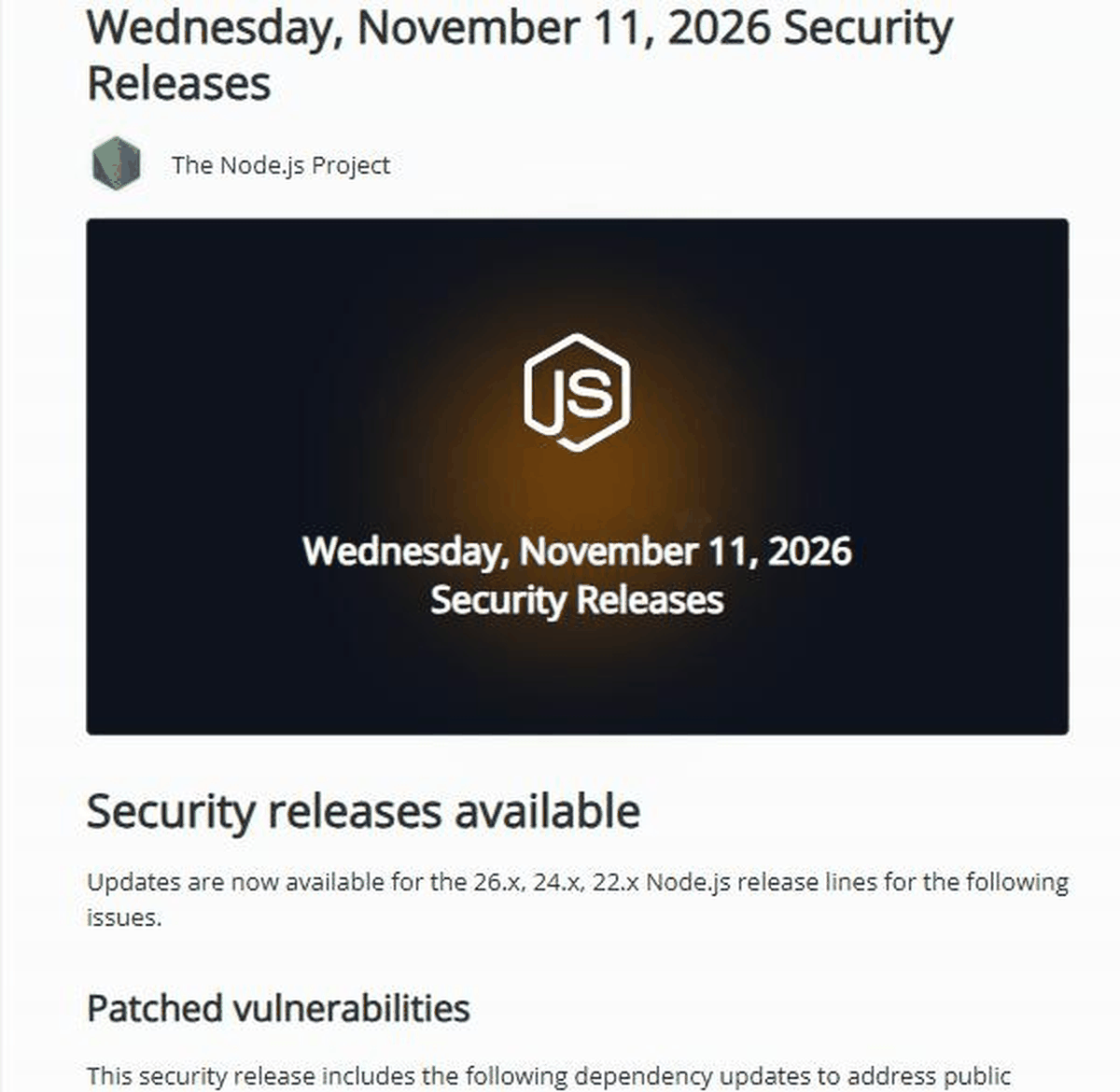
Published November 22, 2026. A news analysis built from primary sources: the Node.js project’s advisory “Wednesday, November 11, 2026 Security Releases” on nodejs.org, the official release index at nodejs.org/dist, and the Node.js release schedule on GitHub, plus our own screenshots of the advisory. Five of the sixteen flaws were reported by a researcher working “in collaboration with Claude and Anthropic Research,” and Claude is among the tools we use to help draft articles, so we disclose that connection; it did not change what we reported. This article contains no affiliate links. We did not install the releases, run any proof of concept or test any of the flaws, and we give no exploit steps. Tallies marked “ours” are our own counts from the advisory.
The short version
- What happened: the Node.js project released v22.23.5, v24.22.3 and v26.13.1 for its 22.x, 24.x and 26.x lines. The advisory is dated Wednesday, November 11, 2026 and lists 16 patched vulnerabilities, plus dependency updates to llhttp, undici and sqlite.
- Severity: by our tally of the advisory’s headings, 7 are rated High, 6 Medium and 3 Low. Nearly all are in HTTP/2, TLS and HTTPS handling, with a few in the experimental Permission Model and in error messages.
- The ones to read first: a heap memory disclosure in HTTPS (CVE-2026-123864), which the advisory says can expose TLS private keys and other users’ requests, and several HTTP/2 flaws that let an unauthenticated client crash the server or exhaust its memory.
- Who is covered: only 22.x, 24.x and 26.x. The advisory says end-of-life versions are always affected when a security release occurs. By the project’s own schedule, Node.js 20 reached end of life on April 30, 2026.
- What to do: upgrade to the patched version of your line. The advisory lists no workaround that we saw.
The releases
| Line | Patched version | Date in nodejs.org/dist | Status in the release schedule |
|---|---|---|---|
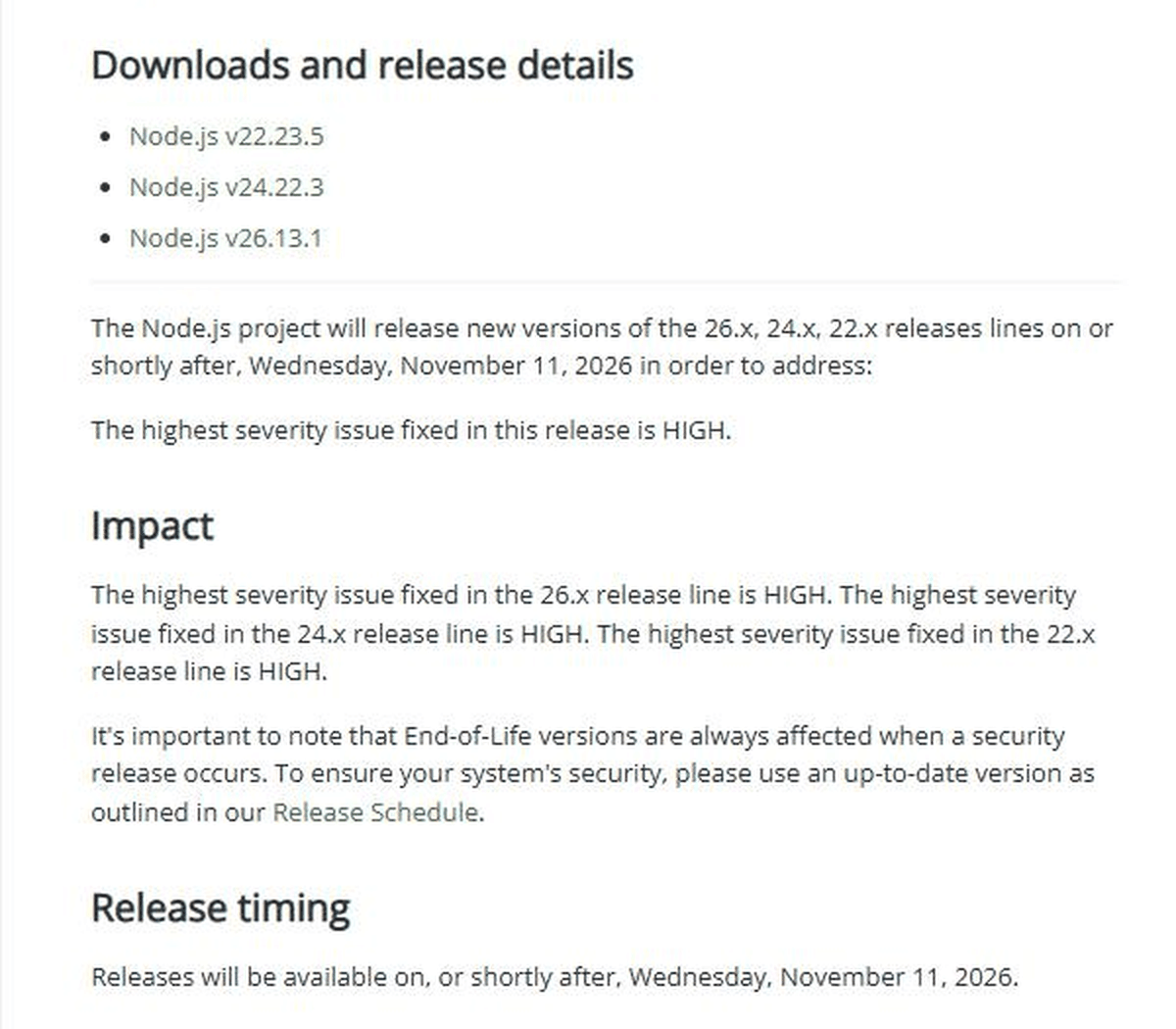
| 26.x (“Lithium”) | v26.13.1 | 2026-11-10 | LTS since Oct 28, 2026; end of life Apr 30, 2029 |
| 24.x (“Krypton”) | v24.22.3 | 2026-11-10 | Maintenance since Oct 20, 2026; end of life Apr 30, 2028 |
| 22.x (“Jod”) | v22.23.5 | 2026-11-11 | Maintenance; end of life Apr 30, 2027 |
| 20.x (“Iron”) | Not patched; last release v20.20.2 (2026-03-24) | – | End of life Apr 30, 2026 |
A small discrepancy: the advisory is dated November 11, while the official release index shows v24.22.3 and v26.13.1 dated November 10 and v22.23.5 dated November 11. We did not look into why; it may be a matter of time zones or of when each build was published. The practical point is the same: all three have been out for more than a week as we write.
All sixteen flaws
The table follows the advisory. “Lines” is the list of active release lines that the advisory says are affected. The severity and the tally are as written in the advisory headings.
| CVE | Severity | What it is, in one line | Lines |
|---|---|---|---|
| CVE-2026-123863 | High | HTTP/2: an unauthenticated client can abort the server through a failed assertion at session teardown | 24, 26 |
| CVE-2026-123864 | High | HTTPS: re-entrancy in a zero-length TLS write; memory of other connections can leak into a request body | 22, 24, 26 |
| CVE-2026-123865 | High | HTTP/2: sessions are never cleaned up after a protocol error during shutdown; memory and file descriptors leak | 22, 24, 26 |
| CVE-2026-123866 | High | HTTP/2: stream teardown can send freed response memory to the peer | 22, 24, 26 |
| CVE-2026-126051 | High | TLS server: uncaught exception from deferred handshake callbacks terminates the process | 24, 26 |
| CVE-2026-123872 | High | TLS 1.2 renegotiation lets a client change the servername and bypass per-host client certificate rules | 22, 24, 26 |
| CVE-2026-123874 | High | HTTP/2: use-after-free when a respondWithFile() stream is reset during a pending write | 24, 26 |
| CVE-2026-123828 | Medium | HTTP/2: one-byte heap overflow in session.altsvc() with a long origin | 24, 26 |
| CVE-2026-123867 | Medium | Client-CA-only SNI override fails open to the default CA, bypassing per-host mTLS | 22, 24, 26 |
| CVE-2026-123868 | Medium | HTTP/2: inbound data on an undrained stream is charged to no memory budget | 24, 26 |
| CVE-2026-123871 | Medium | Proxy credentials disclosed in ERR_PROXY_INVALID_CONFIG error messages | 22, 24, 26 |
| CVE-2026-123877 | Medium | https.Agent can reuse a TLS session across different CA policies, bypassing certificate validation | 22, 24, 26 |
| CVE-2026-123875 | Medium | HTTP/2: cancelling a respondWithFile() download crashes the server (NULL dereference) | 22, 24, 26 |
| CVE-2026-123829 | Low | Permission Model: recursive fs.watch leaks names of denied files on macOS and Windows | 22, 24, 26 |
| CVE-2026-123862 | Low | zlib: a pending params() plus destroy() throws an uncatchable assertion | 22, 24, 26 |
| CVE-2026-106071 | Low | Permission Model: wildcard filesystem grant over-matches paths | 22, 24, 26 |
Our tally from this table: 7 High, 6 Medium and 3 Low, which makes 16. Counting lines per flaw, 11 of the 16 affect all three lines and 5 affect only 24.x and 26.x. The 22.x line is therefore slightly less exposed, but only slightly.
The HTTPS memory disclosure, in the advisory’s words
CVE-2026-123864 is the one that stands out for confidentiality. The advisory describes a re-entrancy flaw in Node.js HTTPS that lets an unauthenticated client read memory belonging to other connections, “including TLS private keys and other users’ requests.” It affects 22.x, 24.x and 26.x. Cleartext node:http is not affected.
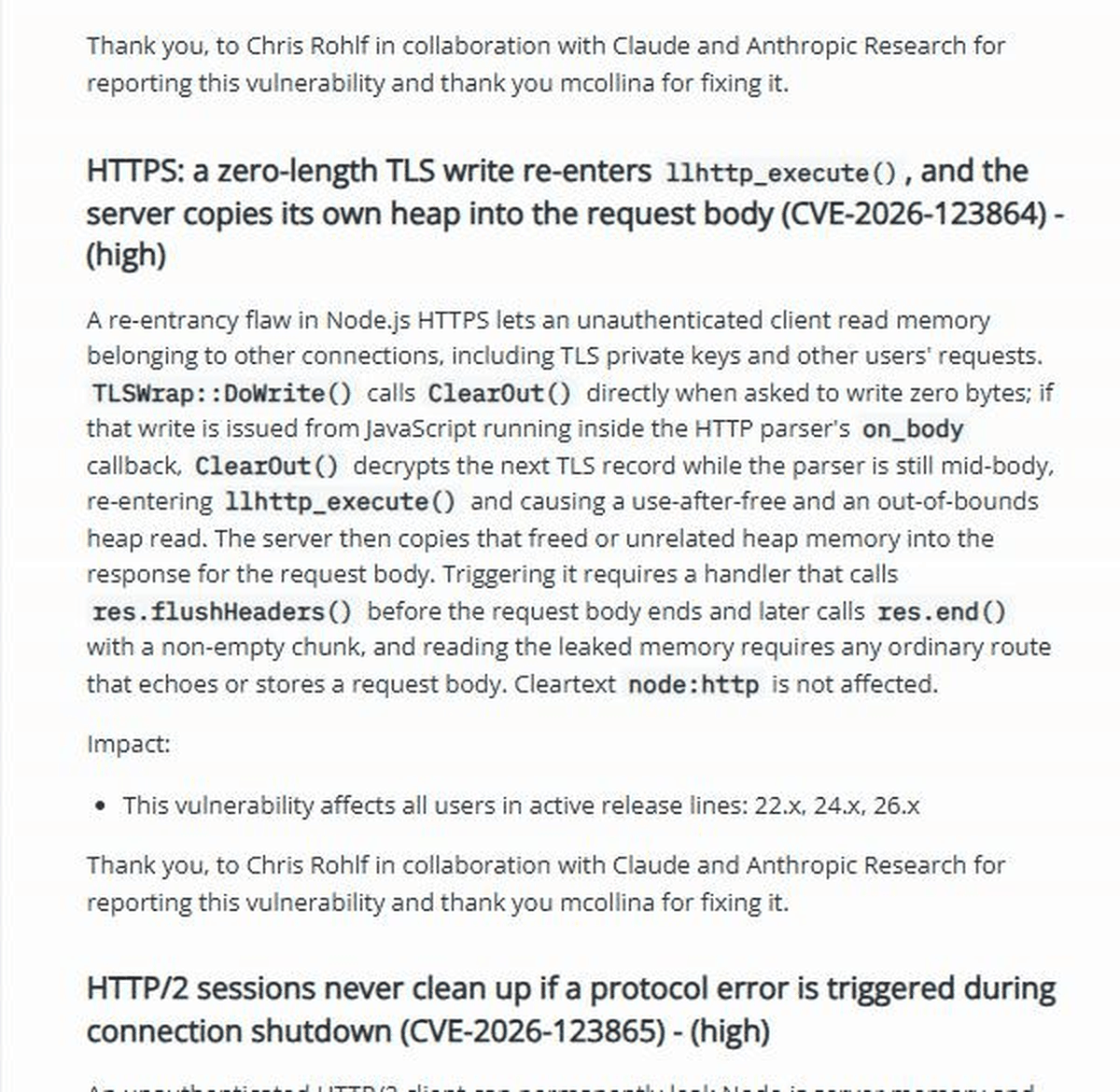
Two conditions in the advisory narrow who is exposed, and both are about application code, not about Node.js alone. The flaw needs a request handler that behaves in a particular way with response headers and the end of the request body, and reading the leaked memory needs an ordinary route that echoes or stores a request body. That is a long way from “every HTTPS server,” but it is not exotic either: handlers that flush headers early and routes that store uploads are common in real applications. We will not restate the exact sequence; the advisory has it, and the safe conclusion for a defender is to patch and not to audit handlers for the trigger.
The advisory does not say whether any key has actually been exposed anywhere, and it does not say that the flaw has been used against anyone. If you run an affected HTTPS server directly on the internet, rotating TLS keys after patching is a judgment call for your own security team; nothing in the advisory tells you to, and we are not recommending it.
The HTTP/2 cluster
Seven of the sixteen flaws are in the HTTP/2 implementation, by our count of the table: CVE-2026-123863, 123865, 123866, 123874, 123828, 123868 and 123875. Their outcomes differ, from a process abort to a memory leak that grows without bound to corruption and, in one case, disclosure of freed response memory to a peer. What they share is that the advisory describes them as reachable by an unauthenticated client, and that several are reachable with a default HTTP/2 server.
- Crash or abort: CVE-2026-123863 (24.x, 26.x) needs only a default HTTP/2 server whose handler responds before the request body has ended, which the advisory calls typical. CVE-2026-123875 (22.x, 24.x and 26.x) concerns servers that serve files with
respondWithFile()orrespondWithFD(). - Resource exhaustion: CVE-2026-123865 says a peer can make the server leak memory and file descriptors for good, with “no further cost to the attacker”; CVE-2026-123868 says
maxSessionMemorydoes not bound inbound data on an undrained stream, so a connection can hold far more memory than the peer sent. - Memory safety: CVE-2026-123866, CVE-2026-123874 and CVE-2026-123828 are described as use-after-free or heap overflow bugs.
If your application serves HTTP/2 straight from Node.js, all of this is relevant. If a reverse proxy or load balancer terminates HTTP/2 and TLS in front of Node.js and talks to it over HTTP/1.1, then these particular code paths are not exposed to the internet. That is our engineering reading, not a statement from the advisory, and it depends on your setup.
Three of the sixteen are second tries
The advisory itself flags three flaws as follow-ups to earlier fixes:
- CVE-2026-123863 is described as a variant of CVE-2024-27983 that the earlier fix did not cover.
- CVE-2026-123865 is described as an incomplete fix of CVE-2026-48937.
- CVE-2026-123871 says an earlier fix, CVE-2026-48615, missed four error paths in the same subsystem.
That is 3 of 16, or about 19% (ours). It is a useful reminder that a fix for one instance of a bug class does not always close the class, and that a patched version number is not the same as a bug-free feature. It also suggests that the HTTP/2 and proxy code will keep appearing in advisories; planning for regular Node.js updates is cheaper than planning for each one separately.
Who found and fixed them
The advisory credits reporters and fixers by name. Our tallies from the credit lines:
- Reporters: five of the sixteen (CVE-2026-123863, 123864, 123874, 123875 and 123862) are credited to Chris Rohlf “in collaboration with Claude and Anthropic Research.” One (CVE-2026-123829) is credited to Trail of Bits (OpenAI). The rest are credited to individuals; one of them, pimterry, is credited with both the report and the fix for two flaws.
- Fixers: twelve of the sixteen are credited to a single maintainer (mcollina), two to pimterry, one to RafaelGSS and one to jasnell.
Two observations, labelled as ours. First, AI-assisted research is now visible in the credit lines of a mainstream runtime’s advisory, and reporters are naming the tools, which helps readers judge how these bugs were found. Second, the concentration of fixes on one maintainer is a reminder of how much of the project’s security response can rest on very few people. Neither point says anything about the quality of the fixes, which we have not tested.
What to check
These steps follow the advisory and standard practice. We have not run them against any system.
- Find your version. Run
node --versionon each host and in each container image. You want v22.23.5, v24.22.3 or v26.13.1 or newer in the same line. - Check your line. On 20.x or older, there is no patched release for these flaws and the advisory says end-of-life versions are always affected. The practical move is to a supported line.
- Find what you expose. List which Node.js services speak HTTP/2 or HTTPS directly to clients, which use
respondWithFile(), and which use SNI callbacks,addContext()or per-host client certificates. Those are the code paths named in the advisory. - Check what sits in front. If a proxy or load balancer terminates TLS and HTTP/2, note that the exposure is different. Do not treat that as a reason to skip the update.
- Rebuild images. A container tagged with a major version does not update itself. Pull a fresh base image and rebuild, and check the version inside the running container.
- Check managed platforms. If a hosting platform runs your Node.js for you, it chooses the version. We checked none of them; look for their notices.
- Plan the cadence. The previous security release was dated October 21, 2026, three weeks earlier (our arithmetic: 21 days). If updates take you a month to ship, you will always be behind.
What we could not confirm
- That the patched versions fix every flaw. We did not install them or run any test.
- Whether any of the flaws has been exploited. The advisory says nothing about it, and we did not check any exploited-vulnerabilities catalogue.
- Whether real applications are exposed to the specific conditions in each advisory entry. That depends on your code.
- Why the release index dates two of the builds one day earlier than the advisory.
- Whether other write-ups agree on every affected line. Some third-party coverage differs on details, so we followed the advisory on nodejs.org and the project’s own release data.
- Whether managed platforms and container registries have updated. We checked none.
Frequently asked questions
Which Node.js versions fix the November 2026 vulnerabilities?
v22.23.5, v24.22.3 and v26.13.1, and later releases in those lines, per the Node.js advisory.
How many vulnerabilities were fixed?
Sixteen by our count of the advisory: 7 High, 6 Medium and 3 Low, mostly in HTTP/2 and TLS.
Is Node.js 20 still supported?
No. The project’s release schedule gives April 30, 2026 as its end of life, and the November advisory covers only 22.x, 24.x and 26.x.
Do I need to update if I use a reverse proxy?
Probably still yes. A proxy changes which code paths face the internet, but your own services, internal traffic and other flaws, such as the proxy credentials one, can still be affected. Treat the proxy as extra protection, not as a patch.
Is there a workaround?
We saw none in the advisory. The fix is to upgrade.
Where are the sources?
The Node.js advisory “Wednesday, November 11, 2026 Security Releases”, the official release index and the Node.js release schedule. All screenshots are ours, taken November 22, 2026.
Disclosure
The advisory credits Claude and Anthropic Research alongside a human reporter for five of the sixteen flaws. Anthropic makes the Claude models that we use among our drafting tools. We have no commercial relationship with Anthropic, the Node.js project, OpenAI, Trail of Bits or any vendor named here, and this article contains no affiliate links.
Related reading
- Xen XSA-526, 527 and 528: Linux Kernel Use-After-Free Fixes and 5.10, 5.15 End of Life
- Valkey Security Update: CVE-2026-130822 Fixed in 9.1.4, 9.0.8, 8.1.12, 8.0.13 and 7.2.16
- NGINX HTTP/2 Remote Code Execution Flaws: Affected Versions, Fixes and What to Check Today
- Java4Shell (CVE-2026-114938): Which OpenJDK Builds Are Affected and What to Check Today
- Hosting reviews