Xen XSA-526, 527 and 528: Linux Kernel Use-After-Free Fixes in 5.10.274, 5.15.225, 6.1.192 and More, While 5.10 and 5.15 Near End of Life
Published November 21, 2026. A news analysis built from primary sources: the kernel.org front page and its “Active kernel releases” page, the kernel.org changelogs for the stable releases named below, and the Xen Project security advisories XSA-526, XSA-527 and XSA-528, plus our own screenshots of those pages. This article contains no affiliate links and we have no commercial relationship with the Linux Foundation, the Xen Project or any vendor named here. We did not build, boot or test any kernel and we do not describe how to exploit the flaws beyond what the advisories say. Calculations marked “ours” are our own arithmetic.
The short version
- What happened: on November 6, 2026 the kernel.org stable team released seven small kernel updates in one afternoon: 5.10.274, 5.15.225, 6.1.192, 6.6.162, 6.12.116, 6.18.62 and 7.3.3. Each contains the same three fixes for use-after-free bugs in the Linux Xen backend drivers, published as Xen Security Advisories XSA-526, XSA-527 and XSA-528 (CVE-2026-100080, CVE-2026-100081 and CVE-2026-100082).
- Who is affected: the advisories describe flaws that a guest virtual machine can trigger in the drivers that serve its network and disk, so the people to worry about are those who run Linux as a Xen host, a Xen “dom0” or a driver domain. The advisories say Linux 4.3, 4.5 and 4.11 and newer are vulnerable, depending on the flaw.
- How bad: the Xen advisories say the most likely outcome is a driver crash, possibly escalating to a crash of the whole host, which is a denial of service for every guest on that host. They add that information leaks cannot be ruled out, and for XSA-527 that privilege escalation “with very low likelihood” cannot be ruled out either.
- A deadline hiding in plain sight: kernel.org projects end of life for the 5.10 and 5.15 long-term lines in December 2026, within weeks. These fixes arrive in kernels that are close to the end of their upstream support.
- Not covered: kernel.org marks 7.2.15, released November 1, as end of life, five days before these fixes. Anyone still on the 7.2 line has not received them from the upstream stable team.
What kernel.org shows today
The front page of kernel.org lists the kernels the stable team currently maintains. This is what it showed when we captured it on November 21, 2026:
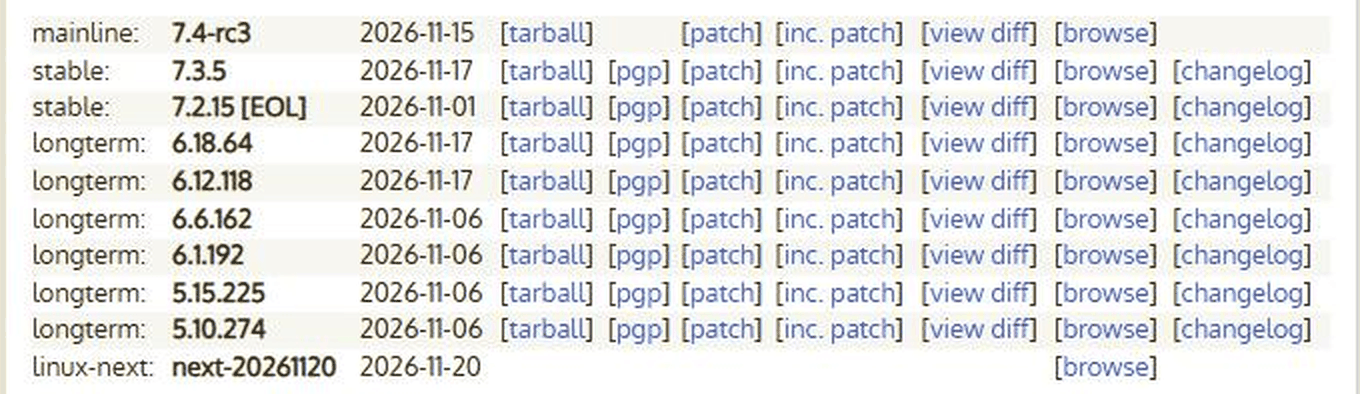
| Branch | Version | Date shown |
|---|---|---|
| Mainline | 7.4-rc3 | 2026-11-15 |
| Stable | 7.3.5 | 2026-11-17 |
| Stable | 7.2.15 [EOL] | 2026-11-01 |
| Longterm | 6.18.64 and 6.12.118 | 2026-11-17 |
| Longterm | 6.6.162, 6.1.192, 5.15.225 and 5.10.274 | 2026-11-06 |
Note the November 6 date on the four oldest long-term lines. Those four were last touched by the Xen fix release, which is why they have not had a newer update since.
The three advisories
The Xen Project published all three advisories on November 6, 2026, within a minute of each other (15:15 and 15:16 on the advisory pages, which do not state a time zone). Each concerns a Linux driver that runs on the Xen host side and serves a guest virtual machine.
| Advisory | CVE | Driver and flaw | Linux versions vulnerable |
|---|---|---|---|
| XSA-526 | CVE-2026-100080 | xen-netback: use-after-free when reading network statistics while queues are torn down after a connection error | 4.11 and newer |
| XSA-527 | CVE-2026-100081 | xen-netback: use-after-free in multicast address lookup that can run in parallel with teardown | 4.3 and newer |
| XSA-528 | CVE-2026-100082 | xen-blkback: use-after-free when reading I/O statistics while the device is torn down | 4.5 and newer |
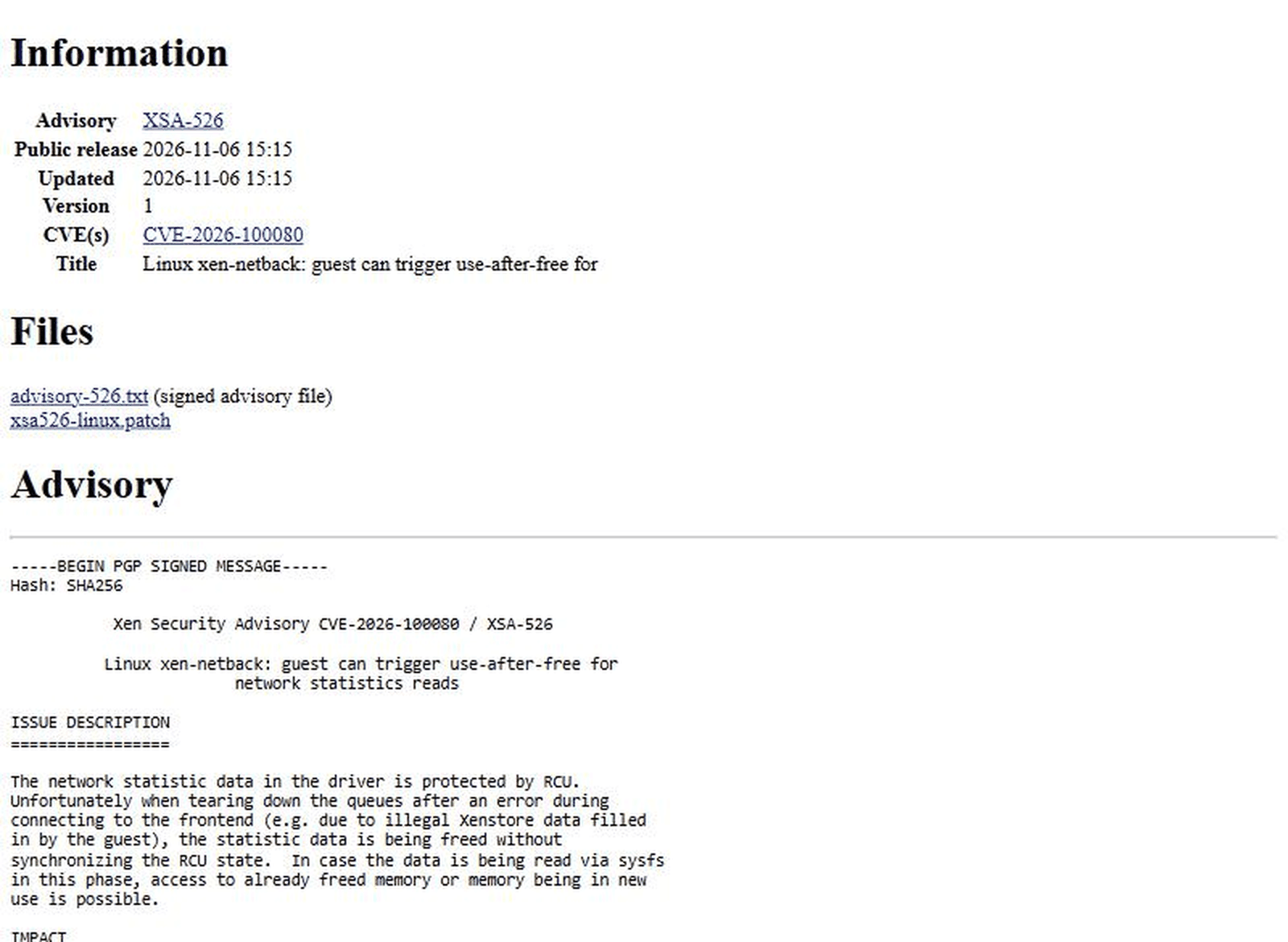
All three share a pattern that the advisory text spells out: a piece of data is freed while another part of the driver may still read it. For XSA-526 and XSA-528 the reader is a statistics query through sysfs; for XSA-527 it is the transmit path looking up multicast addresses. In XSA-526 the trigger the advisory gives is a guest writing illegal values into the Xenstore configuration so that connection setup fails and the queues are torn down.
The impact lines are close to identical. XSA-526 and XSA-528 say the most likely result is a driver crash, possibly escalated to a host crash, a denial of service for the entire host, and that information leaks cannot be ruled out. XSA-527 adds that, “with very low likelihood, privilege escalation cannot be ruled out.” We read that as the Xen team being careful about use-after-free bugs in general, not as a claim that anyone has done more than crash a host, and the advisories do not claim that either.
The advisories also list mitigations that need no kernel update: using a userspace backend such as QEMU’s “qnic” for networking or “qdisk” for block devices, or giving each guest its own dedicated network or block driver domain. The advisory for XSA-526 also carries a note that the issue was disclosed in public, meaning there was no embargo period.
The seven releases
We checked the kernel.org changelogs for each line. Every one of the seven updates below contains exactly four commits (our count of the changelog entries): the version bump and the three Xen fixes. Their commit messages name XSA-526, XSA-527 and XSA-528 directly.
| Line | Fixed in | Changelog date | Commits in this update (ours) |
|---|---|---|---|
| 5.10 | 5.10.274 | Nov 6, 2026 | 4 |
| 5.15 | 5.15.225 | Nov 6, 2026 | 4 |
| 6.1 | 6.1.192 | Nov 6, 2026 | 4 |
| 6.6 | 6.6.162 | Nov 6, 2026 | 4 |
| 6.12 | 6.12.116 | Nov 6, 2026 | 4 |
| 6.18 | 6.18.62 | Nov 6, 2026 | 4 |
| 7.3 | 7.3.3 | Nov 6, 2026 | 4 |
These are not the latest versions in their lines: 6.12 and 6.18 have since moved on to 6.12.118 and 6.18.64 (November 17), and 7.3 to 7.3.5. Any later release in the same line includes the fixes, so we use the earliest fixed version as the minimum, and the later ones as safe choices. We did not check the later changelogs for anything else.
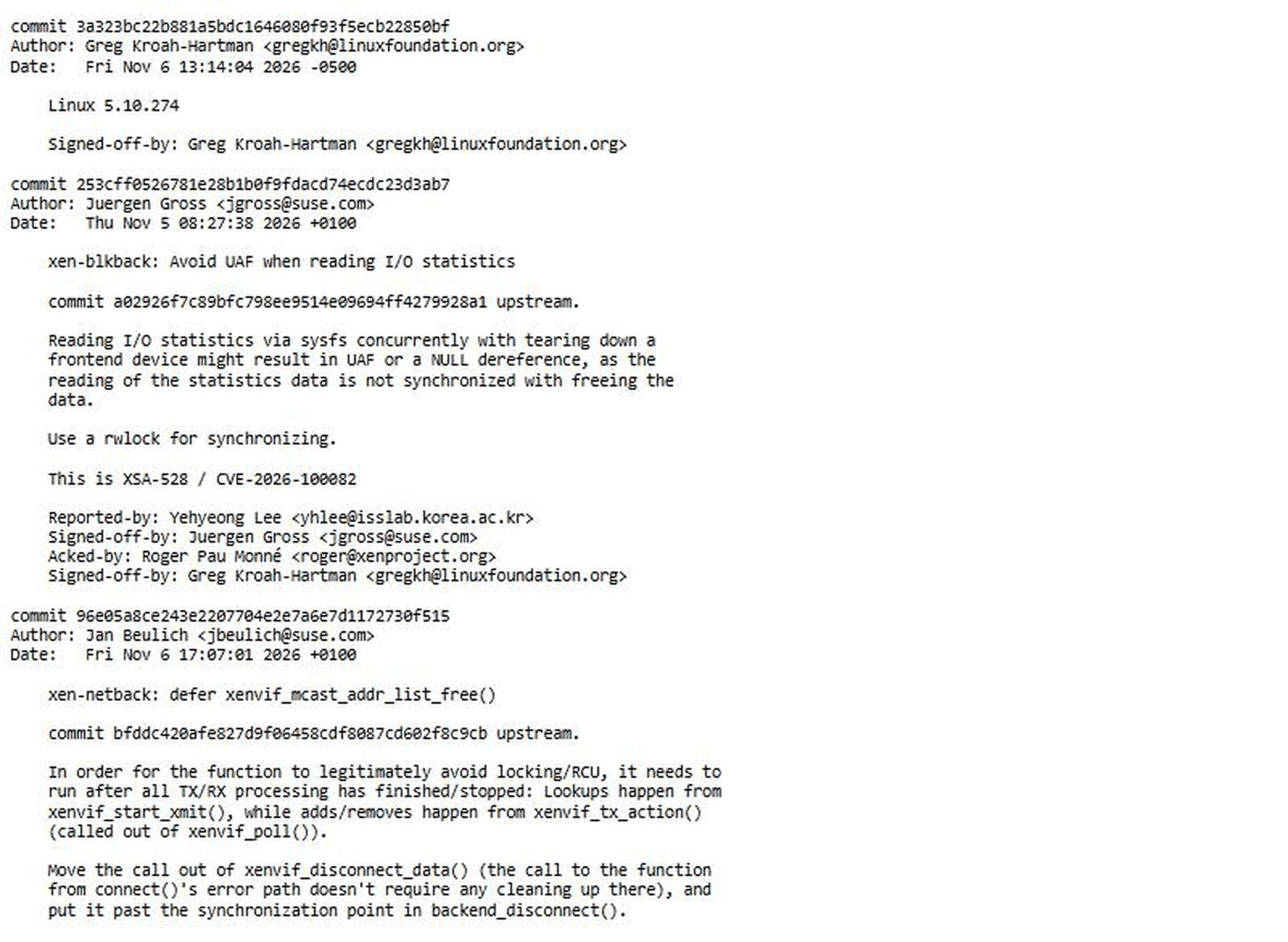
The size of these updates is itself a signal. The previous 5.10 release, 5.10.273 on October 30, has 517 commits in its changelog (our count); the Xen release is 4. Likewise 5.15.224 has 572 and 5.15.225 has 4. Other releases in the same weeks carried from dozens to hundreds of commits. Our reading, which kernel.org does not state, is that the team shipped these fixes quickly and on their own rather than waiting for the next full batch.
The deadline: 5.10 and 5.15 in December
The kernel.org “Active kernel releases” page lists the long-term lines with a release date and a projected end of life. Two of them, 5.15 (released October 31, 2021) and 5.10 (released December 13, 2020), show December 2026 as projected end of life. The 6.1 and 6.6 lines show December 2027, and 6.12 and 6.18 show December 2028.
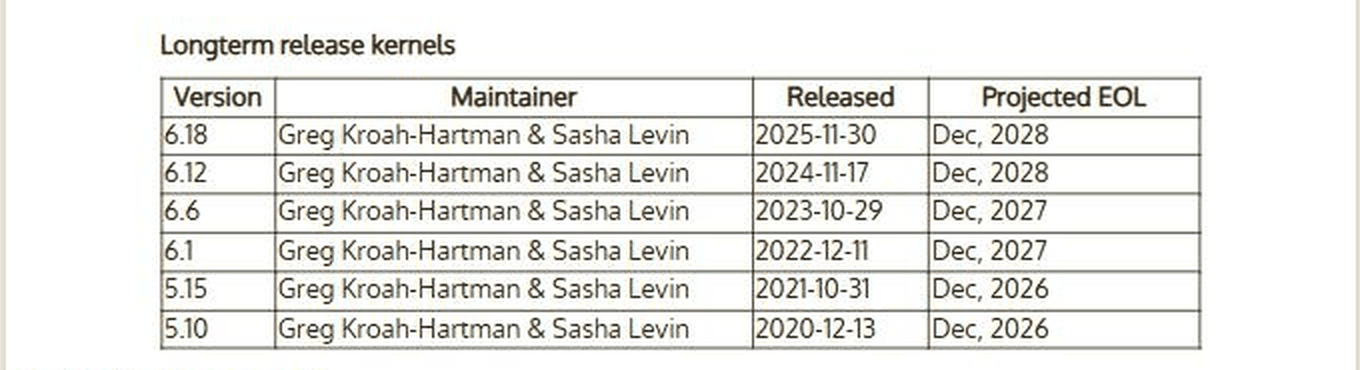
Two cautions from the page itself. First, kernel.org says the projected dates “are not set in stone”: a new long-term line starts with a two-year projection that can be extended if industry interest helps support it. Second, the page carries its own date stamp of February 25, 2026 and does not list any 7.x long-term line, so it may lag the front page. We use it for the projected dates only. We could not confirm which kernel will be the long-term pick for 2026; kernel.org says the choice depends on factors such as new features, distribution needs and maintainer workload.
What December 2026 would mean in practice is an upstream matter: once a line is end of life, kernel.org stops releasing fixes for it. The people most exposed are those who run a 5.10 or 5.15 kernel directly from kernel.org or from a vendor who tracks it, such as an appliance or an embedded device, and who rely on the upstream fixes arriving. Our arithmetic from the page: with the projected end in December 2026 and today being November 21, there are at most about six weeks of projected upstream support left (if the end falls on December 31), and possibly fewer.
Distribution kernels are a different story
The same kernel.org page explains that many Linux distributions ship their own long-term kernels, which “may or may not be based on” the ones kernel.org maintains, and that kernel developers cannot support them. It also gives a simple test: run uname -r; if anything follows a dash in the version, you are running a distribution kernel and should use your vendor’s support channels. That matters here for two reasons. A distribution kernel may carry the Xen fixes under a different version number, and it may keep supporting an old line after kernel.org stops. We did not check any distribution, so we make no claim about which ones have shipped the fixes.
Are you affected? A short checklist
Everything here follows the advisories and kernel.org. We have not run it ourselves, so treat the commands as starting points.
- Do you run Xen at all? The advisories concern the Linux backend drivers that serve guests on a Xen host. A Linux server that is not a Xen host, dom0 or driver domain does not use these drivers in that role. We did not verify how every distribution builds them, so check the kernel modules on your own system (the driver names are xen-netback and xen-blkback;
lsmodlists loaded modules). - Which kernel? Run
uname -r. If it is a plain upstream version, compare it with the table above: 5.10.274, 5.15.225, 6.1.192, 6.6.162, 6.12.116, 6.18.62 or 7.3.3 and later contain the fixes. If there is a vendor suffix, ask your vendor. - On 7.2? kernel.org lists 7.2.15 as end of life and it predates the fix. Plan a move to 7.3.x or to a long-term line.
- Cannot update yet? The advisories list two mitigations: a userspace backend (QEMU’s qnic or qdisk) or a dedicated driver domain per guest. Both change how guests get network and disk access, so test them first.
- Running 5.10 or 5.15? Decide now what you will move to before December, and whether your vendor extends support. Moving a Xen host between kernel lines is a larger change than a point update.
Why a small update deserves attention
These three flaws will not make general headlines: they need a Xen setup, and the likely outcome is a crash. They matter for the people who do run Xen, because a crash of the host takes down every guest on it, and for hosting providers a guest that can trigger it is a neighbour risk. The advisories’ phrase “guest can trigger” is the key: the party that could cause the crash is a tenant, not an outsider.
The bigger lesson is about timing. A security fix and an end-of-life date arrived in the same month for the same two kernels. Teams that run old long-term kernels often discover the deadline only when a patch stops coming. The kernel.org table gives years of warning for each line; it is worth reading once a year and writing the dates in a calendar.
What we could not confirm
- That the fixes work in practice. We did not build or run any kernel or reproduce any flaw.
- Whether the flaws have been exploited. The advisories and changelogs we read say nothing either way.
- Which distributions have shipped the fixes, and under which version numbers. We checked none.
- Whether the projected December 2026 end of life for 5.10 and 5.15 will hold or be extended. kernel.org says the dates can change.
- Which kernel will be the 2026 long-term pick. We found no announcement on kernel.org.
- The time zone of the advisory timestamps, so we make no claim about the gap between the advisories and the kernel releases.
- Anything about XSA-527 and XSA-528 beyond what their advisory pages say. We read the top of XSA-526 on screen and the full text of all three, but did not read the attached patch files.
Frequently asked questions
What are XSA-526, XSA-527 and XSA-528?
Three Xen Security Advisories published on November 6, 2026 for use-after-free flaws in Linux’s xen-netback and xen-blkback drivers, tracked as CVE-2026-100080, CVE-2026-100081 and CVE-2026-100082. A guest can trigger them; the likely result is a crash of the driver or the whole host.
Which Linux kernels have the fixes?
According to the kernel.org changelogs we read: 5.10.274, 5.15.225, 6.1.192, 6.6.162, 6.12.116, 6.18.62 and 7.3.3, and later releases in those lines.
Does this affect my desktop or ordinary Linux server?
The advisories concern the Xen backend drivers that serve guests. We would expect an ordinary desktop or a server that is not a Xen host to be unaffected, but we did not verify it for any distribution, so check your own setup if you run Xen.
When does Linux 5.10 reach end of life?
kernel.org projects December 2026 for both 5.10 and 5.15, and says projected dates are not set in stone.
Is Linux 7.2 still supported?
kernel.org marks 7.2.15, dated November 1, 2026, as end of life, and lists 7.3.5 as the current stable release.
Where are the sources?
kernel.org (front page and releases page), the kernel changelogs on cdn.kernel.org, and the Xen Project advisories XSA-526, XSA-527 and XSA-528. All screenshots are ours, taken November 21, 2026.
Related reading
- Node.js Security Releases: 16 Flaws Fixed in v22.23.5, v24.22.3 and v26.13.1
- Valkey Security Update: CVE-2026-130822 Fixed in 9.1.4, 9.0.8, 8.1.12, 8.0.13 and 7.2.16
- PostgreSQL 19 Is Out and PostgreSQL 14 Is Already Unsupported: What to Check Before You Upgrade
- PHP 8.6 Is Out and PHP 8.2 Loses Security Support on December 31
- Hosting reviews