PHP 8.6 Is Out and PHP 8.2 Loses Security Support on December 31: What WordPress Site Owners Should Check
Published November 20, 2026. A news analysis built from the PHP 8.6 release announcement and the “Supported Versions” page on php.net, the PHP 8.6 migration guide, WordPress.org’s “Requirements” page, the “PHP Compatibility and WordPress Versions” page of the WordPress core handbook, and our own screenshots of each. This article contains no affiliate links and we have no commercial relationship with PHP, WordPress or any host named in it. We label every calculation of ours as ours, quote only short phrases, and did not benchmark PHP 8.6 or test any plugin on it.
The short version
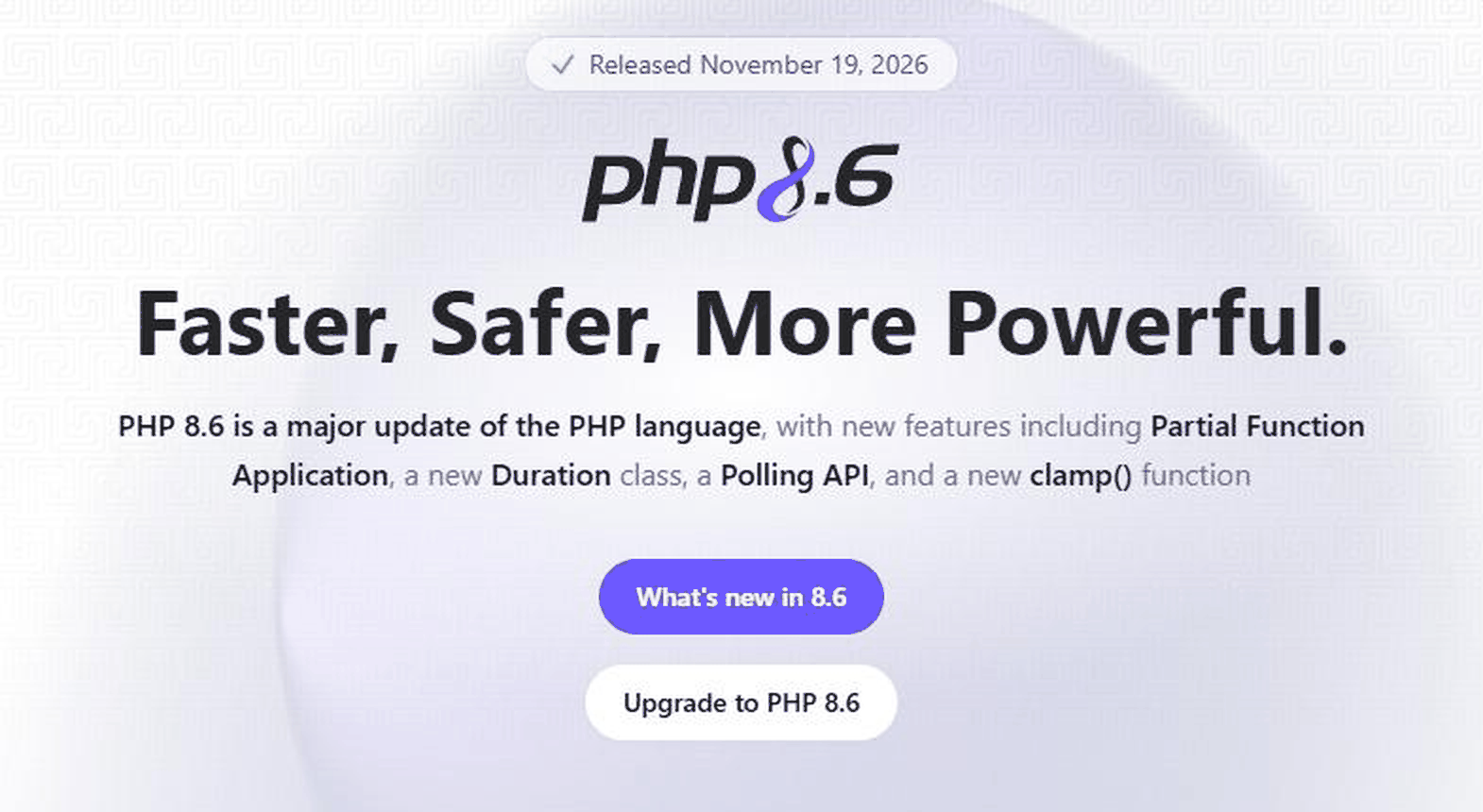
- The release: php.net says PHP 8.6.0 was released on November 19, 2026. Its headline features are Partial Function Application, a new Duration class, a Polling API and a clamp() function.
- The date that matters more: PHP 8.2 receives security fixes only until December 31, 2026. After that date the branch is end of life. From November 20 that is 41 days away (our arithmetic).
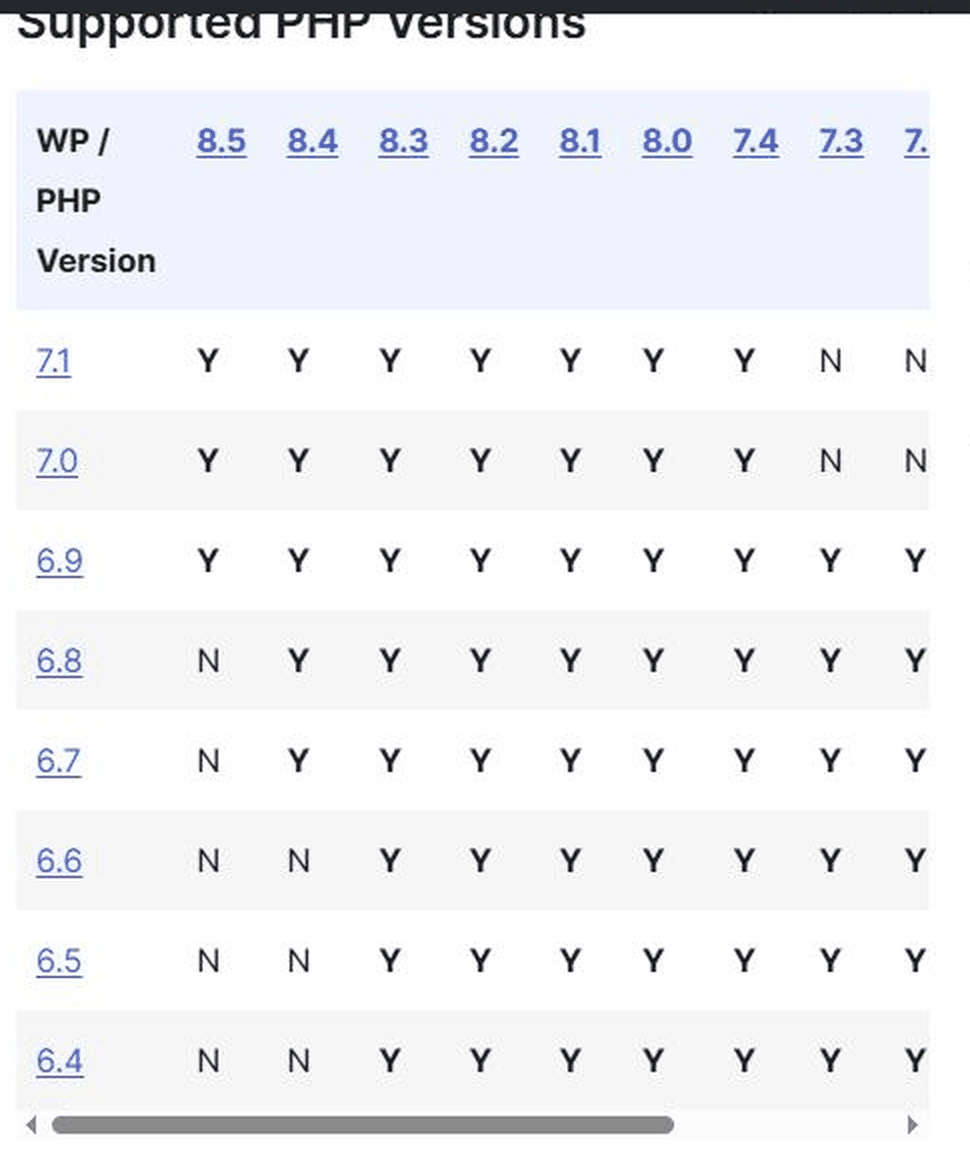
- What WordPress recommends: PHP 8.3 or greater. WordPress’s own compatibility table lists PHP 8.5 as supported for WordPress 6.9, 7.0 and 7.1, and it has no column for PHP 8.6 yet.
- Our advice: if your site runs PHP 8.2 or older, move to 8.3 or newer before the end of December. Do not rush production to 8.6 in release week.
- Not tested: we did not measure speed or compatibility. The 8.6 page calls the release “Faster, Safer, More Powerful” but, in what we read, gives no figures.
What PHP announced
The announcement page is dated November 19, 2026. It describes PHP 8.6 as a major update of the language and lists these main features:
- Partial Function Application: supply some arguments now and get a Closure that takes the rest.
- A new Time\Duration class: elapsed time with nanosecond precision, useful for timeouts and benchmark timings.
- A Polling API (Io\Poll): scalable I/O multiplexing using native mechanisms such as epoll and kqueue, meant as a base for event-loop libraries like ReactPHP and AMPHP.
- A clamp() function and a SortDirection enum.
- Readonly property defaults, so fixed values no longer need a constructor.
The page also lists smaller changes: structured stream errors, parameter-level doc comments, new URI builder classes, post-quantum key encapsulation in the Sodium extension, TLS 1.3 early data, a mysqli::quote_string() method and JSON error messages that include the position of the error. Most of this matters to developers writing PHP, not to someone running a WordPress blog. For a site owner the release itself is mostly a signal, and the useful part of the announcement is the migration guide.
The date that matters: PHP 8.2 security support ends December 31, 2026
php.net’s “Supported Versions” page explains the rule. Each branch gets two years of active support, with bug and security fixes. After that it gets two more years of critical security fixes only. When the four years are over, the branch is end of life and, in the page’s words, users “should upgrade as soon as possible” because they may be exposed to unpatched vulnerabilities.
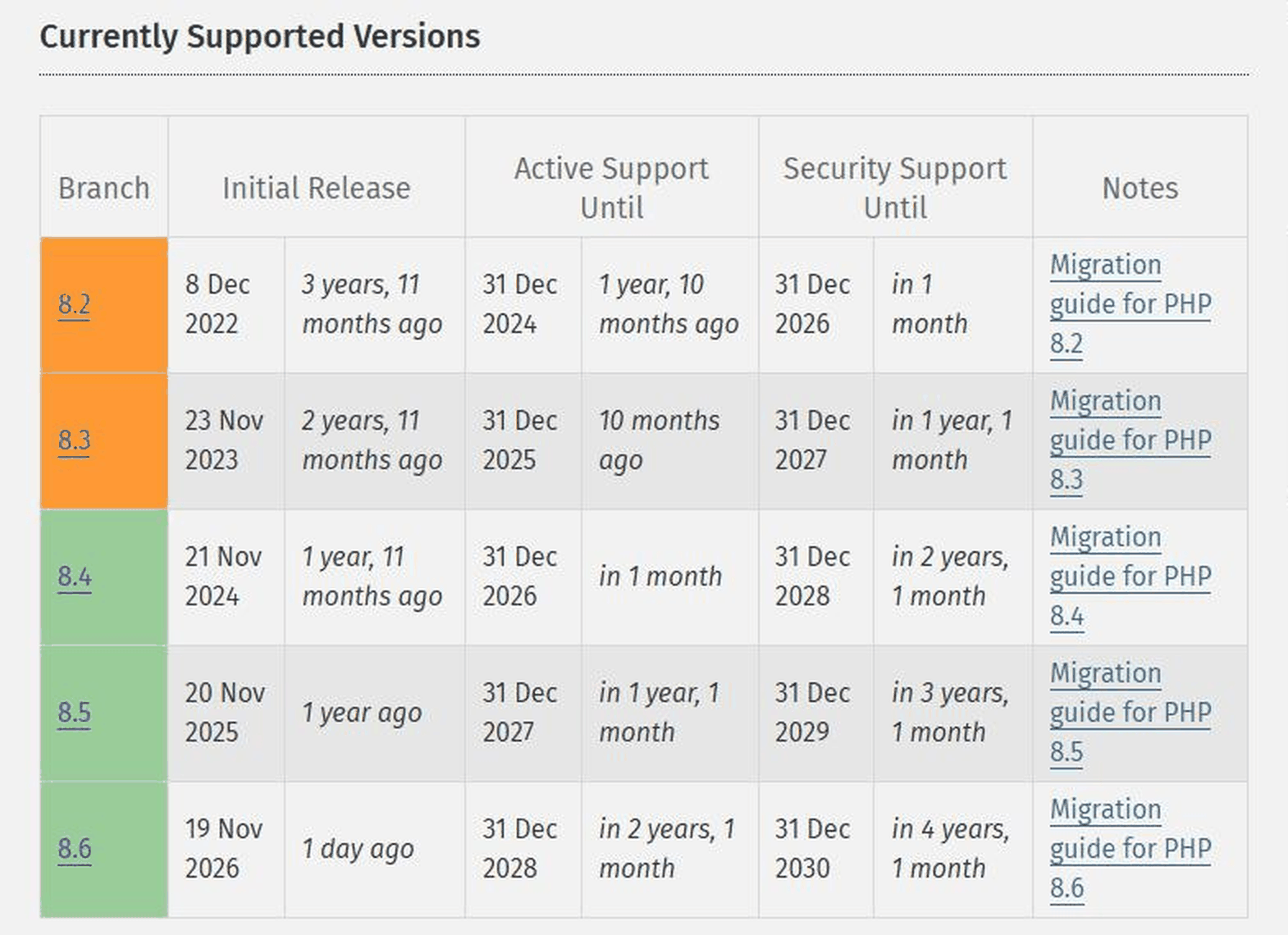
| PHP branch | Released | Active support until | Security fixes until | Days of security support left on Nov 20, 2026 (ours) |
|---|---|---|---|---|
| 8.2 | Dec 8, 2022 | Dec 31, 2024 | Dec 31, 2026 | 41 |
| 8.3 | Nov 23, 2023 | Dec 31, 2025 | Dec 31, 2027 | 406 |
| 8.4 | Nov 21, 2024 | Dec 31, 2026 | Dec 31, 2028 | 772 |
| 8.5 | Nov 20, 2025 | Dec 31, 2027 | Dec 31, 2029 | 1,137 |
| 8.6 | Nov 19, 2026 | Dec 31, 2028 | Dec 31, 2030 | 1,502 |
Three readings of the table. First, PHP 8.2 is already past active support, so it only receives critical security fixes, and that ends in 41 days. Second, PHP 8.3, which is WordPress’s recommended minimum, has been security-only since the end of 2025 and has until the end of 2027. Third, PHP 8.4 moves to security-only on the same date that PHP 8.2 ends, so the branches with active support are 8.5 and 8.6 from January 2027 onward (our reading of the table).
What WordPress says
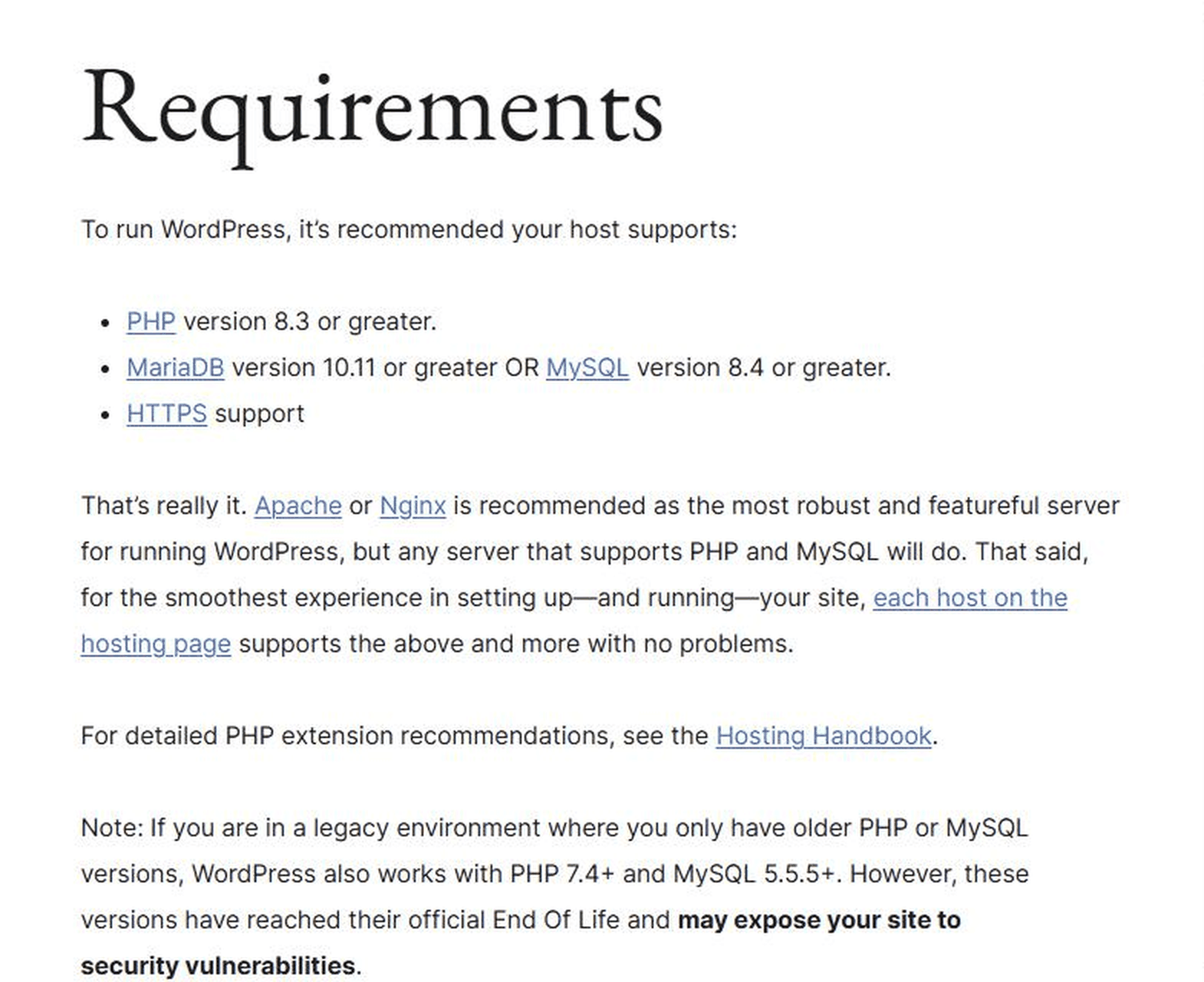
WordPress.org’s “Requirements” page recommends that a host supports PHP 8.3 or greater, MariaDB 10.11 or greater or MySQL 8.4 or greater, and HTTPS. It adds that WordPress also works with PHP 7.4 and above, but those versions have reached end of life and “may expose your site to security vulnerabilities”.
The WordPress core handbook publishes a compatibility table. When we read it, the first column was PHP 8.5, marked supported for WordPress 6.9, 7.0 and 7.1, and not supported for 6.8 and older. The page notes that WordPress 6.9 added beta support for PHP 8.5 and that the “beta support” label was retired in May 2026. There was no PHP 8.6 column. That does not mean 8.6 is unsupported, only that WordPress has not published a position on it yet.
What can break in PHP 8.6
The migration guide lists backward-incompatible changes and deprecations. Deprecations emit notices; they do not stop a site by themselves. The incompatible changes are the ones to watch, because several now raise a ValueError, and an uncaught exception ends the request. The guide includes:
- File functions such as file_exists(), is_file(), is_dir(), filesize() and stat() now raise a ValueError when the filename contains NUL bytes.
- Functions including array_filter(), pathinfo() and scandir() raise a ValueError for invalid flag or mode values. number_format(), sleep() and usleep() raise it for out-of-range values instead of silently clamping.
- trim(), rtrim() and ltrim() now strip the form feed character by default.
- Several behaviours change: by-reference foreach after array compaction, null coalescing on magic properties, and the order and number of conversion warnings in array_intersect().
- base_convert(), bindec(), hexdec() and octdec() raise a notice when they cannot convert a number precisely.
The deprecations are shorter to list and show where older code lives: using return inside a finally block, returning a value from a constructor or destructor, passing a third argument to define(), and using let, is or _ as names. One of them names WordPress directly: declaring a function called readonly is now deprecated, and the guide says a special lexer exception was added in PHP 8.1 solely to keep an existing WordPress function of that name working.
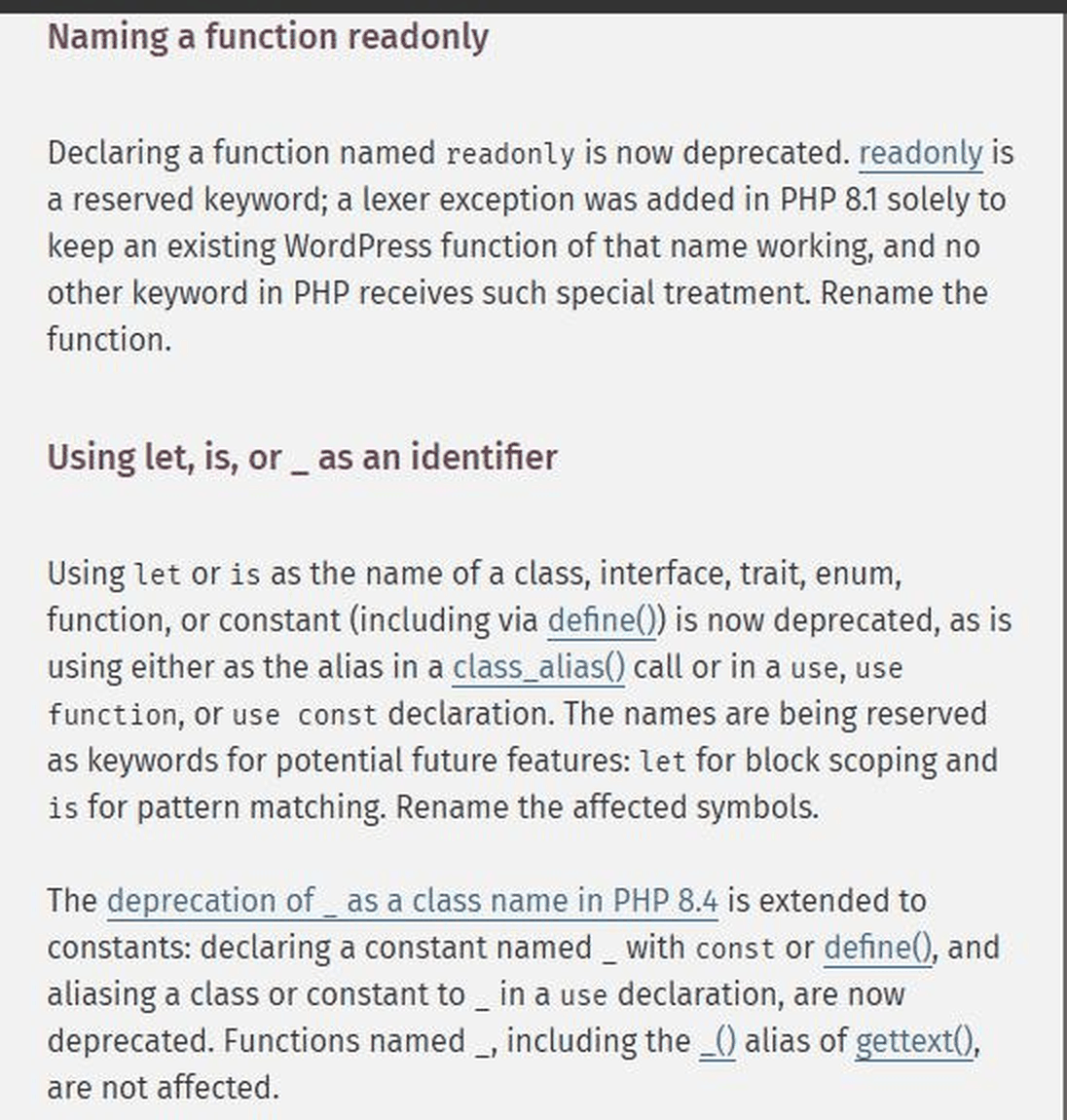
In practice, a theme or plugin written for older PHP may hit one of these. Plugin vendors normally publish a compatibility statement in their changelog or support forum for each new PHP version. For PHP 8.6 those statements may not exist yet, and we did not check any plugin.
What to check before you change your PHP version
- Find your version. In WordPress open Tools, then Site Health, then the Info tab and read the Server section. Your hosting panel also shows it (on our cPanel host it is under “Select PHP Version”).
- If you are on 8.2 or older, plan the move now. WordPress recommends 8.3 or greater, and 8.2 loses security fixes on December 31. Moving to 8.3 is the smallest step; 8.4 or 8.5 gives a longer runway if your plugins and theme confirm support.
- Back up, then test on a staging copy. Turn on WP_DEBUG on staging and read the error log while you click through the front page, login, forms, search, checkout and any custom code.
- Update first. Update WordPress core, the theme and plugins before you change PHP, and read the changelogs for statements about newer PHP versions.
- Do not rush production to 8.6. In our judgment, a major new branch is a poor choice for a live site in its first weeks: WordPress has published no 8.6 position, hosts may not offer it yet, and extensions your site depends on may not have builds. Revisit after your plugins and WordPress confirm support.
- Watch the logs after switching. Check the PHP error log for 24 to 48 hours, and check that scheduled tasks still run.
- Fix your own code. If you maintain custom code, search it for the deprecated patterns listed above.
We followed this on our own site. It moved from PHP 8.2 to 8.3 on November 13, 2026, and we re-checked the home page, the review pages, the sitemaps and the admin screens for PHP messages afterwards and found none. That is one small site on one host, not evidence about yours.
What we could not confirm
- Any speed or security improvement in PHP 8.6: we ran no benchmark and the announcement page we read gives no figures.
- Whether your host offers PHP 8.6, or when it will.
- Whether any specific plugin or theme works on PHP 8.6.
- When WordPress will publish a position on PHP 8.6.
- Whether php.net will change the support dates for 8.2 before December 31. We report the table as we read it on November 20, 2026.
Frequently asked questions
When does PHP 8.2 stop getting security updates?
According to php.net’s Supported Versions table, on December 31, 2026. After that, the branch is end of life.
Which PHP version should I use for WordPress?
WordPress.org recommends PHP 8.3 or greater. Its compatibility table lists PHP 8.5 as supported for WordPress 6.9, 7.0 and 7.1.
Is PHP 8.6 supported by WordPress?
WordPress has not published a position that we could find. The compatibility table we read on November 20 had no PHP 8.6 column.
Is PHP 8.3 still safe to use?
PHP 8.3 receives critical security fixes until December 31, 2027, according to php.net. It no longer gets regular bug fixes.
Where are the sources?
php.net: the PHP 8.6 release announcement, the Supported Versions page and the PHP 8.6 migration guide. WordPress: the Requirements page on WordPress.org and the “PHP Compatibility and WordPress Versions” page in the core handbook. All screenshots are ours, taken on November 20, 2026, and every figure marked “ours” is our own arithmetic.
More Security and Infrastructure News
- PostgreSQL 19 Is Out and PostgreSQL 14 Is Already Unsupported: What to Check Before You Upgrade
- Quad9 Leaves France on November 24: What Changes for DNS Users and What to Check Now
- NGINX HTTP/2 Remote Code Execution Flaws: Affected Versions, Fixes and What to Check Today
- OpenSSL CVE-2026-121481: A 9.8 in NVD, a Fix Still in Review and No Advisory on OpenSSL’s Own Page
- Synology DSM Critical Flaw CVE-2026-120382: Deactivate OAuth Service Now, Fixed Builds Due by November 20