Valkey Security Update: CVE-2026-130822 Fixed in 9.1.4, 9.0.8, 8.1.12, 8.0.13 and 7.2.16, and What to Check
Published November 21, 2026. A news analysis built from primary sources: the Valkey release notes for 9.1.4, 9.0.8, 8.1.12, 8.0.13 and 7.2.16 on GitHub (all dated November 18, 2026) and the Valkey security advisory GHSA-3885-pq5f-788j, plus our own screenshots of the pages. This article contains no affiliate links and we have no commercial relationship with the Valkey project or any vendor named here. We did not install the new releases, run Valkey or reproduce the issue, and we publish no exploit details beyond what the advisory itself says. Calculations marked “ours” are our own arithmetic.
The short version
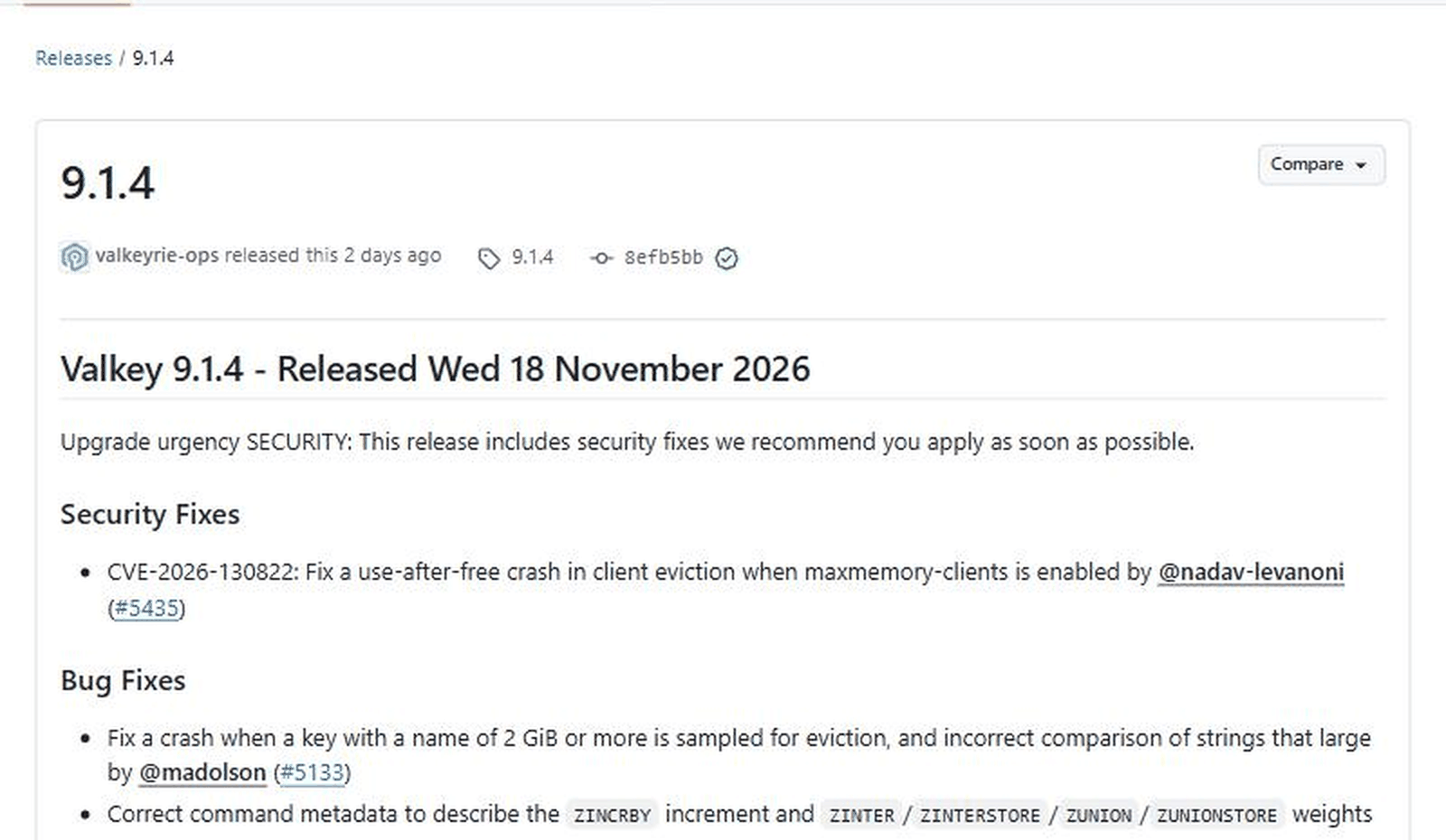
- What happened: on November 18, 2026 the Valkey project shipped five security releases at once: Valkey 9.1.4, 9.0.8, 8.1.12, 8.0.13 and 7.2.16. Each release note carries the label “Upgrade urgency SECURITY” and says to apply the security fixes “as soon as possible.”
- The vulnerability: CVE-2026-130822, a use-after-free (CWE-416) in client eviction. The advisory rates it High, CVSS v3.1 base score 7.5 out of 10.
- Who is exposed: only servers with client eviction turned on. The advisory says servers with
maxmemory-clientsset to 0, which is the default, are not affected. - What an attacker needs: to be an authenticated user who can write to a key that other clients are blocked on. The advisory describes the result as a reliable crash of the server process.
- What to do: upgrade to the patched version for your release line, or, if you cannot upgrade yet, use the mitigations in the advisory: turn client eviction off, or tighten ACLs.
The five releases, in one table
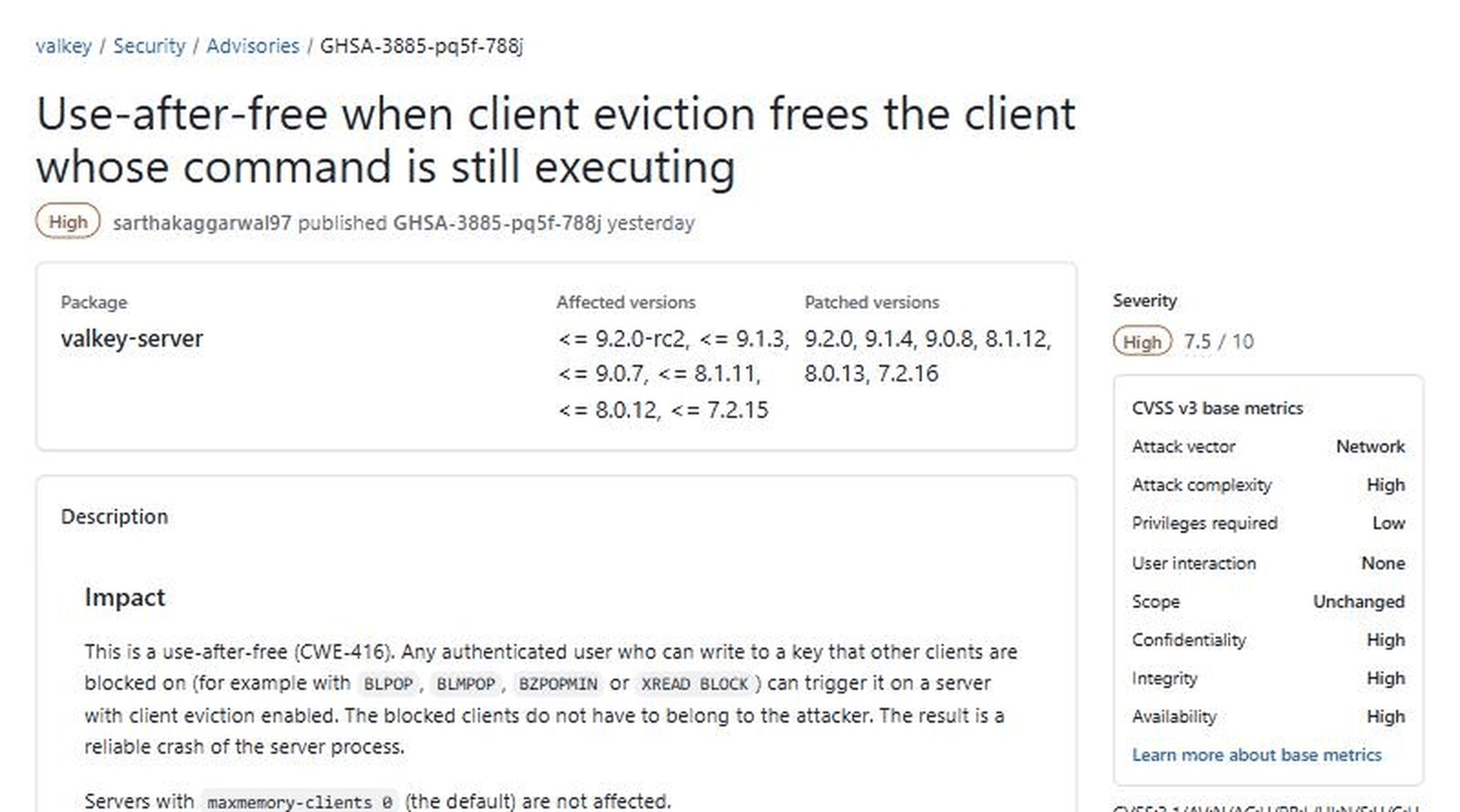
Valkey maintains several release lines at once. The advisory lists which versions are affected and which are patched. The table below is copied from the advisory and the release pages; it contains no calculation of ours.
| Release line | Affected (advisory) | Patched | Release date (GitHub) |
|---|---|---|---|
| 9.2 | Up to 9.2.0-rc2 | 9.2.0 | Listed in the advisory; we did not open a 9.2.0 release page |
| 9.1 | Up to 9.1.3 | 9.1.4 | November 18, 2026 |
| 9.0 | Up to 9.0.7 | 9.0.8 | November 18, 2026 |
| 8.1 | Up to 8.1.11 | 8.1.12 | November 18, 2026 |
| 8.0 | Up to 8.0.12 | 8.0.13 | November 18, 2026 |
| 7.2 | Up to 7.2.15 | 7.2.16 | November 18, 2026 |
The practical reading: whichever line you run, the fix is the next patch release in that line. You do not have to jump to a new major or minor version to get it, which matters for teams that pin a version for stability. Five old lines being patched on the same day also shows the project treats the flaw as relevant to every supported line, not only the newest.
What the advisory says about the flaw
The advisory, titled “Use-after-free when client eviction frees the client whose command is still executing,” was published by the project’s maintainers on GitHub. Its facts, in order:
- Class and severity: use-after-free, CWE-416. High, 7.5 out of 10, with the CVSS v3.1 vector AV:N/AC:H/PR:L/UI:N/S:U/C:H/I:H/A:H. In plain words: reachable over the network, high attack complexity, low privileges needed, no user interaction, and a high rating for confidentiality, integrity and availability impact.
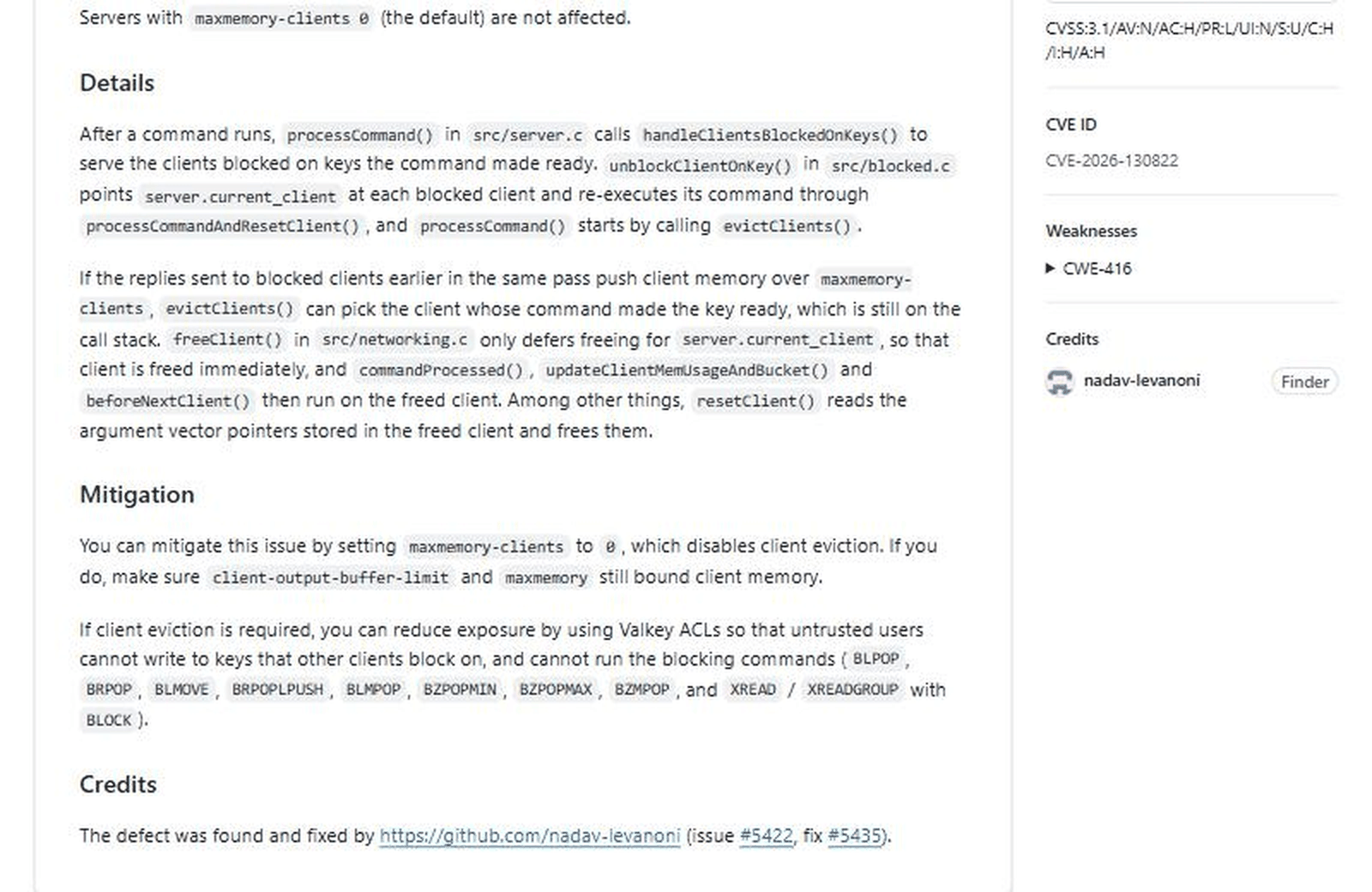
- The trigger: client eviction is a feature that disconnects clients when their combined memory use passes the
maxmemory-clientslimit. The advisory says that when replies sent to clients that are blocked on keys push memory over that limit, the server can pick the very client whose command made the key ready, and that client is still in use when it is freed. - Who can trigger it: “any authenticated user who can write to a key that other clients are blocked on,” for example with blocking commands such as BLPOP, BLMPOP, BZPOPMIN or XREAD with BLOCK. The blocked clients do not have to belong to the attacker.
- The outcome: a reliable crash of the server process.
- Credit: found and fixed by the contributor nadav-levanoni, with the issue tracked as #5422 and the fix as #5435.
A detail worth noticing: the score and the description do not match perfectly
The CVSS vector rates confidentiality, integrity and availability impact all as High. The written impact, however, describes a crash, which is an availability problem. The advisory does not say that an attacker can read or change data, and we are not claiming that. The simplest reading, and it is only our reading, is that the score is deliberately conservative for a use-after-free, a bug class that can sometimes be worse than a crash. The advisory does not say that either, and we did not test it. What matters for readers: the documented result is a crash, the score is High, and the safe response is the same.
The other number to hold on to is the attack complexity. The vector says High, and the trigger needs authentication, write access to a specific key and client eviction switched on. That is a narrower target than a bug in a default, internet-facing code path. It does not mean the issue is harmless: many Valkey and Redis-compatible servers sit inside private networks where every application account is an “authenticated user.”
Are you affected? A five-minute check
Everything below is drawn from the advisory’s own wording. We have not run it ourselves, so treat the commands as a starting point and check them against your version’s documentation.
- Find your version. Run
valkey-server --versionon the host, orINFO serverfrom a client, and compare it with the table above. Anything at or below the “affected” version in its line needs the update. - Check client eviction. Run
CONFIG GET maxmemory-clients. The advisory says a value of 0, the default, means the server is not affected. If you see a non-zero value, such as a percentage or a byte limit, you are in the group the advisory describes. - Check who can write and block. List which accounts can write to keys that other clients wait on, and which can run the blocking commands the advisory names. In many applications this is a queue or a job list, so the accounts that push to it matter most.
- Check managed services. If your Valkey runs inside a cloud provider’s managed service, the provider controls the patch schedule. We did not read any provider’s notice, so look for one from yours.
- Check images and packages. Container images and operating-system packages often lag a release by days. We did not check any image or distribution package, so confirm the version inside, not only the tag outside.
If you cannot upgrade today: the advisory’s mitigations
The advisory gives two options, quoted here in substance:
- Turn client eviction off by setting
maxmemory-clientsto 0. The advisory adds a condition: if you do, make sureclient-output-buffer-limitandmaxmemorystill bound client memory. Turning one limit off without checking the others can trade a crash risk for a memory-exhaustion risk. - If you need client eviction, reduce exposure with ACLs, so that untrusted users cannot write to keys that other clients block on and cannot run the blocking commands, which the advisory lists as BLPOP, BRPOP, BLMOVE, BRPOPLPUSH, BLMPOP, BZPOPMIN, BZPOPMAX, BZMPOP, and XREAD or XREADGROUP with BLOCK.
Both are stop-gaps. The project’s own recommendation, in every release note, is to apply the security fix as soon as possible.
What else is in the same release
The security fix is one line in a long list. The 8.1.12 notes carry more than 50 bug-fix entries (our count of the list on the page), covering crashes, memory leaks and cluster and replication edge cases. A few of them touch access control and credentials, and we point them out because administrators often read only the headline CVE:
- A fix so that a SORT command whose STORE destination is named like an option can no longer bypass ACL checks and write to an unauthorized key.
- A fix for PFMERGE with no source keys bypassing ACL key permissions.
- A fix so that credentials of rejected HELLO, AUTH and MIGRATE commands are redacted and no longer leak to MONITOR and the command log.
The release notes list these under “Bug Fixes,” not under “Security Fixes,” and carry no CVE for them. We are not saying they are vulnerabilities; we are saying that the notes describe them, and that an upgrade brings them along with the CVE fix. Readers who rely on ACLs for multi-tenant separation should read the full list for their line.
Why this matters beyond Valkey users
Valkey is a Redis-compatible in-memory database under the Linux Foundation, widely used for caches, queues, rate limiting and session storage. That makes the “blocked clients” trigger easy to picture: job queues built on list or stream commands are exactly where applications leave clients waiting on a key. It also explains why the advisory stresses that the blocked clients do not have to be the attacker’s: a queue shared by several applications is a shared surface.
The lesson is wider than one CVE. Many operators set maxmemory-clients to protect a busy server from a few clients that hold huge buffers. That is a reasonable safeguard, and this advisory is a reminder that safety features are code too, and that a defensive setting can sit on the path of a bug. Keeping such settings, and the ACLs around them, documented and reviewed is cheap compared with learning about them from a crash.
What we could not confirm
- That the patched releases fix the issue in practice. We did not install them or reproduce the problem.
- Whether the flaw can do more than crash the server. The advisory documents a crash; the CVSS vector rates every impact High, and we do not know why the two differ.
- Whether the flaw has been exploited in the wild. The advisory and release notes we read say nothing either way.
- The status of Valkey 9.2.0. The advisory lists it as patched, but we did not open a 9.2.0 release page.
- When managed services, container images and distribution packages pick up the fix. We checked none of them.
- An NVD entry for CVE-2026-130822. When we looked on November 21, the National Vulnerability Database returned “CVE ID Not Found,” which its own page says can happen when an ID is not yet published there. We therefore rely on the project’s advisory for severity.
Frequently asked questions
What is CVE-2026-130822?
A use-after-free vulnerability in Valkey’s client eviction. Per the project’s advisory, an authenticated user who can write to a key that other clients are blocked on can crash a server that has client eviction enabled. It is rated High, 7.5 out of 10.
Which Valkey versions are fixed?
Valkey 9.2.0, 9.1.4, 9.0.8, 8.1.12, 8.0.13 and 7.2.16, according to the advisory. Versions up to 9.2.0-rc2, 9.1.3, 9.0.7, 8.1.11, 8.0.12 and 7.2.15 are affected.
Am I affected if I use the default configuration?
The advisory says servers with maxmemory-clients set to 0, which is the default, are not affected. Check the value in your own configuration; defaults can be changed by a package, an image or a managed service.
Do I have to upgrade to a new major version?
No. Each affected release line has its own patch release, for example 8.1.11 to 8.1.12.
Is there a workaround?
Yes, according to the advisory: set maxmemory-clients to 0 while keeping other memory limits in place, or use ACLs to stop untrusted users writing to keys others block on and running blocking commands.
Where are the sources?
The Valkey releases on GitHub (9.1.4, 8.1.12, 7.2.16 and the 9.0.8 and 8.0.13 pages we also read) and the advisory GHSA-3885-pq5f-788j. All screenshots are ours, taken November 21, 2026.
Related reading
- Node.js Security Releases: 16 Flaws Fixed in v22.23.5, v24.22.3 and v26.13.1
- Xen XSA-526, 527 and 528: Linux Kernel Use-After-Free Fixes and 5.10, 5.15 End of Life
- PostgreSQL 19 Is Out and PostgreSQL 14 Is Already Unsupported: What to Check Before You Upgrade
- Apache 2.4.71 Fixes Critical mod_http2 Flaw: What to Check
- Synology DSM Critical Flaw CVE-2026-120382: Deactivate OAuth Service Now
- Hosting reviews