Claude Whiteboards, Sheets and Data: What Teams Should Check
Updated November 11, 2026. A news analysis built from Anthropic’s two product posts of November 10, 2026, our own screenshots of those pages, and the Hacker News front page. Disclosure: the research and drafting tools we used for this article include Claude, an AI model made by Anthropic, the company this story is about. We therefore rely on the primary pages, quote only what they say, and label company claims as company claims. This is not purchasing advice.
The short version
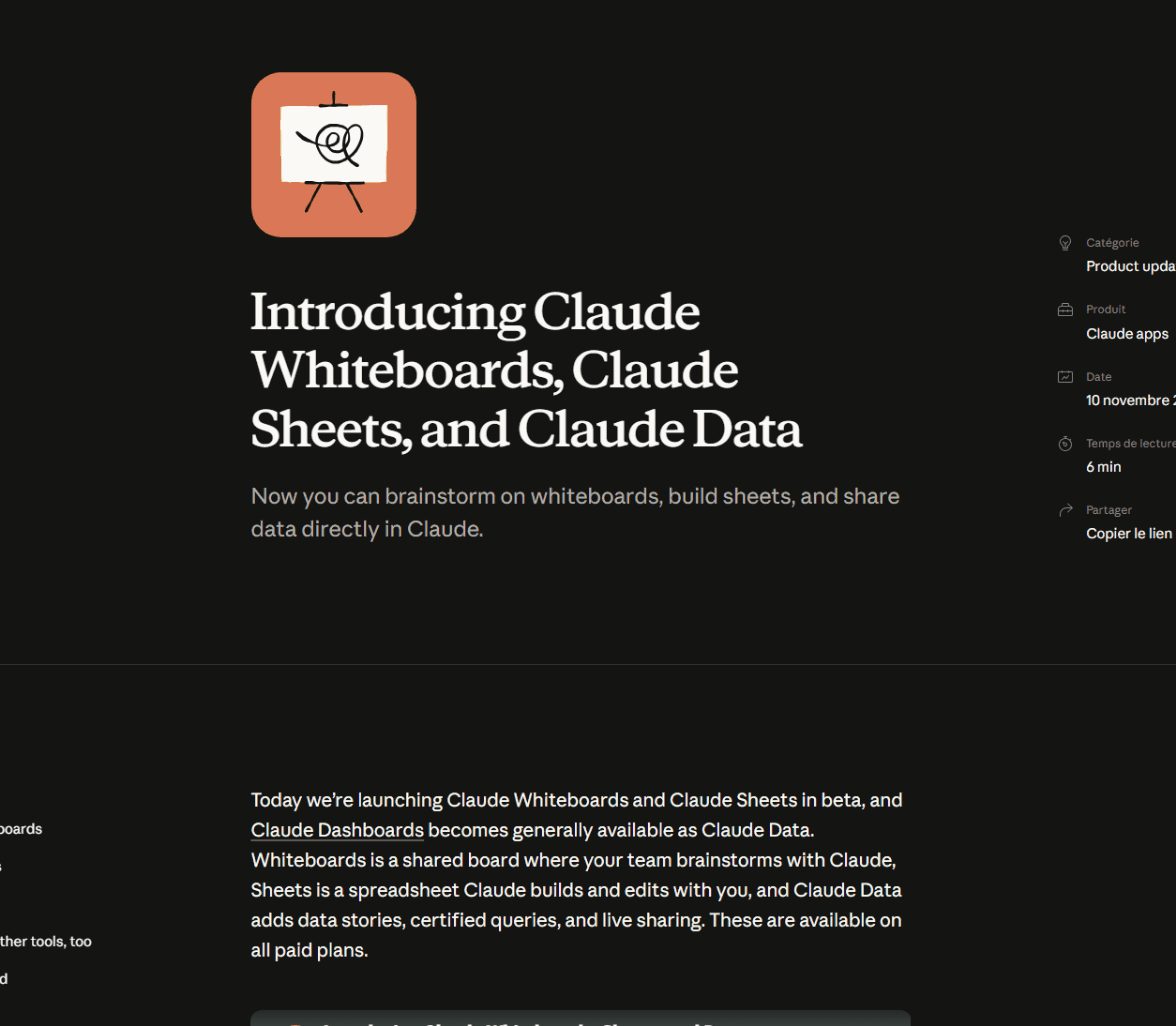
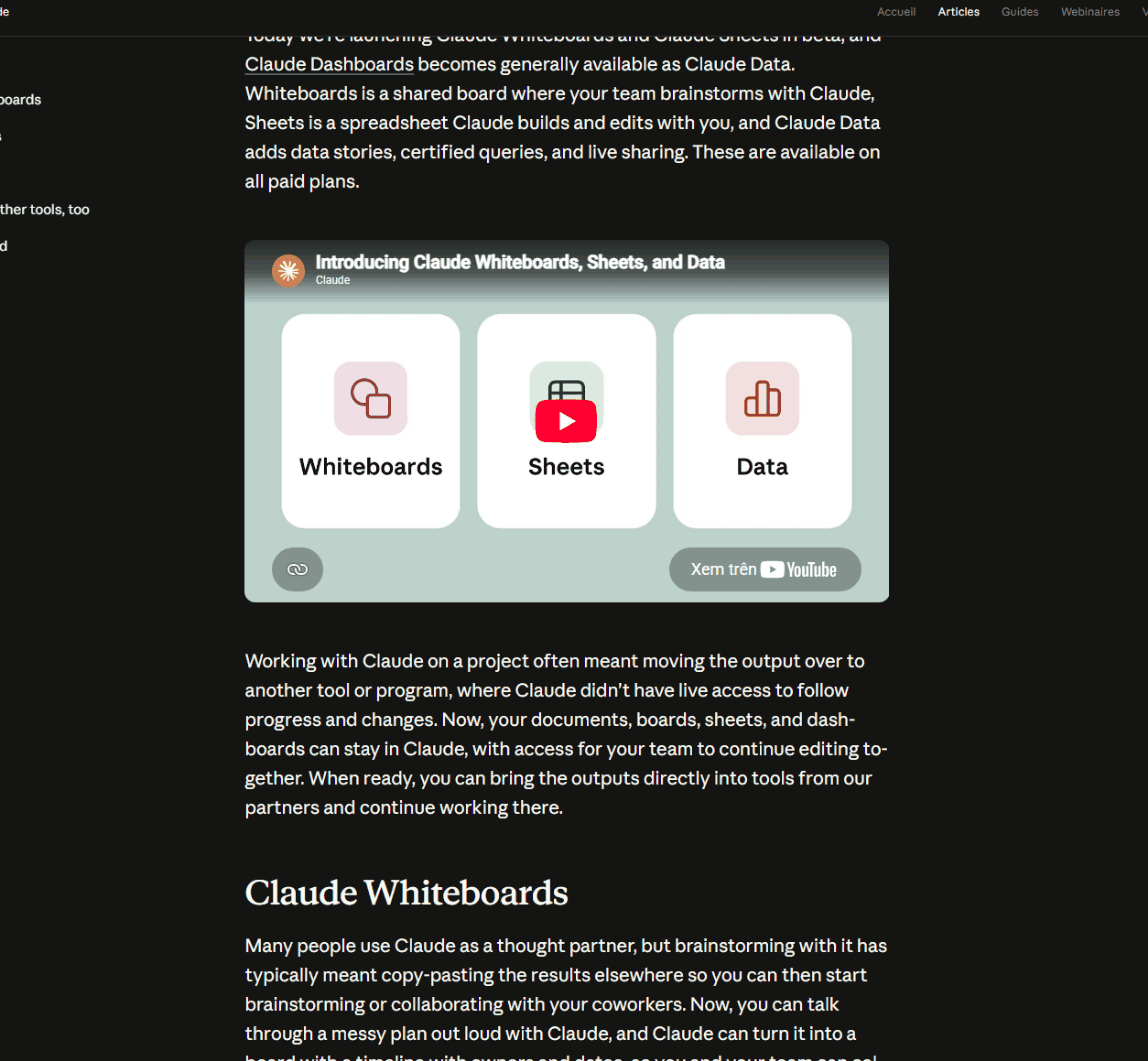
On November 10, 2026, Anthropic announced that Claude Whiteboards and Claude Sheets are launching in beta, and that Claude Dashboards, which started in beta in October, is now generally available under a new name, Claude Data. The company says all three are available on all paid plans and work on web, desktop and mobile. On the same day it published a second post saying that interactive connectors can now open as full apps beside the conversation, so a person and Claude can edit the same Notion page, Confluence page or Box file while both watch the changes appear.
The practical meaning is simple: a lot of work that used to end with “copy the answer into another tool” is now meant to stay inside Claude. Whether that is good for a team depends on what the team already uses, who administers it, and which switches are on or off by default. This article walks through what each product does according to Anthropic, what the announcement does not say, the one date admins should write down (November 19, 2026), and a checklist for deciding whether to turn any of it on.
Timeline
- October 2026: Claude Dashboards launches in beta, letting teams ask questions of company data in tools such as Amazon Redshift, BigQuery and ClickHouse (Anthropic’s description).
- November 9, 2026: Anthropic publishes the Claude Fable 5.2 and Mythos 5.2 model announcement, covered in our pricing and benchmarks analysis.
- November 10, 2026: Anthropic publishes “Introducing Claude Whiteboards, Claude Sheets, and Claude Data” and “Your apps can now open in Claude, and Claude can work in them”.
- November 19, 2026: per Anthropic, Claude Data turns on by default for Enterprise plans.
What each product does, according to Anthropic
Claude Whiteboards (beta)
Anthropic describes Whiteboards as a shared board where a team brainstorms with Claude. The example it gives is a messy plan talked through out loud, which Claude turns into a board with a timeline, owners and dates. In a retro meeting, everyone adds notes and Claude groups them by theme and drafts action items for each person. You can drag a box around part of the board and ask Claude questions about just that part. When the brainstorming is done, Claude can turn the board into a doc or a deck, or bring it into Lucid, Miro or Vani by Zoho to keep working there.
If you already pay for a dedicated whiteboard product, the comparison is not feature-for-feature yet, because this is a beta and Anthropic does not publish a feature matrix in the post. See our Miro review for what a mature whiteboard tool includes today.
Claude Sheets (beta)
Sheets is a spreadsheet that Claude builds and edits with you. Anthropic says Claude can generate spreadsheets with tabs, formulas, formatting and drop-downs, often from a one-line prompt such as a campaign tracker or a hiring budget. Claude can edit inside cells and outline each new edit so you can track changes, and sheets can be shared with teammates. Anthropic is candid about the limits: sheets have simple spreadsheet functionality for now, and when you need the full power of Excel you can export to .xlsx or CSV or use Claude for Excel. It also lists Airtable, Asana, monday.com and Smartsheet as partner tools where work can continue. Our monday.com review covers one of those.
Claude Data (generally available)
Claude Data is the new name for Claude Dashboards. Anthropic says it changed the name because company data use is broader than dashboards. It requires a data connector, such as a warehouse or CRM. The post lists these capabilities:
- Certified definitions: a data team can certify the queries everyone should use, and charts built on them carry a “certified” badge. Certified queries are in beta.
- Data stories: Claude can draft data stories or narrated videos from your metrics, for you to review before sharing.
- Live sharing (beta): colleagues see up-to-date numbers on a shared dashboard even without access to the underlying connectors. Anthropic says viewers see the results of approved queries and cannot run others with your access.
- Design systems: dashboards can match your look and feel.
- Caching: refresh cadences can be set per dashboard instead of reloading on every view.
- Tracked changes: you can see who edited a dashboard and roll back to a specific version.
Named partners for Claude Data are Amplitude, Mixpanel, Omni, PostHog and Sigma.
The second announcement: apps that open inside Claude
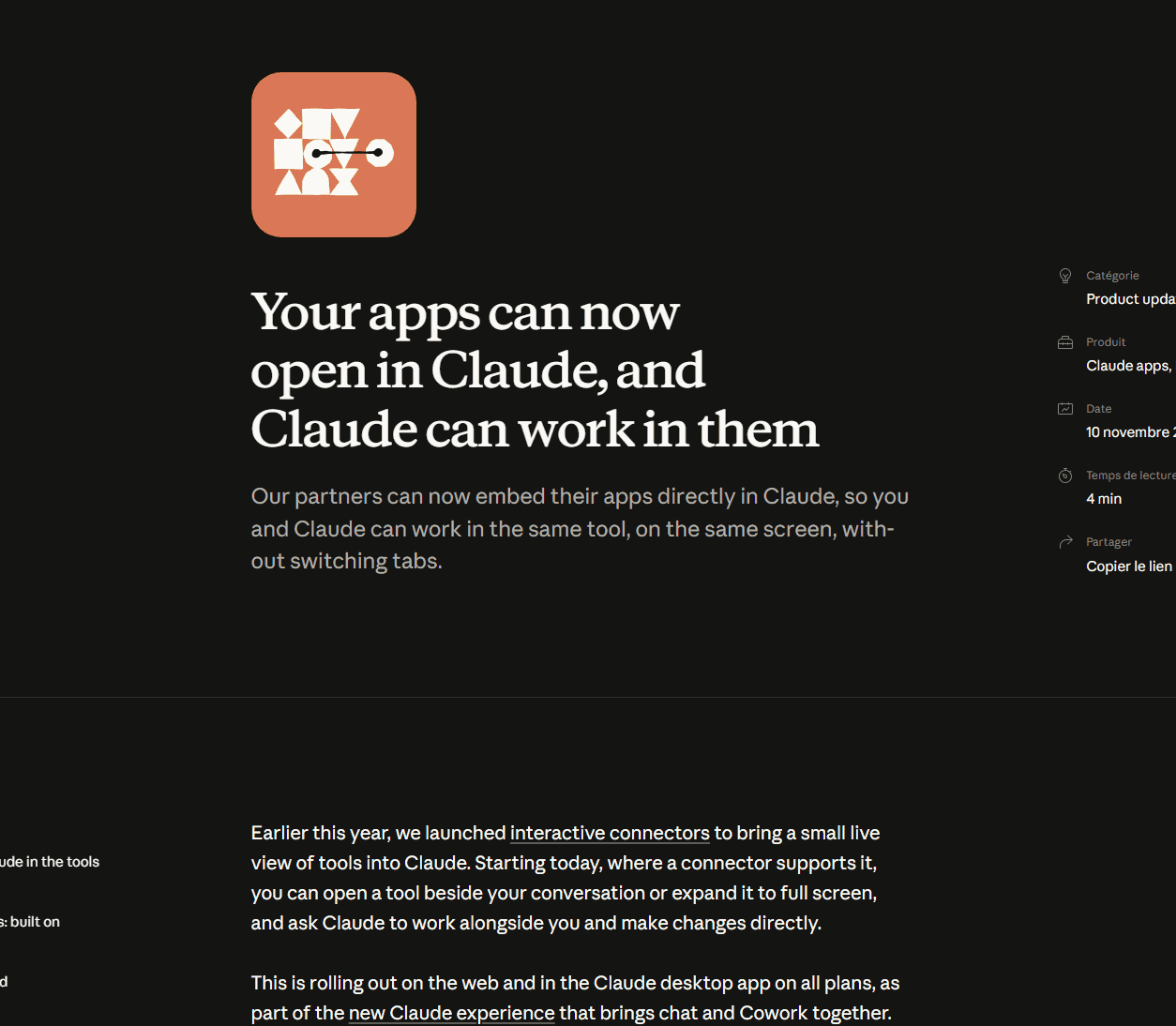
The companion post is about interactive connectors. Earlier in 2026 Anthropic launched connectors that show a small live view of a tool inside Claude. As of November 10, where a connector supports it, you can open the tool beside your conversation or expand it to full screen and ask Claude to make changes directly. Anthropic lists four changes: Claude can work in tools you have open, with its actions approved the same way connector actions are approved; the whole tool opens next to the conversation (for Confluence or Notion, the full editor signed into your own account rather than a limited preview); you can open a connected tool without writing a prompt; and you can pin frequently used tools in the sidebar and the plus menu.
Anthropic says it is starting with a small group of tools from its directory, including Asana, Canva, Carta, Dropbox, monday.com, Smartsheet, Vercel and Webflow. It gives examples for Adobe (photo edits, PDF highlight and redaction), Atlassian (Confluence pages), Box (revise a file and compare versions side by side), HubSpot (pipeline tasks and follow-ups) and Notion (docs and databases). Figma, Harvey and Shopify are described as building integrations. For developers, the feature runs on MCP Apps, an open extension to the Model Context Protocol, and support for the newer capabilities is in public preview. Anthropic also says rollout is on web and the desktop app on all plans, as part of the “new Claude experience” that brings chat and Cowork together, and that you see it once your account is updated or your organization turns it on.
Our own arithmetic (labelled as ours)
These numbers come from counting names on Anthropic’s two pages, not from any Anthropic statistic.
| Item | Count we got | How we counted |
|---|---|---|
| New or renamed products in the first post | 3 | Whiteboards (beta), Sheets (beta), Data (GA, renamed) |
| Partner tools named for continuing work or data | 12 | Lucid, Miro, Vani by Zoho; Airtable, Asana, monday.com, Smartsheet; Amplitude, Mixpanel, Omni, PostHog, Sigma |
| Additional tools named in the connectors post | 13 new names | Canva, Carta, Dropbox, Vercel, Webflow; Adobe, Atlassian, Box, HubSpot, Notion; Figma, Harvey, Shopify (Asana, monday.com and Smartsheet repeat) |
| Distinct third-party tools across both posts | 25 | 12 + 13 |
| Days from announcement to Enterprise default-on for Claude Data | 9 | November 19 minus November 10 |
The count of 25 is a reminder that the announcement is as much about integration surface as about new features. Several of those names, such as Figma, Harvey and Shopify, are described only as “building integrations”, so they are not usable yet according to the post.
Claimed by the company versus what we could verify
| Statement | Status |
|---|---|
| Whiteboards and Sheets are in beta; Claude Data is generally available | Stated on Anthropic’s page; we read the page but did not test the products |
| Available on all paid plans | Stated on the page; plan prices are not in the post and we did not verify them |
| Claude turns a messy plan into a board with owners and dates | Company description; no demo output published in the text we read |
| Viewers of a shared dashboard cannot run other queries with your access | Company statement about live sharing, which is itself a beta feature |
| Interactive connectors work with the tools listed | Company list; availability depends on your account update and organization settings |
| Admin defaults by plan | Stated on the page; check your own admin console before relying on it |
We have not signed in to these features, so nothing here is a hands-on review. Where we describe behavior, it is Anthropic’s description of that behavior.
The admin detail most people will miss
The “Getting started” section carries the part with real consequences. On Team plans, all three products are on by default. On Enterprise plans, Whiteboards and Sheets are off by default, while Claude Data turns on by default on November 19, 2026. Anthropic says admins can change these under Organization settings, in the Artifacts section, at any time. Claude Data also needs a data connector, so on its own it only matters to organizations that have already connected a warehouse or CRM.
This asymmetry is worth pausing on. A Team-plan account can have a shared whiteboard or sheet exist before anyone has discussed where it should live, who owns it, or what data it may contain. An Enterprise admin gets a longer runway, but the Claude Data switch flips on a fixed calendar date unless someone acts first.
Why this matters beyond Anthropic
Look at the two posts together and the strategy is visible. One post says documents, boards, sheets and dashboards can stay in Claude with team access. The other says other companies’ apps can open inside Claude. That is a bet that the place where a conversation happens should also be the place where the work product lives. For the vendors named, the trade is distribution: being one of the tools Claude can open and edit. For buyers, the trade is that one more layer sits between you and the tool you pay for, and that layer has its own permissions, its own change history and its own admin switches.
There is also a behavioral point. When copying output between tools is no longer necessary, the friction that used to give people a moment to review disappears. Anthropic says changes in an open tool appear as Claude makes them and that Claude’s actions are approved the way a connector’s actions are approved. That helps, but a team that wants a human check should decide in advance which actions require one, instead of discovering the default after something has changed.
Checklist before you turn anything on
- Find out your plan type. Team and Enterprise defaults differ, as above.
- Open Organization settings, then Artifacts. Confirm the current state of Whiteboards, Sheets and Claude Data and write it down.
- Put November 19, 2026 in the calendar if you are on Enterprise and have a data connector; decide before that date whether Claude Data should be on.
- Decide who owns a shared board or sheet. Sharing works with teammates, so name an owner and a place for approvals.
- Review connector permissions. The post says admins can restrict a connector’s tools as they do today; check whether any connector already allows all of its tools, because new features appear as they roll out in that case.
- Keep sensitive data out of a beta until you have tested it. Whiteboards and Sheets are labelled beta, and so are certified queries and live sharing in Claude Data.
- Test an export. Export one sheet to .xlsx or CSV and open it in the spreadsheet tool you already use, so you know how much survives.
- Compare against the tool you already pay for. A spreadsheet with “simple functionality” is not a replacement for a full spreadsheet product yet, by Anthropic’s own wording.
What to watch next
- Whether Anthropic publishes a feature list or limits page for Whiteboards and Sheets, including what “simple spreadsheet functionality” covers.
- Whether the named partners publish their own notes on how the embedded versions differ from the full products.
- How the public preview of MCP Apps capabilities develops, since that determines whether smaller vendors can follow.
- Any change to the November 19, 2026 Enterprise default for Claude Data.
- Independent hands-on tests from users who are on the new Claude experience, as opposed to company demos.
For related reading, see our earlier notes on Claude Fable 5.2 pricing and benchmarks, on Amazon’s Strands Decider and the 98 percent cost claim, and on Val Town winding down, which is a reminder to check export paths before depending on a young platform. Browse more in our news section and tool reviews, including Notion, Webflow and Figma.
Frequently asked questions
What did Anthropic announce on November 10, 2026?
Claude Whiteboards and Claude Sheets in beta, the general availability of Claude Dashboards as Claude Data, and the ability for interactive connectors to open as full apps beside the conversation.
Which plans include Whiteboards, Sheets and Claude Data?
Anthropic says all paid plans. The first post does not list prices, and we did not verify them.
Are they switched on automatically?
On Team plans all three are on by default. On Enterprise plans, Whiteboards and Sheets are off by default and Claude Data turns on by default on November 19, 2026, per Anthropic. Admins can change these in Organization settings under Artifacts.
Can Claude Sheets replace Excel?
Not yet, according to Anthropic, which says sheets have simple functionality for now and points to .xlsx or CSV export, or Claude for Excel, for full Excel features.
What does Claude Data need to work?
A data connector, such as a warehouse or CRM. The post names Amazon Redshift, BigQuery and ClickHouse as examples for the earlier Dashboards beta.
What are interactive connectors?
Connectors that open a tool inside Claude, beside the chat or in full screen, where you and Claude can both work. They run on MCP Apps, an open extension to the Model Context Protocol, and are rolling out on web and desktop on all plans once your account has the new Claude experience.
Is this a review of the products?
No. We read Anthropic’s pages and did not use the features, so we describe what the company says and flag what it does not say.
Sources and method
- Anthropic, “Introducing Claude Whiteboards, Claude Sheets, and Claude Data”, claude.com/resources/articles/sheets-whiteboards-data, dated November 10, 2026.
- Anthropic, “Your apps can now open in Claude, and Claude can work in them”, claude.com/resources/articles/interactive-connectors-full-tool, dated November 10, 2026.
- Hacker News front page, November 11, 2026, where the first post appeared with 190 points at the time we looked.
Method: we read both pages in full on November 11, 2026, captured the three screenshots above ourselves, counted partner names by hand, and compared dates by simple subtraction. Our browser was served a French-language shell around the English article text, so the screenshots show French labels such as the category and date fields. We did not sign in to any Claude feature.
Risk note
Beta features can change or be withdrawn, and defaults can differ by account and rollout stage. Check your own admin settings before relying on anything described here. This article is information, not purchasing or legal advice. ToolReviewHub may earn commissions from some tools reviewed elsewhere on the site; no affiliate link appears in this article, and the company named here did not pay for or review it.