Strawberry, zCAD AI, Moli and TheySaid: Four More New AI Tools Priced, and Two Roundup Entries Were Out of Date
Published November 23, 2026. A news analysis built from the official pricing pages of Strawberry, TheySaid, zCAD and Lexmount, the Moli repository on GitHub, and the Product Hunt weekly ranking for October 22 to 29, 2026 as summarized by the Shareuhack roundup. The screenshots are ours and were taken on November 23, 2026. This article contains no affiliate links and we have no commercial relationship with any company named here. ToolReviewHub is produced with the help of an AI assistant (Claude, made by Anthropic). One top-ten product that week, Claude Duet, is made by Anthropic and has no public pricing yet, so we left it out and say so here. We did not sign up for, install or test any of these tools: everything below is what the vendors’ own pages say, and numbers marked “ours” are our own arithmetic.
The short version
- What we looked at: four products from the top ten of Product Hunt’s week of October 22 to 29, 2026: TheySaid 4.0 (AI user testing, second with 366 upvotes), Strawberry 1.0 (a browser with AI “companions” that do work for you, fifth with 351), zCAD AI (editable CAD parts from a text prompt, sixth with 320) and Moli by Lexmount (an open-source headless browser for AI agents, eighth with 301). Upvote counts come from the Shareuhack roundup, not our own count.
- Two of the four roundup entries no longer match the vendors’ pages. The roundup says Strawberry’s free plan has 2,000 credits a month; the page now says 500. It gives TheySaid an Essential plan at $49 a month and a Pro plan at $149 a month; the page we read shows only a Free plan and a custom Enterprise plan. zCAD matched, and Moli’s hosted prices were not in the roundup.
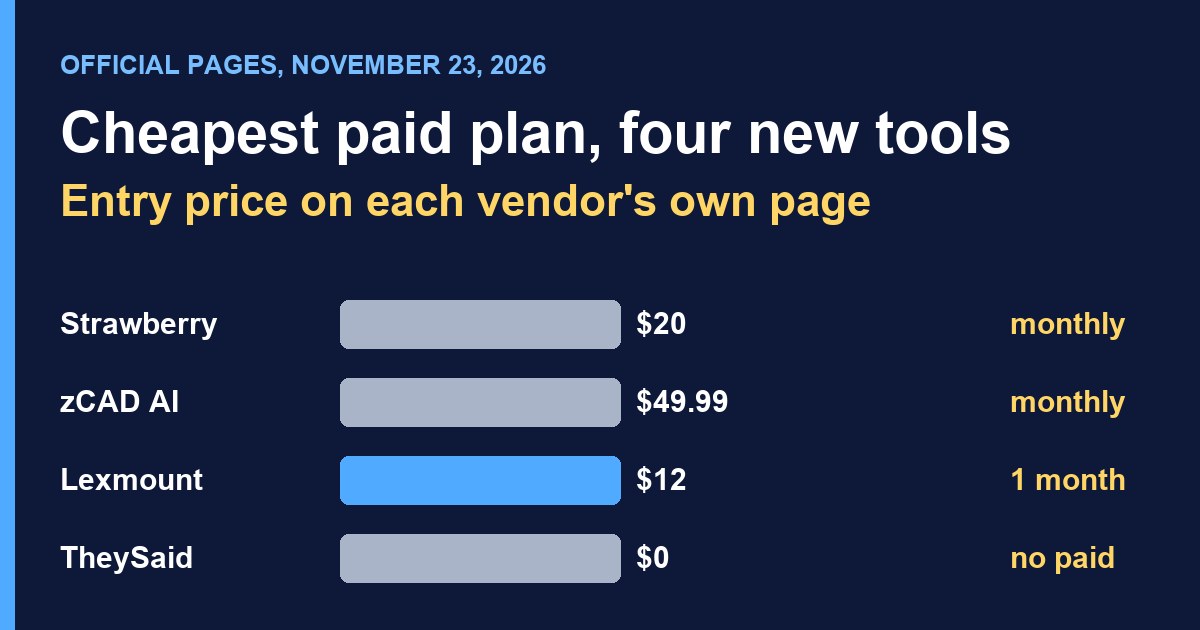
- Cheapest way in: TheySaid, zCAD and Strawberry have free tiers, and Moli is free to self-host. The cheapest paid plan is Lexmount’s Pro at $12 (listed as “one-time, 1 month”), then Strawberry’s Intern at $20 a month and zCAD’s Plus at $49.99 a month. TheySaid shows no self-serve paid plan.
- The number worth a second look: every paid Lexmount plan works out to the same $0.12 per browser hour (ours). Moving from $12 to $60 to $180 buys more concurrent browsers, CAPTCHA solves and profiles, not cheaper hours.
- What we could not do: sign in to any of the four, verify any speed or accuracy claim, or confirm whether Lexmount’s “one-time” plans renew.
How these four were picked
Product Hunt’s weekly ranking measures attention, not quality, payment or reliability, and the roundup says so itself. This is the fifth article in our series on recent top tens, after our pieces on RankSpot, Rakazo, Plurai and HiringNow, Creatify Max, YouArt, S.Space and Filament, Tobira, Dageno, AXL and Databox CLI and Scalekit, UnleashX, Wanaka and Screen Studio. From this week we took four whose pricing pages we could read without an account. We left out Claude Duet (see the note above), Product Hunt’s own launch editor (a feature, not a product), DeepCell (the roundup could not verify its pricing), MOVO AI (an app with in-app purchases), and Overmind and Agent Hunt, which we did not study. This site already carries reviews of TheySaid and zCAD AI, and their prices agree with what we found today.
| Product | What it says it does | Product Hunt week rank, upvotes | Entry price on its own page |
|---|---|---|---|
| TheySaid 4.0 | AI user tests, interviews and surveys, with real or synthetic testers | 2nd, 366 | Free; Enterprise custom |
| Strawberry 1.0 | A browser whose AI companions research, draft and do repetitive admin | 5th, 351 | Free (500 credits); $20/month |
| zCAD AI | Editable parametric 3D parts and assemblies from a prompt | 6th, 320 | Free (200 credits); $49.99/month |
| Moli by Lexmount | An open-source headless browser built for AI agents, plus a hosted cloud browser | 8th, 301 | Free to self-host; cloud from $12 |
TheySaid 4.0: a free plan, then a phone call
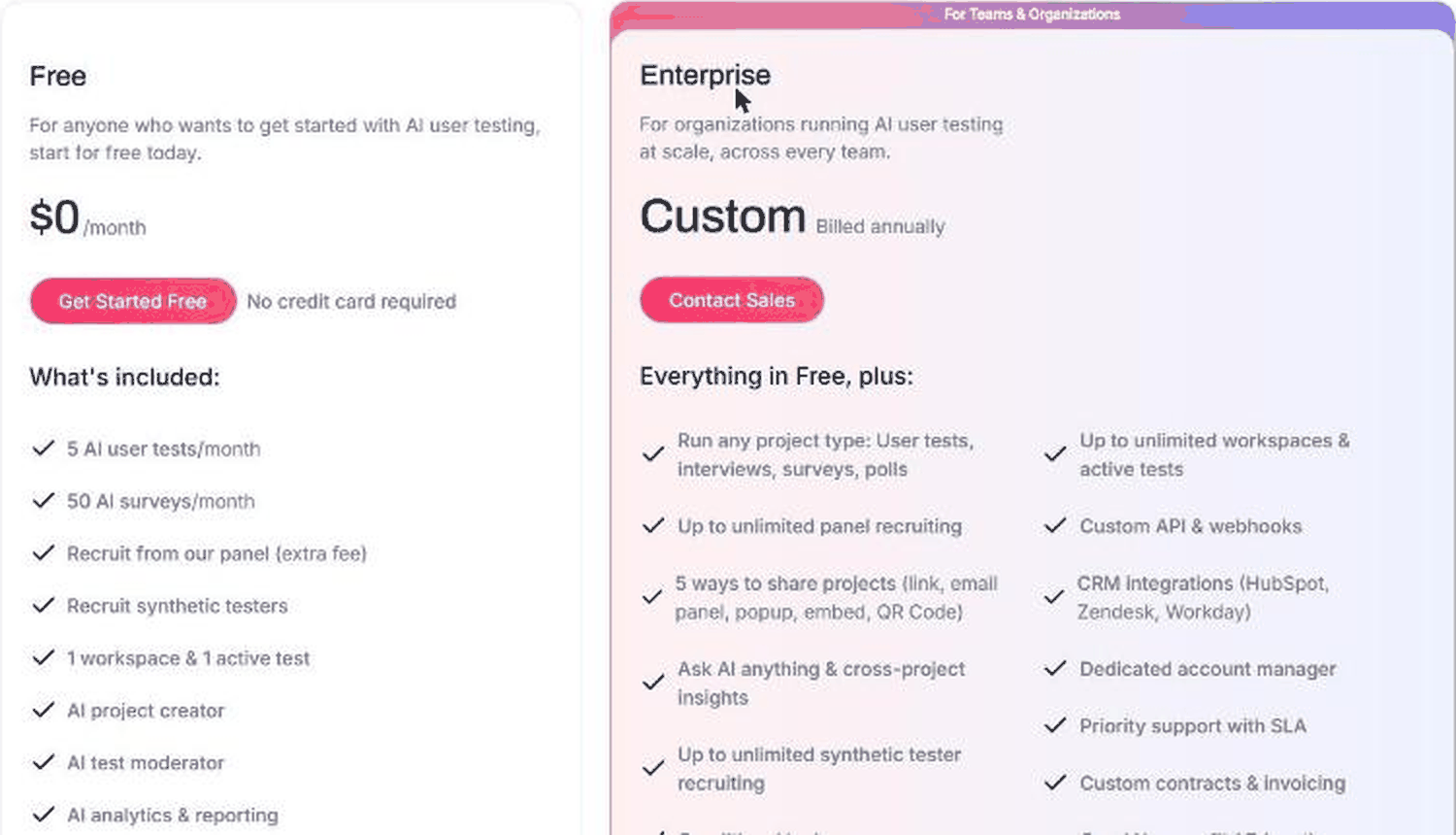
TheySaid sells AI-run user research: AI user tests, interviews, chats, polls and surveys, with an AI that moderates, analyzes and reports. Version 4.0, per the roundup, puts synthetic testers (AI personas trained to react like a customer group) into the planning, design and build workflow, as a way to get feedback before the code is finished. The pricing page says “Affordable, Transparent Pricing” and shows two columns.
| Plan | Price | What the page lists |
|---|---|---|
| Free | $0 a month, no card | 5 AI user tests and 50 AI surveys a month, recruiting from TheySaid’s panel for an extra fee, synthetic testers, 1 workspace and 1 active test, AI project creator, AI test moderator, analytics and reporting, shareable link |
| Enterprise | Custom, billed annually | Everything in Free plus every project type, up to unlimited panel and synthetic-tester recruiting, five ways to share, cross-project insights, conditional logic, templates, SSO and SAML, unlimited workspaces and active tests, API and webhooks, CRM integrations (HubSpot, Zendesk, Workday), a dedicated account manager, support with an SLA, custom contracts, and government, non-profit and education pricing |
The page adds a note that additional fees apply to recruit hard-to-find testers such as business people, owners and doctors.
What the numbers show (our arithmetic)
- There is no step between $0 and “contact sales.” The roundup lists Essential at $49 and Pro at $149. Figures like those appear on a third-party review site, which may describe the older TheySaid survey product, but we did not find them on the page we read. A small team that outgrows one active test and 5 tests a month has no published price to plan around.
- The free tier is tight by design. Five AI user tests a month is about one a week, and one active test at a time means you cannot run two studies side by side.
- Panel recruiting is where costs hide. Real testers cost extra on every tier, and harder-to-reach groups cost more. The page does not give a price list, so budget by asking.
What to check. A page that lists a free plan and a custom plan is not unusual, but it means you cannot compare TheySaid with a competitor by price alone. Ask what a panel test costs per participant, whether synthetic testers are included in the free allowance in practice, and how the vendor validates synthetic reactions against real ones. The roundup itself warns that synthetic users cannot replace real interviews, and we agree: use them to find obvious friction, then check with people. Also ask where your product screenshots and any customer data you upload are stored.
Strawberry 1.0: the free tier shrank, the top-up costs three times more
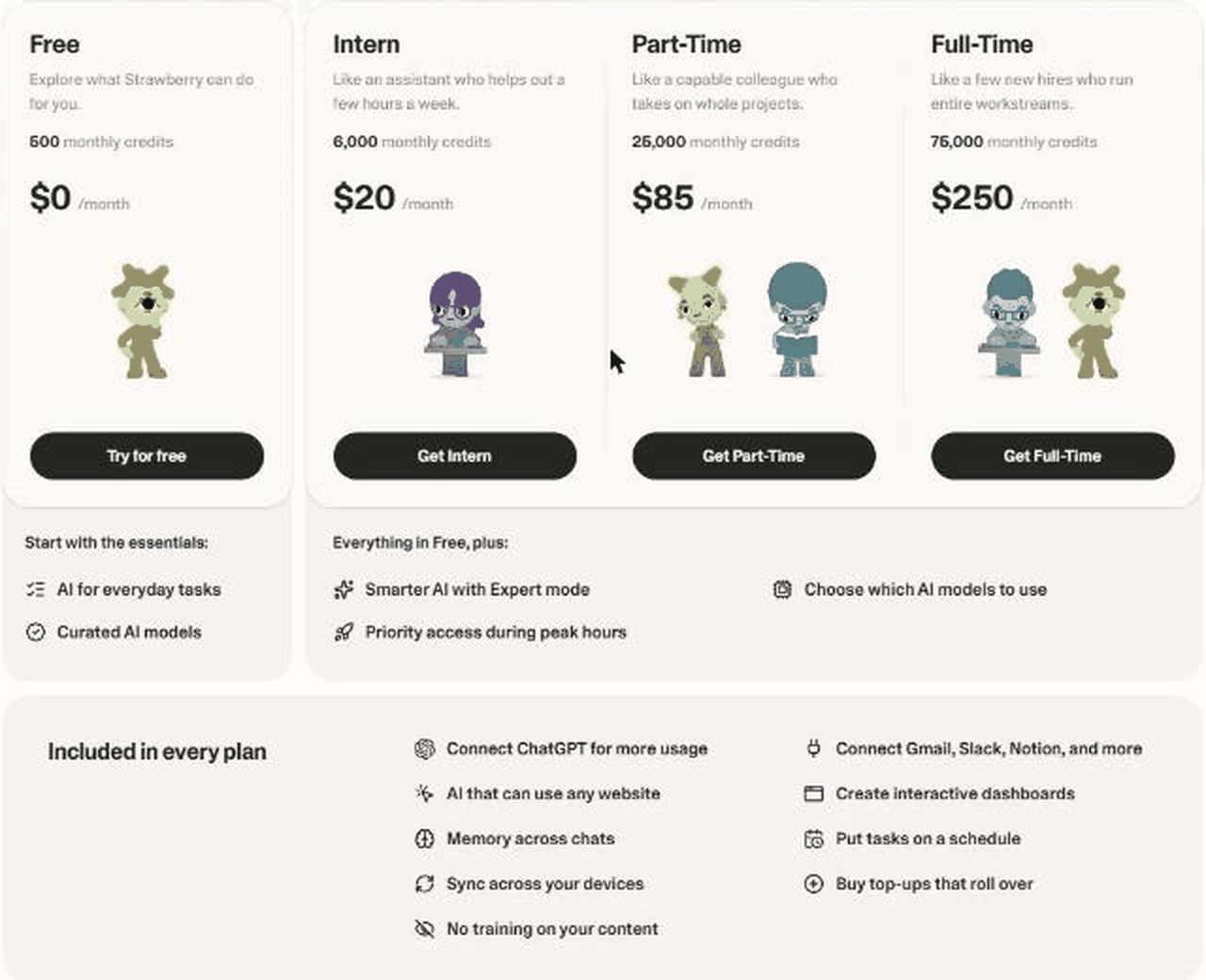
Strawberry is a browser built around “companions,” named AI helpers that can research leads, draft follow-ups, source candidates or handle repetitive admin by using any website for you. Every plan includes connections to Gmail, Slack, Notion and ChatGPT, memory across chats, scheduled tasks, interactive dashboards and a promise of no training on your content.
| Plan | Monthly billing | Annual billing (per month) | Credits a month | Our price per 1,000 credits (monthly billing) |
|---|---|---|---|---|
| Free | $0 | $0 | 500 | $0 |
| Intern | $20 | $17 ($200 a year) | 6,000 | $3.33 |
| Part-Time | $85 | $71 ($850 a year) | 25,000 | $3.40 |
| Full-Time | $250 | $208 ($2,500 a year) | 75,000 | $3.33 |
Paid plans add “Expert mode,” a choice of AI models and priority access at peak hours. The page says plan credits refresh monthly and do not roll over, and that extra credits can be topped up at $0.01 each, with purchased top-ups rolling over.
What the numbers show (our arithmetic)
- Top-ups cost about three times the plan rate. At $0.01 a credit a top-up is $10 per 1,000 credits, against $3.33 on Intern or Full-Time (ours). Choosing a plan that covers your normal month is much cheaper than topping up.
- The price per credit is flat across plans. $3.33, $3.40 and $3.33 per 1,000 credits means moving up buys volume and features, not a discount.
- Annual billing is two months free on every plan. Intern saves $40 a year, Part-Time $170 and Full-Time $500 (ours).
- The free tier is worth about $5 at top-up rates: 500 credits at $0.01.
What to check. The roundup says the free plan has 2,000 credits. Our own Strawberry review, which is written but not yet published, already lists 500, and the page shows 500. We could not load the documentation page that some listings cite for the older figure, so we do not know when the allowance changed, only that free users should expect 500 today. Credits are the unit to understand: ask what one lead-research task or one meeting summary costs in credits before you size a plan, because the page does not say. A browser that logs into your accounts and acts on any website needs the usual care: start with a throwaway or low-risk account, use the approval and permission settings, and review what it did before trusting it with email or CRM access.
zCAD AI: free STEP export, with a catch
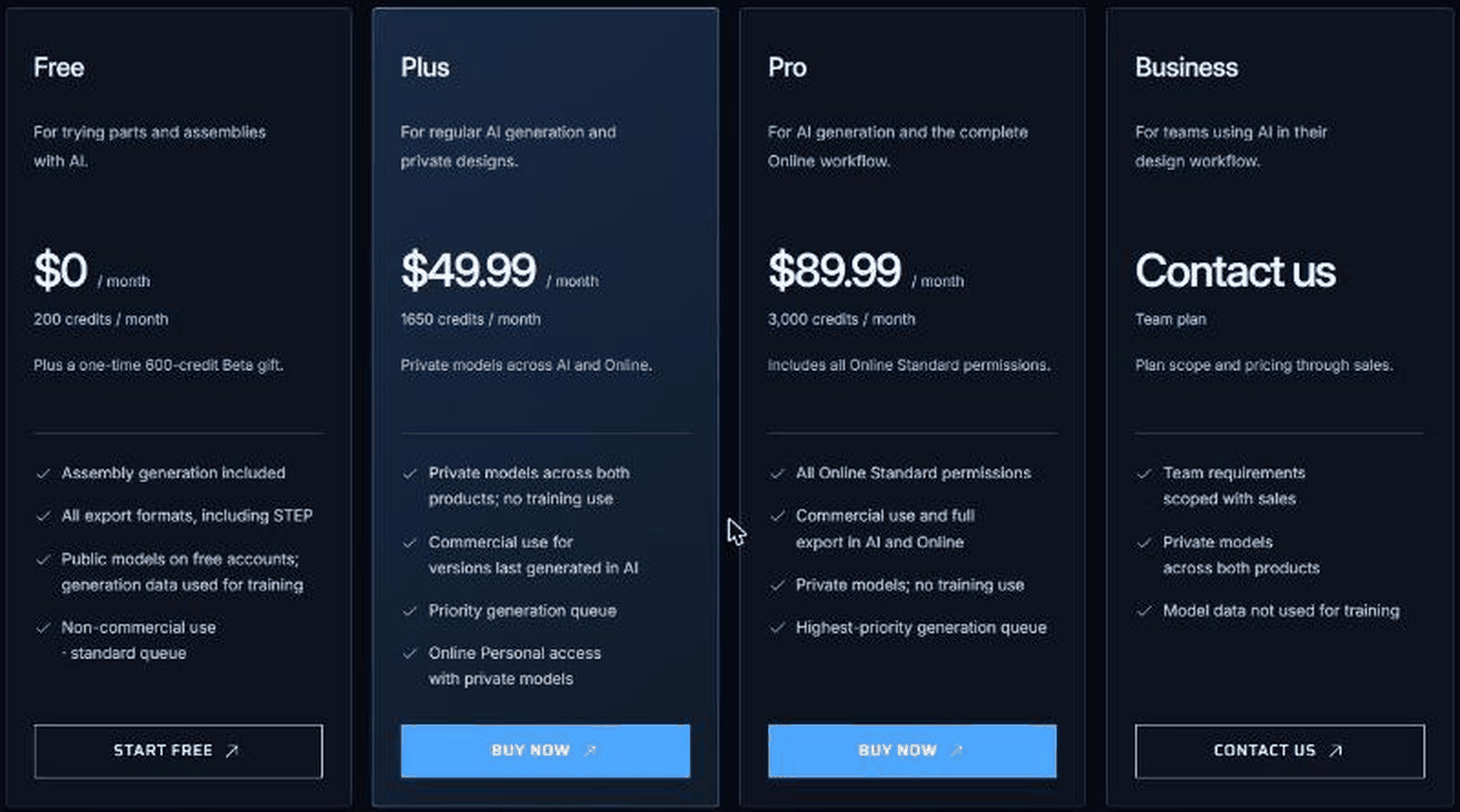
zCAD sells “one account, two products”: zCAD AI, which generates editable parametric parts and assemblies from an idea, and zCAD Online, a browser CAD tool for building, editing and collaborating. The two share AI credits. The pricing page we captured covers the AI plans.
| Plan | Monthly billing | Yearly billing | Credits a month | What changes |
|---|---|---|---|---|
| Free | $0 | $0 | 200, plus a one-time 600-credit Beta gift | Assembly generation and all export formats including STEP; public models, with generation data used for training; non-commercial use; standard queue |
| Plus | $49.99 | $499.99 (about $41.67 a month) | 1,650 | Private models, no training use, commercial use for versions last generated in AI, priority queue, Online Personal access |
| Pro | $89.99 | $899.99 ($75 a month) | 3,000 | All Online Standard permissions, commercial use and full export in AI and Online, highest-priority queue |
| Business | Contact sales | Contact sales | Scoped with sales | Team requirements, private models across both products, model data not used for training |
The page adds that all AI plans use the same generation model during Beta, and that monthly credits reset each month while the one-time Beta gift stays until used.
What the numbers show (our arithmetic)
- Plus and Pro buy the same credits per dollar. Plus is about 33 credits per dollar monthly (1,650 divided by $49.99) and Pro about 33.3 (3,000 divided by $89.99); on yearly billing both are close to 40. Pro’s extra $40 buys the Online workflow permissions, full export and top queue priority, not cheaper generation.
- Yearly billing saves about 17%: $99.89 a year on Plus and $179.89 on Pro, which matches the page’s “save about 17%.”
- Free to Plus is an 8.25 times jump in credits (200 to 1,650) for $49.99 a month.
What to check. The roundup says zCAD supports STEP export. That is true on the Free plan as well, but the Free plan is for non-commercial use, makes your models public and uses your generation data for training, according to the page. If you design parts for a client, you are in Plus or Pro territory, and even Plus limits commercial use to “versions last generated in AI.” Read the wording on what you may do with a model you edit afterwards. As with any generated engineering geometry, check dimensions and tolerances yourself before anything is manufactured.
Moli by Lexmount: an open-source browser engine and a hosted bill
Moli is Lexmount’s open-source browser for AI agents, described in its repository as the “best headless browser for AI agents” and, in its README banner, “structure first, pixels on demand.” The roundup’s summary is that it starts from the page’s DOM, text, links and interaction and asks for rendering or screenshots only when needed. Lexmount also sells a hosted service, Lexmount Browser, with cloud browser sessions and a web fetch API.
| Fact (GitHub, November 23, 2026) | What we saw |
|---|---|
| Repository | lexmount/moli, written in Rust, Apache-2.0 licence as shown by GitHub |
| Interest | 24,306 stars, 698 forks, 834 open issues |
| Created, last updated | August 10, 2026; last push November 23, 2026 |
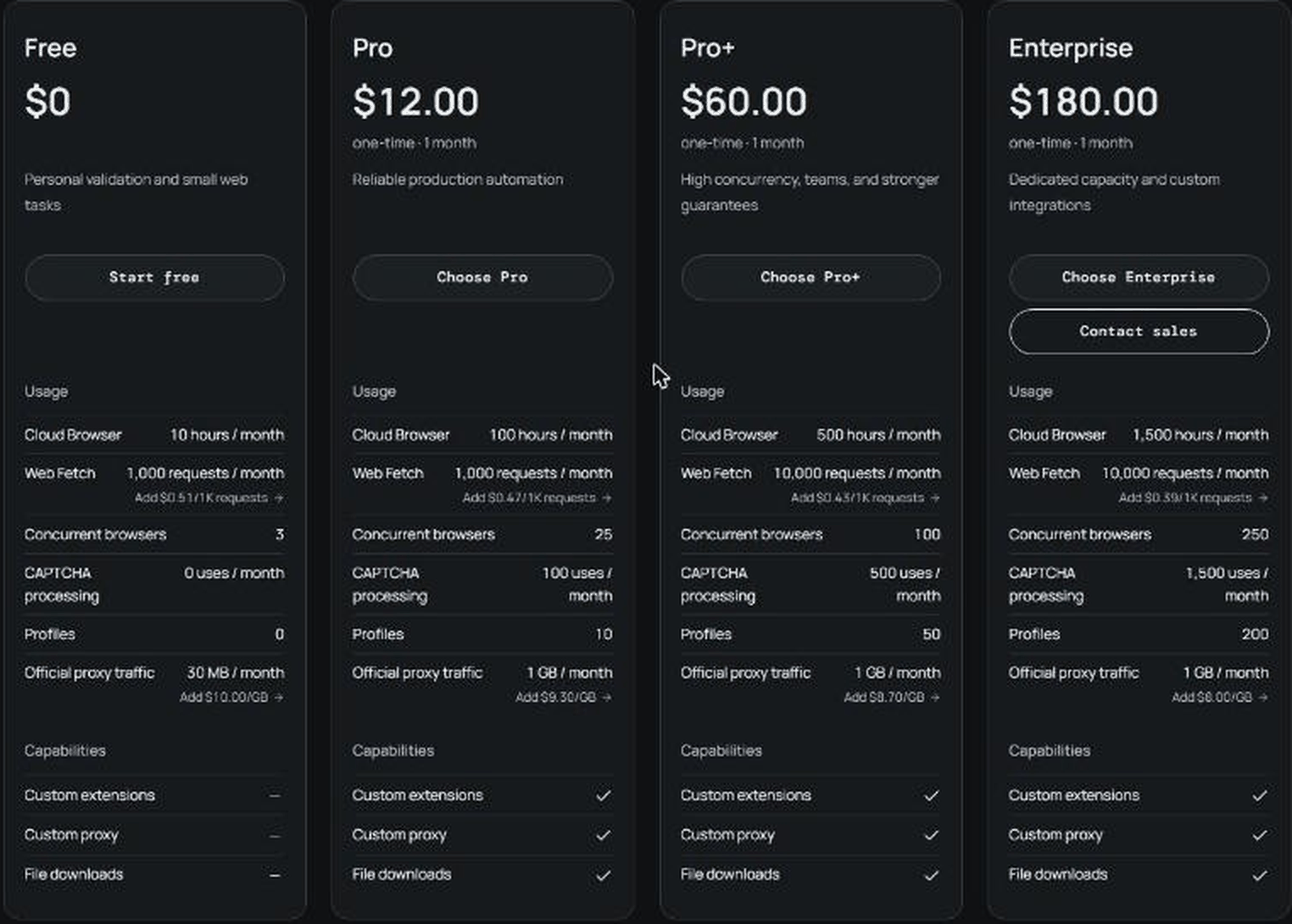
| Plan | Price | Cloud browser hours | Concurrent browsers | Web fetch requests a month | CAPTCHA, profiles | Proxy traffic |
|---|---|---|---|---|---|---|
| Free | $0 | 10 | 3 | 1,000 (extra $0.51 per 1,000) | 0, 0 | 30 MB (extra $10 a GB) |
| Pro | $12, “one-time, 1 month” | 100 | 25 | 1,000 (extra $0.47 per 1,000) | 100, 10 | 1 GB (extra $9.30 a GB) |
| Pro+ | $60, “one-time, 1 month” | 500 | 100 | 10,000 (extra $0.43 per 1,000) | 500, 50 | 1 GB (extra $8.70 a GB) |
| Enterprise | $180, “one-time, 1 month”; contact sales available | 1,500 | 250 | 10,000 (extra $0.39 per 1,000) | 1,500, 200 | 1 GB (extra $8 a GB) |
Custom extensions, custom proxy and file downloads are not included on Free and are included from Pro up. The pricing page also shows a GitHub star counter of 24.3k.
What the numbers show (our arithmetic)
- Every paid plan is $0.12 per browser hour. $12 for 100 hours, $60 for 500 and $180 for 1,500 all give $0.12. The higher plans add concurrency (25, 100, 250 browsers), more CAPTCHA solves and profiles, and bigger web fetch allowances.
- Concurrency gets pricier per slot. $12, $60 and $180 over 25, 100 and 250 concurrent browsers is $0.48, $0.60 and $0.72 per slot (ours).
- Overage falls with the plan: web fetch beyond the allowance goes from $0.51 per 1,000 on Free to $0.39 on Enterprise, and extra proxy traffic from $10 to $8 a GB.
- The stars grew fast. 24,306 stars in 15 weeks since the repository was created is about 1,600 a week on average (ours). Stars measure attention; the 834 open issues are a better hint of how much real use and rough edges there are.
What to check. Self-hosting the engine is free, but a browser for agents still means you run, patch and monitor it, and you carry the compliance risk of what your agents visit. The cloud plans are described as “one-time, 1 month,” and third-party listings call them “$12 a month.” We could not tell from the page whether a plan renews automatically or has to be bought again each month, so ask before you build a workflow on it. The roundup itself says the vendor advises testing compatibility on representative sites, which is the right instinct for any new browser engine: check login flows, dynamic pages and anti-bot walls on your real targets.
What the four have in common
1. “Free” keeps changing size. Strawberry’s free credits fell from the roundup’s 2,000 to 500; TheySaid’s listed paid plans disappeared into “contact sales”; zCAD’s free tier carries commercial and privacy limits. Read the limits next to the word.
2. Credits and hours are the unit of account. Strawberry and zCAD sell credits, Lexmount sells browser hours and fetch requests. A plan price tells you little until you know what one task consumes.
3. Higher tiers often buy capacity and rights, not a lower unit price. Lexmount’s hour price is flat, Strawberry’s credit price is flat, and zCAD’s Pro adds permissions and priority more than value per credit.
4. Agents are being given hands. A browser that acts on any website, a browser engine for agents and synthetic testers that speak for customers all push decisions to software. Permissions, logs and a way to take over are the real features to look for.
Checklist before you connect anything
- Open the vendor’s pricing page, check both billing toggles, and note the date.
- Find what one real task costs in credits, hours or requests.
- Check what the free tier does with your data: public models, training use, retention.
- Read what you may do commercially with generated output before you deliver it.
- Use a low-risk account or a test site for any tool that acts on your behalf.
- Ask whether a plan renews automatically or must be repurchased.
- Know how you stop and reverse an agent’s action before you start a large run.
What we could not confirm
- That any of the four works as described: we did not create an account, install or run them.
- When Strawberry cut its free tier from 2,000 to 500 credits, and what one companion task costs in credits.
- Whether TheySaid ever had the Essential and Pro plans the roundup lists, and what a panel test costs.
- Whether zCAD’s Free plan data and licence terms change after Beta.
- Whether Lexmount’s “one-time, 1 month” plans renew, and the compatibility of Moli on real-world sites.
- Product Hunt rankings, which come from the Shareuhack roundup, and any funding or company detail not on the vendors’ own pages. We read the pages from Vietnam, so prices shown to you may differ by region.
Frequently asked questions
How many free credits does Strawberry give?
The pricing page we read says 500 monthly credits on the Free plan. Plan credits refresh monthly and do not roll over, and top-ups are $0.01 a credit.
Does TheySaid have paid plans?
Its pricing page lists a Free plan and a custom Enterprise plan billed annually. Some third-party sites list Essential and Pro plans, but we did not find them on the vendor’s page.
Can I export STEP files from zCAD for free?
Yes, the Free plan lists all export formats including STEP, but with non-commercial use only, public models and generation data used for training.
Is Moli free?
The engine is open source under the Apache-2.0 licence on GitHub. Lexmount’s hosted cloud browser has a free tier with 10 browser hours a month and paid plans from $12.
Which of the four is the lowest-risk to try?
zCAD’s free plan on a non-commercial test part and Lexmount’s free tier on a test site cost nothing. TheySaid’s free plan is safe for a first look if you upload nothing confidential. A browser that acts on your accounts, like Strawberry, deserves a throwaway account first.
Method: figures come from the vendors’ public pages and the Moli GitHub repository on November 23, 2026; our screenshots show the pages that day. Product Hunt data is from the Shareuhack weekly roundup for October 22 to 29, 2026. Calculations marked “ours” divide the prices shown by the quantities shown and exclude taxes, add-ons and overage unless stated. For how we research, see How We Review Tools.