Java4Shell (CVE-2026-114938): Which OpenJDK Builds Are Affected and What to Check Today
Updated November 18, 2026. A news analysis built from the Calif.io write-up “Java4Shell: Write once, RCE everywhere”, the OpenJDK Vulnerability Advisory dated 2026/11/17, Oracle’s Critical Security Patch Update Advisory for November 2026, our own screenshots of all three and the Hacker News front page. Disclosure: the research and drafting tools we use for these articles include Claude from Anthropic, and the researchers behind this bug say they used OpenAI’s Codex. We therefore rely on the primary pages, quote only short phrases and label every number we compute as ours. We did not run any exploit, did not run the proof-of-concept and did not test any product. This is not security, legal or purchasing advice.
The short version
On November 17, 2026, the security firm Calif.io disclosed Java4Shell, tracked as CVE-2026-114938: a memory-corruption bug in the optimized Base64 decoder that OpenJDK’s HotSpot virtual machine generates for certain x86-64 processors. Calif says a remote attacker with no credentials can overwrite heap memory, read it back in the style of Heartbleed and reach remote code execution, and that it scored 9.2 out of 10 (CRITICAL) under CVSS 4.0. OpenJDK’s own advisory scores the same CVE 8.1 under CVSS 3.1 and marks it as affecting JDK 17, 21, 25 and 27.
The detail that decides whether a given server is exposed is hardware. Calif writes that the vulnerable code only runs on x86-64 processors with AVX-512 VBMI support, and that ARM64 chips are not affected. If your Java runs on ARM, or on an older Intel or AMD server without those instructions, this particular bug is not reachable through that code path, according to the researchers. If it runs on a recent Xeon or EPYC, read on.
The Hacker News submission of the Calif page had 964 points and 246 comments when we scanned the front page on November 18, which is why we are covering it. Below we separate what the primary pages say, what we checked ourselves and what we could not confirm.
Timeline
- November 17, 2026, 1:00pm PT: according to Calif, OpenJDK released a security advisory and Oracle released a patch at this time. The OpenJDK advisory page we read carries the stamp “Last update: 2026/11/17 17:44 UTC”, which is earlier than 1:00pm PT (21:00 UTC). We do not know why the two times differ and we draw no conclusion from it.
- November 17: Calif’s write-up appears, with a demo video and a proof-of-concept that Calif says is safe to run. Application-specific exploits are, in Calif’s words, held back “until everyone has had a chance to upgrade”, and the firm says it will publish them later.
- November 18: the story reaches the Hacker News front page. Oracle’s November 2026 Critical Security Patch Update, which we read the same day, lists 655 new security patches across its product families.
What the bug is, in plain language
Base64 is a way of writing binary data as text. It appears in login protocols, file uploads and network messages, which is why a flaw in a Base64 decoder is more serious than it sounds. To decode it quickly, OpenJDK’s just-in-time compiler can switch to a hand-written routine that uses AVX-512 VBMI instructions to process 64 bytes at a time. Calif says the bug sits in the part of that routine that handles the last few characters.
When the input ends in padding characters, the routine subtracts from the expected output length. For some short tails that length becomes zero and then underflows to a negative number, and the mask that decides how many bytes the instruction may write turns into “all 64”. Java later rejects the input with an exception, but by then neighbouring objects on the heap may already have been overwritten. In Calif’s example the result array is 50 bytes long and the write lands 62 bytes past its end.
We checked that arithmetic ourselves with the numbers in the write-up: the decoded buffer length is the input length divided by 4, rounded up, times 3, minus the padding bytes, so a 65-character input with one padding character gives 17 times 3 minus 1, which is 50 bytes. The vector write starts at offset 48 and is 64 bytes wide, so only 2 of its bytes fall inside the buffer and 62 fall outside. The figures in the write-up are internally consistent. We have not reproduced the overwrite, and we deliberately do not print the trigger input here.
One more condition from Calif’s technical section matters for defenders: the fast path is only used after the method has been compiled by the C2 compiler, which happens after the decoder has been called many times. Calif describes a “warm-up” stage in which the attacker sends valid data until the optimized path is selected. Applications that never decode much Base64 may never get there on their own, but a remote attacker can supply the volume if the application exposes a decoder.
Who is affected
There are three statements to line up, and they do not use the same wording.
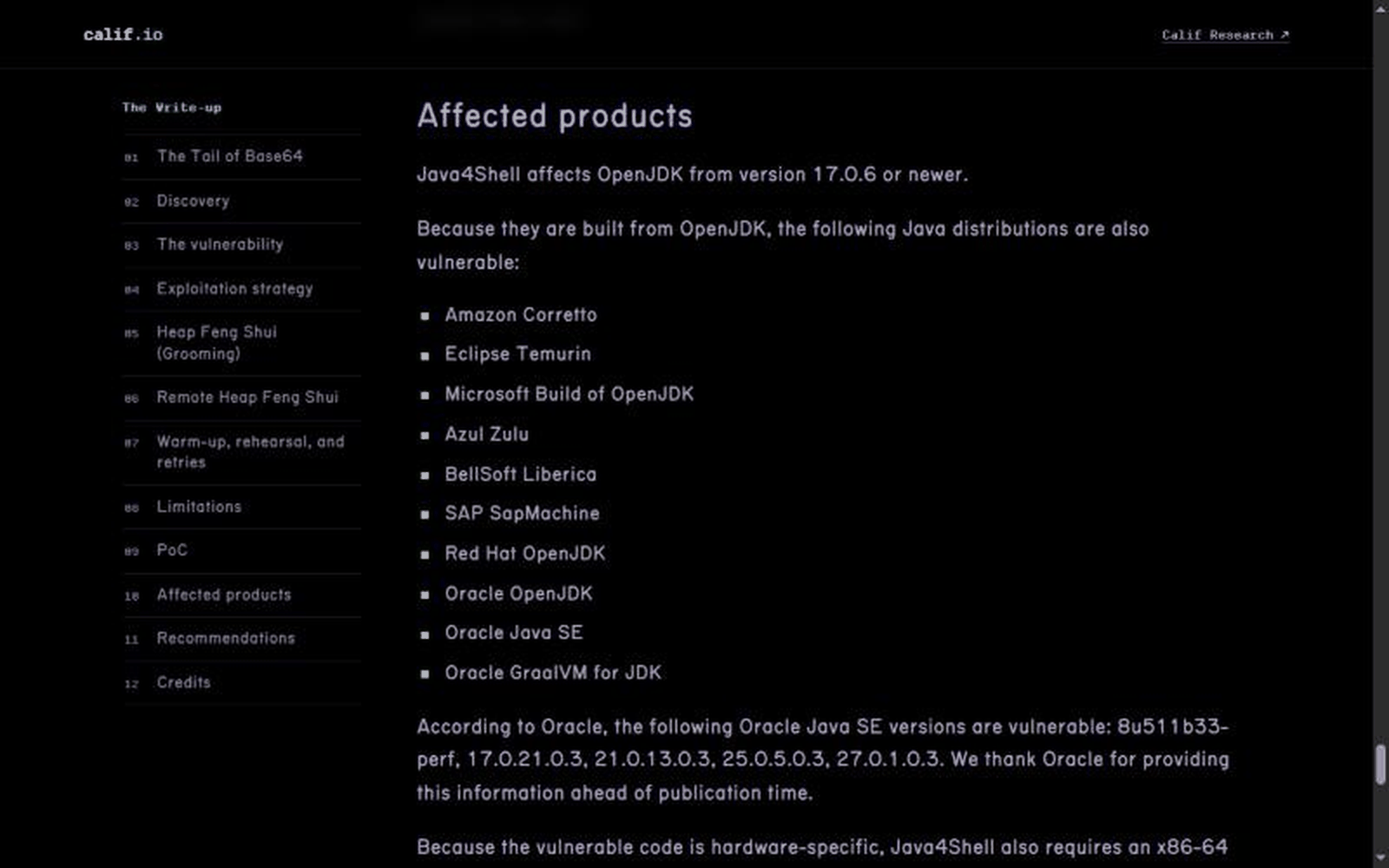
- Calif: “Java4Shell affects OpenJDK from version 17.0.6 or newer.” It adds that builds derived from OpenJDK are also vulnerable and names Amazon Corretto, Eclipse Temurin, Microsoft Build of OpenJDK, Azul Zulu, BellSoft Liberica, SAP SapMachine, Red Hat OpenJDK, Oracle OpenJDK, Oracle Java SE and Oracle GraalVM for JDK.
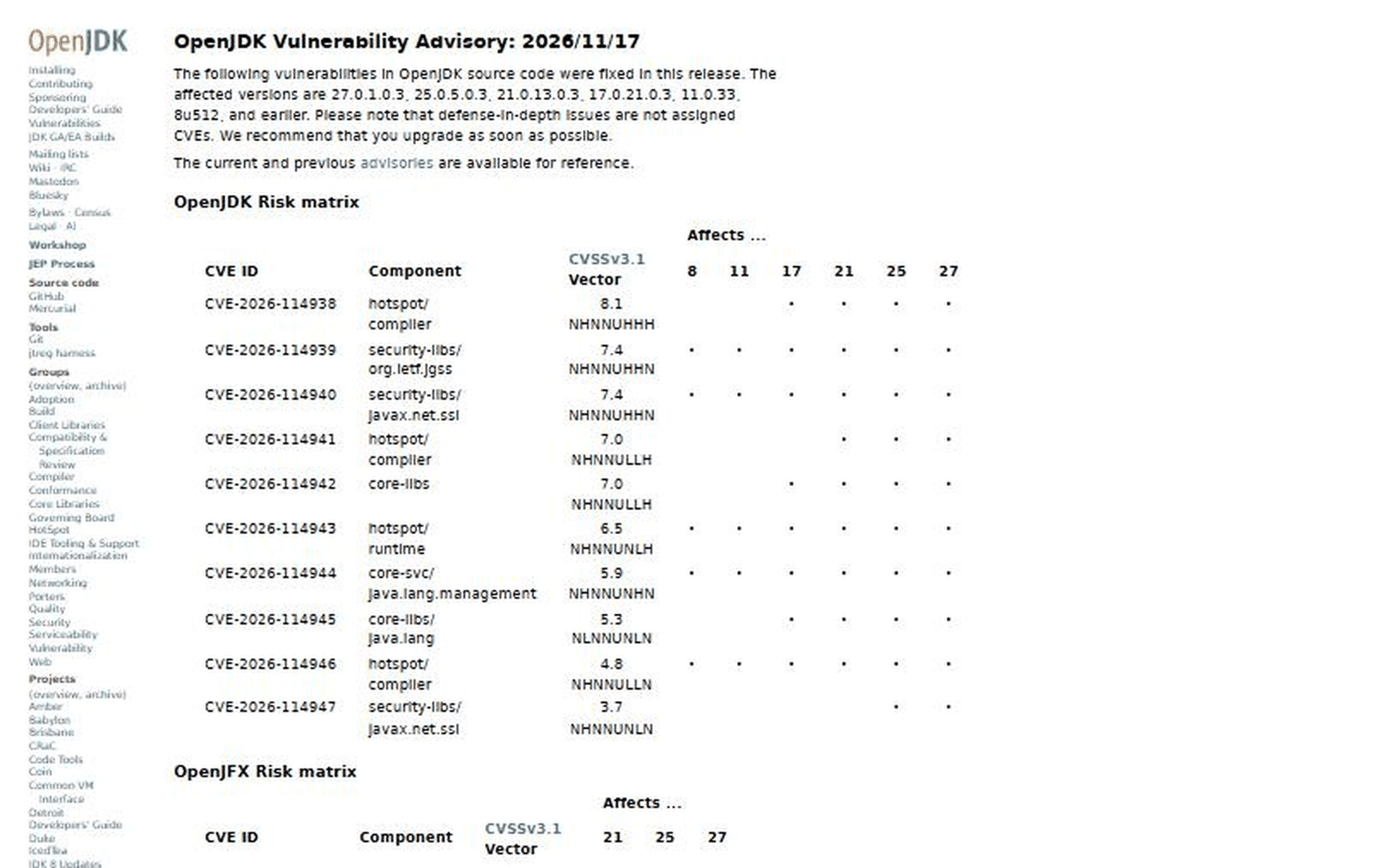
- OpenJDK advisory: the affected versions of the release are listed as 27.0.1.0.3, 25.0.5.0.3, 21.0.13.0.3, 17.0.21.0.3, 11.0.33 and 8u512 “and earlier”. In the risk matrix, the row for CVE-2026-114938 (component hotspot/compiler, CVSS 3.1 score 8.1) has markers under 17, 21, 25 and 27 and none under 8 or 11.
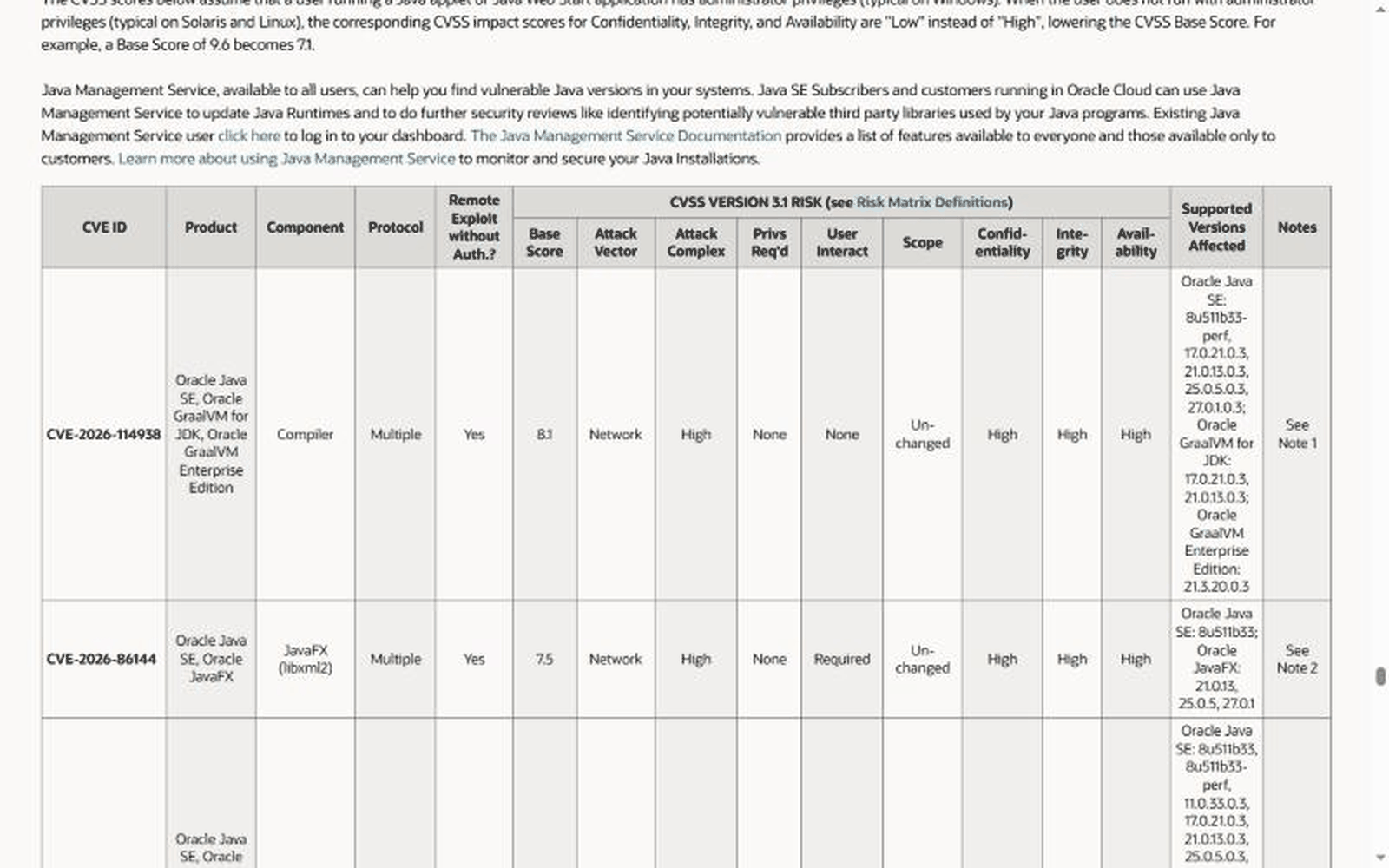
- Oracle: the Java SE risk matrix lists Oracle Java SE 8u511b33-perf, 17.0.21.0.3, 21.0.13.0.3, 25.0.5.0.3 and 27.0.1.0.3, Oracle GraalVM for JDK 17.0.21.0.3 and 21.0.13.0.3, and Oracle GraalVM Enterprise Edition 21.3.20.0.3, and marks the flaw as remotely exploitable without authentication.
The practical reading, which is ours: JDK 17, 21, 25 and 27 on x86-64 hardware with AVX-512 VBMI are the builds to worry about first. Oracle’s 8u511b33-perf entry is the only Java 8 build named for this CVE, and OpenJDK’s matrix has no marker under 8, so it does not mean every Java 8 installation is affected.
The hardware condition
Calif names the mainstream processor families that meet the requirement: Intel Xeon Ice Lake, Sapphire Rapids, Emerald Rapids and Granite Rapids, and AMD EPYC and Ryzen Zen 4 or newer. On Linux it gives this command, and says the output must include all four flags:
grep -m1 '^flags' /proc/cpuinfo | tr ' ' '
' | grep -E '^(avx512f|avx512bw|avx512vbmi|bmi2)$'
Two cautions from us. First, virtual machines and containers inherit the host’s flags, so run the check inside the environment where the Java process actually runs, not on a laptop. Second, cloud fleets are often mixed: the same service can run on a Sapphire Rapids instance in one availability zone and an older generation in another. A clean result on one node says little about the others.
What Calif says it demonstrated, and what it does not say
Calif reports remote code execution in default configurations of several widely deployed Java applications. Without authentication: Keycloak, Atlassian Jira, Atlassian Confluence, JFrog Artifactory, Jenkins and PingFederate. After authentication: Apache Kafka Broker, Apache Solr, Elasticsearch, Gerrit and Spinnaker. It calls the lists non-exhaustive and adds sample applications built on Apache Struts and Spring Boot. A second researcher, named as samczsun, is credited with a client-side exploit in which a Java program that opens a TLS connection to a malicious server can be compromised even if it exposes no service.
The same write-up is clear about limits, and they are worth reading before panicking:
- “There is no universal exploit.” Each target needs its own profile: a decoder route, a writable object, a way to read data back, a heap layout and an application action.
- The attack is “sensitive to network conditions, like RTT and jitter”. Calif says it rented a virtual machine in the same region as its target to get stable timing, and that an incorrect placement can crash the JVM, although in many cases the attacker can try again.
- Some of the grooming profiles need partial request bodies to reach the application, so a proxy that waits for the whole body removes their timing. Calif notes that nginx buffers request bodies by default, but also says request buffering “is not a general mitigation”: Elasticsearch runs from one complete request, and after a WebSocket upgrade later frames pass through the tunnel without buffering.
- The exploits for individual products are not public yet. That is a window, not a guarantee: the write-up documents the method, and the firm says it will publish the chains later.
None of the three pages we read claims that Java4Shell has been exploited in the wild. They also contain no statement from Keycloak, Atlassian, JFrog, Jenkins, Ping Identity, Apache or Elastic, and we did not look for vendor advisories for those products. Treat the product list as Calif’s claim about its own testing until each vendor says otherwise.
Two scores for one bug
Calif reports CVSS 4.0 9.2 (CRITICAL). The OpenJDK advisory and Oracle both report CVSS 3.1 8.1. These are different versions of the scoring system, so the numbers are not directly comparable and are not a contradiction by themselves. The 3.1 vector on the OpenJDK page reads NHNNUHHH, and Oracle’s table spells it out in words: network attack vector, high attack complexity, no privileges, no user interaction, unchanged scope, and high impact on confidentiality, integrity and availability. High attack complexity is consistent with Calif’s own limits above. We did not recompute the 4.0 score and do not know how Calif arrived at 9.2.
For context, the same OpenJDK advisory lists ten OpenJDK CVEs plus one OpenJFX CVE. The other nine OpenJDK scores are 7.4, 7.4, 7.0, 7.0, 6.5, 5.9, 5.3, 4.8 and 3.7, so CVE-2026-114938 has the highest 3.1 score of the OpenJDK group in this release, ahead of the OpenJFX entry at 7.5. If you are patching anyway, the remaining nine are fixed in the same release.
One small oddity we noticed: Oracle’s credit statement lists Albert Yang for CVE-2026-114938, while Calif credits the research to Quang Luong. The OpenJDK advisory thanks both names in a general list without saying which report maps to which CVE. We cannot tell from public pages whether these were two independent reports of the same flaw, and we draw no conclusion.
The AI angle, with its limits
Calif says Quang Luong asked Codex to audit areas such as the JIT compiler, intrinsics and cryptography, that most early results were “slops”, and that after about 20 minutes of persistence Codex returned the Base64 finding. Calif then writes that it took one hour to discover the vulnerability and two more hours to build the first working exploit, with a total token cost of less than $200. By our arithmetic, that is a ceiling of roughly $67 per hour if all of the spend fell inside those three hours, which the write-up does not say. It also notes that the exploit work involved prepared pipelines and human direction, and calls the result the work of a “centaur hacker”, part human and part AI.
That is a security firm describing its own research, in a write-up that also promotes its method, and the New York Times story it links to is one we did not read. Calif itself points to two earlier disclosures, PHP2Shell and Squidbleed. The cost and time figures are self-reported and we cannot verify them. The defensive lesson does not depend on them: if finding such bugs gets cheaper, the interval between a public patch and a working attack against unpatched servers is likely to shrink.
What to check today
- Inventory your Java. List every host, container image and appliance running a JDK 17, 21, 25 or 27, including bundled runtimes inside products such as Jenkins, Confluence, Keycloak, Elasticsearch and Kafka. Vendors often ship their own JDK, so the system Java may not be the one that matters.
- Check the CPU. Run Calif’s flag check inside each environment. Hosts that return all four flags are your priority list; hosts that do not are, per the write-up, outside this bug’s code path.
- Apply the mitigation while you wait for your vendor’s build. Calif gives two options: start the JVM with -XX:-UseBASE64Intrinsics to disable the hardware-accelerated Base64 routines, or with -XX:UseAVX=2 to disable AVX-512. It warns to apply the second flag only on x86-64 hosts, because OpenJDK on ARM does not recognize it and will fail to start. Neither source quantifies the performance cost, so test it on a staging copy first. A flag set in one place does not reach other launchers, so check how each product starts its JVM.
- Do not rely on request buffering. It may disrupt some of the demonstrated chains, but Calif says it is not a general mitigation.
- Upgrade and then verify the build. Both advisories list the November 2026 levels with the words “and earlier” (OpenJDK) or as affected versions (Oracle). Our reading is that a build at those levels is still affected and that the fix ships in a newer build. When we queried Adoptium’s public API on November 18 for the latest Temurin Linux x64 JDKs, the newest builds for 17, 21 and 25 were 17.0.21+9, 21.0.13+9 and 25.0.5+8, all dated October 22, which are the same update levels the advisories list as affected. The newest 27 build was 27.0.1.1+4, dated November 18, and we did not verify whether it carries the fix. Read your distribution’s release notes for CVE-2026-114938 before assuming a version number is safe.
- Rebuild container images. A base image that bundles a JDK keeps the old runtime until you rebuild and redeploy it.
- Watch your edge. The unauthenticated products in Calif’s list are often internet-facing identity, build and collaboration servers. If you cannot patch or mitigate one of them today, reduce its exposure and review recent logs for unusual Base64 payloads followed by crashes or restarts of the Java process. Crashes are one of the failure modes Calif describes.
If you operate on ARM, for example Graviton or Apple silicon hosts, the write-up says you are not affected by this bug, but the same OpenJDK release contains nine other CVEs, so you should still schedule the update.
What we could not confirm
- Whether any vendor has shipped a build that fixes CVE-2026-114938 for each major distribution, and which version numbers those are.
- Whether Keycloak, Jira, Confluence, Artifactory, Jenkins, PingFederate, Kafka, Solr, Elasticsearch, Gerrit or Spinnaker have published their own guidance.
- Whether the mitigation flags change performance in practice.
- Whether anyone has used the bug against real targets. The pages we read do not say so, and absence of a claim is not proof of absence.
- How Calif’s 9.2 CVSS 4.0 score was computed, and the reason for the difference in credit between Oracle’s page and Calif’s.
Frequently asked questions
Is every Java application vulnerable?
Not according to the sources. Calif says the flaw needs OpenJDK-derived HotSpot, a version from 17.0.6 onward, an x86-64 processor with AVX-512 VBMI and a path that decodes attacker-influenced Base64 data. Each missing piece removes the exposure, but a recent Xeon or EPYC server running a current JDK satisfies the first three.
Does disabling AVX-512 or the Base64 intrinsic fix it?
Calif presents both flags as mitigations, not fixes. They stop the vulnerable routine from being used, but the code remains in the runtime until you upgrade.
Where can I read the sources?
The Calif.io write-up at calif.io/java4shell, the OpenJDK advisory at openjdk.org/groups/vulnerability/advisories/2026-11-17 and Oracle’s advisory at oracle.com/security-alerts/cspunov2026.html. We also queried Adoptium’s public release API for the Temurin version numbers above.
More Security and Infrastructure News
- Quad9 Leaves France on November 24: What Changes for DNS Users and What to Check Now
- NGINX HTTP/2 Remote Code Execution Flaws: Affected Versions, Fixes and What to Check Today
- PHP 8.6 Is Out and PHP 8.2 Loses Security Support on December 31: What WordPress Site Owners Should Check
- OpenSSL CVE-2026-121481: A 9.8 in NVD, a Fix Still in Review and No Advisory on OpenSSL’s Own Page
- Synology DSM Critical Flaw CVE-2026-120382: Deactivate OAuth Service Now, Fixed Builds Due by November 20