NGINX HTTP/2 Remote Code Execution Flaws: Affected Versions, Fixes and What to Check Today
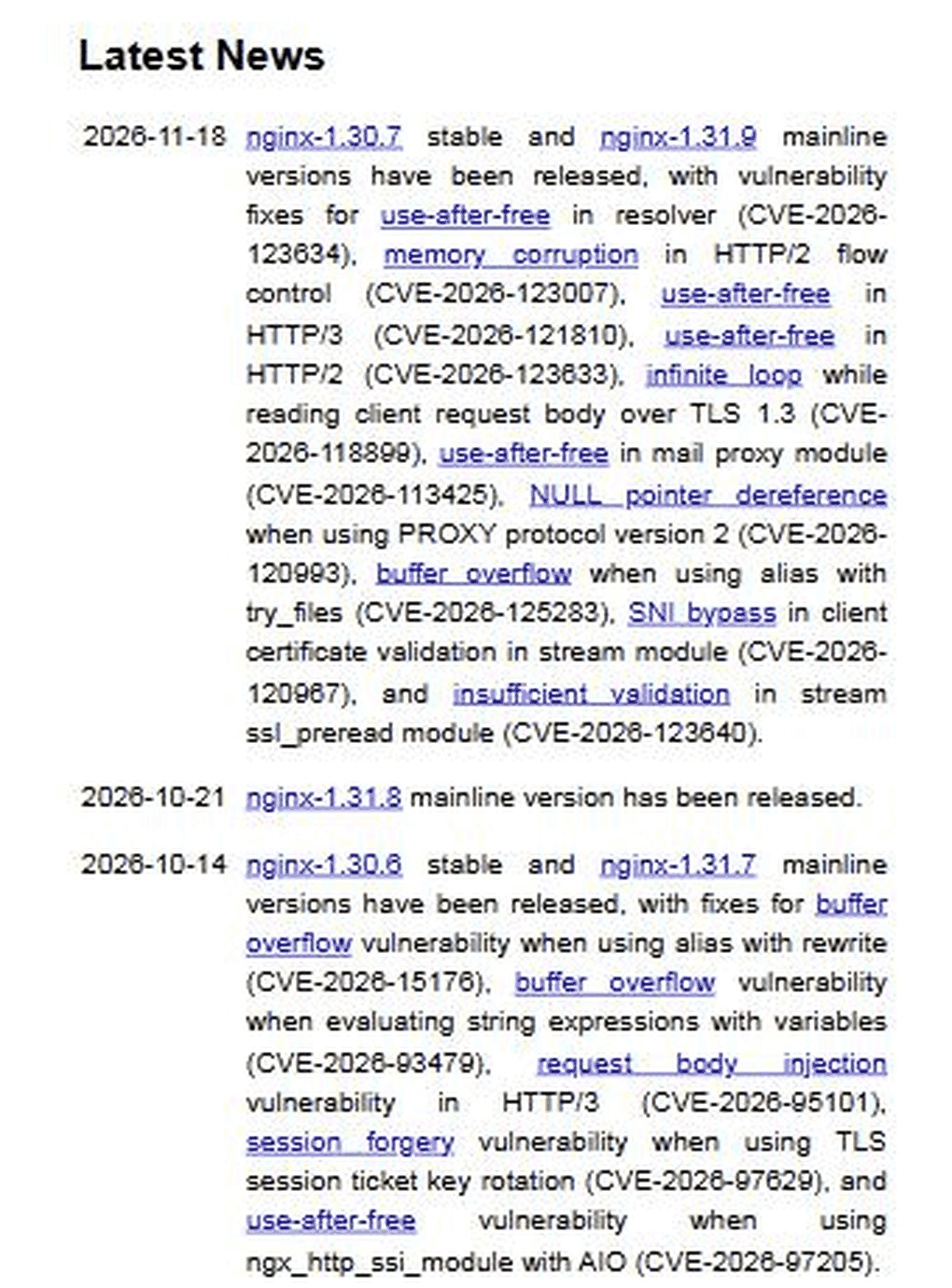
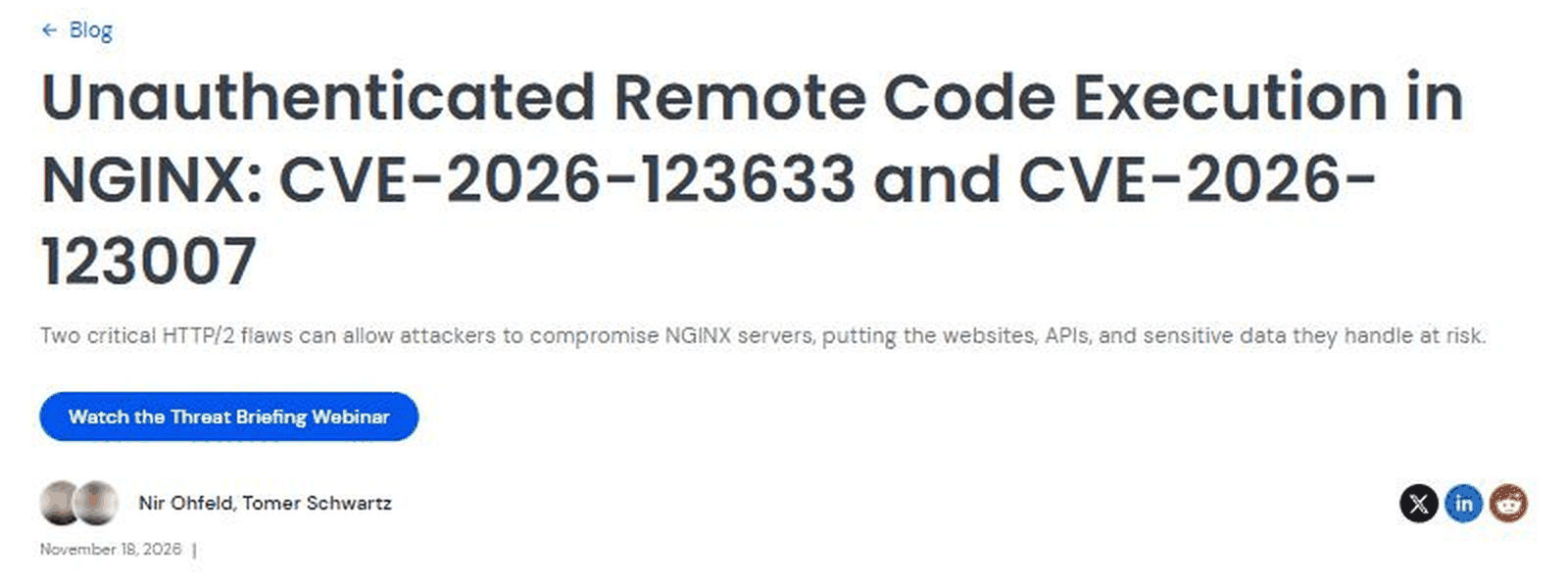
Updated November 19, 2026. A news analysis built from Wiz Research’s blog post “Unauthenticated Remote Code Execution in NGINX: CVE-2026-123633 and CVE-2026-123007” (November 18, 2026), the nginx.org news page and security advisories page, our own screenshots of those pages and the Hacker News front page. Disclosure: Wiz sells security products and the research is also marketing for them, the research and drafting tools we use for these articles include Claude from Anthropic, and the Server header of our own domain reports LiteSpeed, not NGINX. We quote only short phrases, label every number we compute as ours, did not run any exploit or test any NGINX build, and have not read F5’s own advisories. This is not security or purchasing advice.
The short version
On November 18, 2026, the NGINX project released versions 1.30.7 (stable) and 1.31.9 (mainline) with fixes for ten vulnerabilities. Two of them, CVE-2026-123633 and CVE-2026-123007, are in the HTTP/2 code and, according to Wiz Research, can let an unauthenticated attacker run code on the server. Wiz rates both Critical at 9.2 on the CVSS 4.0 scale. Both need HTTP/2 to be enabled. The older bug, CVE-2026-123007, affects NGINX back to 1.9.5, released in 2015.
NGINX is a very common front door for websites and APIs, and Wiz says it powers “more than 225 million websites”, a figure we did not verify. If you run NGINX with HTTP/2 enabled, the practical steps are: find your version, upgrade to 1.30.7 or 1.31.9 or a vendor build that includes the fixes, and, if you cannot upgrade today, turn HTTP/2 off until you can. The Wiz post reached the Hacker News front page with 1,113 points and 497 comments when we scanned on November 19.
Timeline
- October 21, 2026: Wiz reports the HTTP/2 use-after-free (later CVE-2026-123633) to F5, the company behind NGINX. F5 confirms another research team had already reported it. The same day, nginx.org shows mainline 1.31.8 being released.
- November 10: F5 supplies Wiz with a patch for CVE-2026-123633 to review.
- November 16: Wiz reports the second flaw, later CVE-2026-123007.
- November 17: F5 confirms the second report matches CVE-2026-123007 and is part of the planned November 18 release.
- November 18: F5 and the NGINX project publish the security release and Wiz publishes its research.
By our arithmetic, that is 28 days from Wiz’s first report to the public release, 8 days from the patch Wiz reviewed to release, and 2 days between the second report and release. Wiz also says Ikotas Labs, Metnir, Rapid7 and Xint independently found the same issues, so five teams reported overlapping bugs.
What the two bugs are
Both are memory-safety bugs in how NGINX handles HTTP/2 traffic.
- CVE-2026-123633, HTTP/2 use-after-free. Wiz says a connection’s memory can be freed while a request still needs it. It affects reverse-proxy processing when available connection slots run low, so Wiz says it is more likely to be exploited when NGINX is configured as a proxy. Vulnerable versions: 1.19.7 to 1.31.8, which Wiz describes as nearly six years of exposure.
- CVE-2026-123007, HTTP/2 flow-control integer underflow. Wiz says incorrect accounting of the HTTP/2 send window leads to an invalid memory copy. It can also affect NGINX serving content directly. Wiz demonstrated code execution on NGINX serving ordinary static files over HTTPS on 64-bit systems, with no backend application or third-party modules, on official 1.31.7 and 1.31.8 builds. Vulnerable versions: 1.9.5 to 1.31.8.
Wiz adds that ASLR, the common memory-safety defense, does not protect against these issues because an attacker can read memory before running code. Wiz says it built working proofs of concept but is not releasing the exploits, and that exploiting memory-safety bugs like these “require the attacker to disclose memory addresses, groom and shape the heap correctly” and cope with different builds. It also warns that, as with PHP2Shell, widespread attacks tend to start against packaged products where many customers share an identical build.
Which versions are affected and fixed
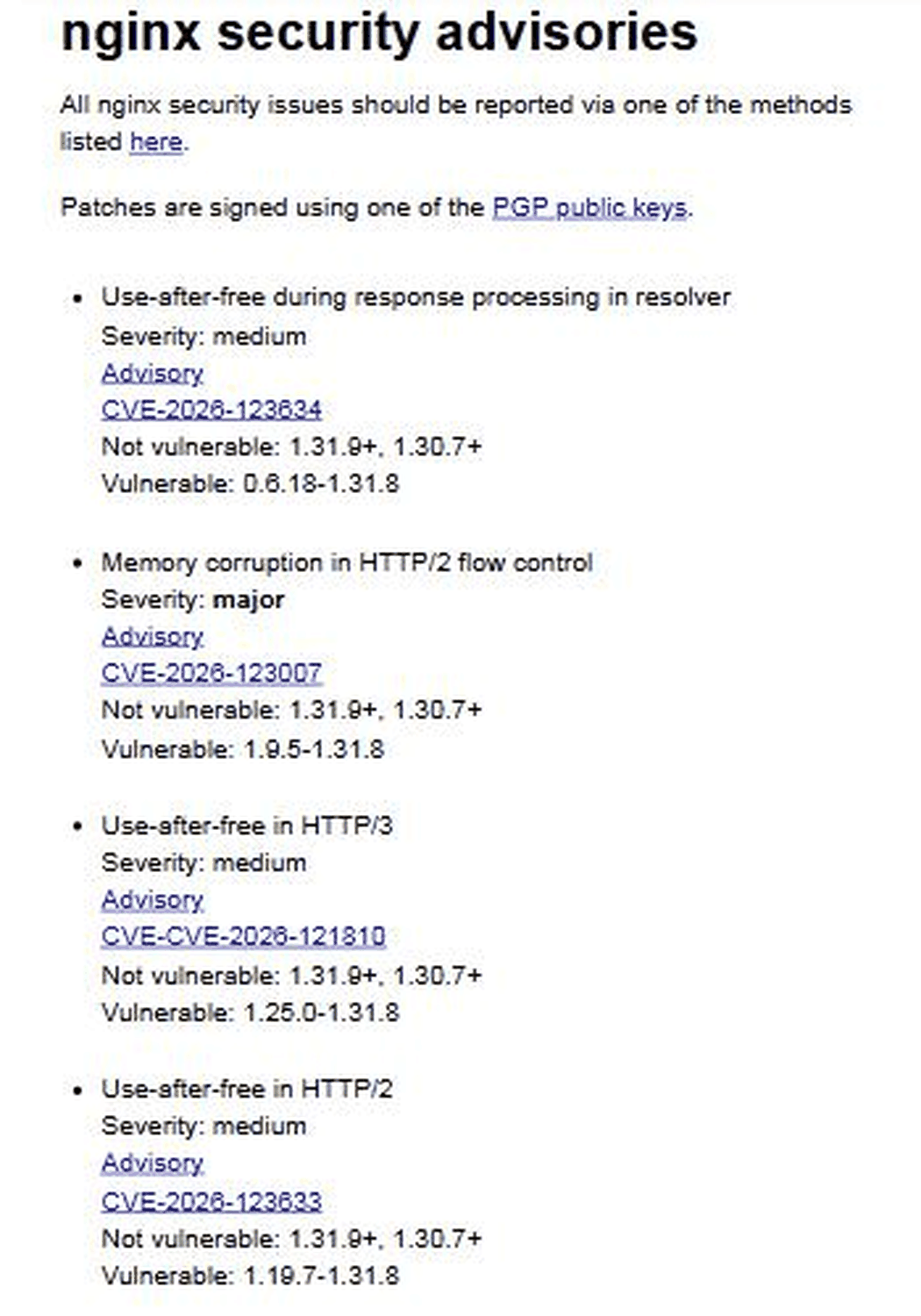
The nginx.org advisories page and Wiz agree on the ranges and fixes for the two headline bugs:
- CVE-2026-123007: vulnerable 1.9.5 to 1.31.8; not vulnerable 1.30.7+ and 1.31.9+.
- CVE-2026-123633: vulnerable 1.19.7 to 1.31.8; not vulnerable 1.30.7+ and 1.31.9+.
For NGINX Plus, Wiz’s table lists fixed releases 37.0.7.1 and 37.2.0.1 for the first bug and 37.0.8.1 and 37.3.0.1 for the second. We did not check F5’s advisories for Plus, so confirm with F5 before relying on those numbers.
Two ratings for the same bugs
Wiz calls both flaws Critical with a CVSS 4.0 score of 9.2. The nginx.org advisories page uses the project’s own three-level scale and labels CVE-2026-123007 “major” but CVE-2026-123633 only “medium”. These scales are different, and the nginx.org page does not show a CVSS score, so we cannot say whether F5 scores 123633 lower than Wiz does. What the pages do agree on is the practical point: both involve HTTP/2, both are fixed in the same release, and Wiz says each can lead to code execution.
The same release fixes eight other bugs. Wiz’s table gives CVSS 9.2 to three of them: a use-after-free in HTTP/3 (CVE-2026-121810, vulnerable from 1.25.0), a use-after-free in the DNS resolver (CVE-2026-123634, from 0.6.18) and a use-after-free in the mail proxy module (CVE-2026-113425, from 0.5.33). The nginx.org page labels them medium, medium and major. The remaining entries range from denial of service to a client certificate bypass in specific SNI configurations, with Wiz scores from 8.7 down to 6.3. The nginx.org page also has a small typo, showing “CVE-CVE-2026-121810” for the HTTP/3 entry. This matters for one reason: turning off HTTP/2 does not address the HTTP/3, resolver or mail proxy bugs, so upgrading is still the real fix.
The AI angle
Wiz says it used its own AI code-scanning harness to find both bugs and then used Gemini 4 Carbon and ChatGPT 5.6 Sol to validate the impact. It links the discovery to PHP2Shell, disclosed last month, and Java4Shell, which Calif disclosed the day before. We covered Java4Shell separately. Wiz argues that AI is “dissolving” the barrier that complexity used to create, and that this shortens the window between disclosure and exploitation. That is a vendor’s view and the claim about a shrinking window is a prediction, not a measurement. What is checkable is the age of the bugs: the integer underflow dates to NGINX 1.9.5 in 2015, which by our arithmetic is about eleven years in the code before anyone reported it, and five teams found the same flaws independently.
What to check today
- Find your NGINX versions. On each host run
nginx -v. Check containers, load balancers, ingress layers and appliances too. Versions up to 1.31.8 are in the vulnerable range for both bugs, subject to the minimum versions above. - Check whether HTTP/2 is enabled. Run
nginx -T 2>/dev/null | grep -n http2. On 1.25.1 and later the setting ishttp2 on;, and on older configurations it appears as thehttp2parameter on alistenline. Print only the matching lines, because the full configuration dump can contain secrets. - Upgrade. Move to 1.30.7 (stable) or 1.31.9 (mainline), or to your vendor’s build that includes the fixes. Operating-system packages often keep an older version number while backporting fixes, so check your distribution’s security notice for these CVE numbers instead of relying on the version string alone. This part is our advice, not Wiz’s.
- If you cannot upgrade yet, disable HTTP/2. Wiz’s guidance: set
http2 off;in affected server blocks on NGINX 1.25.1 or later and remove thehttp2parameter from anylistendirectives, test application compatibility, reload NGINX and confirm the old workers have exited. Re-enable HTTP/2 after upgrading. Expect clients to fall back to HTTP/1.1. - Prioritize what an attacker can reach. Internet-facing instances first, and instances that act as reverse proxies for several applications, because one NGINX can front many services.
- Look at your CDN and WAF. Wiz says CDNs and WAFs that terminate HTTP/2 “may mitigate parts of the exploit” by not passing the exact payload to NGINX, but that this depends on implementation. Do not treat a CDN as a substitute for patching the origin.
- Watch for warning signs. Wiz suggests investigating unexpected NGINX worker crashes or commands launched by NGINX, and says these are general warning signs, not confirmed indicators of these bugs. In NGINX error logs, repeated worker restarts are typically logged as a worker process exiting on a signal. For CVE-2026-123007, Wiz also suggests detection rules for long-lived HTTP/2 connections sending large amounts of data.
- Do not forget the other eight fixes. If you use HTTP/3, the DNS resolver, the mail proxy,
aliaswithtry_files,ssl_prereador PROXY protocol version 2, the same upgrade covers them.
What we could not confirm
- F5’s own advisory text and CVSS scores, and the exact NGINX Plus builds, which we did not read.
- Whether anyone is exploiting these bugs. Wiz says it is not releasing its exploits and none of the pages we read claims attacks in the wild, but absence of a claim is not proof of absence.
- Whether Linux distributions, Docker images and the separate Kubernetes ingress projects have shipped patched builds. The nginx.org page notes that NGINX Ingress Controller is not the same project as the community ingress-nginx, so check each project’s own advisory.
- Wiz’s figure of 225 million websites, and how many of those run HTTP/2.
- How effective any given CDN or WAF is against these bugs.
Frequently asked questions
Does this affect Apache or LiteSpeed?
These two CVEs are in NGINX’s own code, so they apply to NGINX. We covered a separate critical HTTP/2 flaw in Apache earlier this month. A server that runs LiteSpeed, as our own domain’s Server header reports, is not covered by these NGINX advisories, although a proxy or CDN in front of it could be NGINX, and we have not checked that.
Is turning off HTTP/2 enough?
It removes the exposure to the two HTTP/2 bugs according to Wiz, but it is a temporary measure. The same release fixes other bugs outside HTTP/2, so you should still upgrade.
Where are the sources?
Wiz’s post at wiz.io/blog/nginx-http2-rce-vulnerabilities, the nginx.org news page at nginx.org and the security advisories page at nginx.org/en/security_advisories.html.
More Security and Infrastructure News
- Quad9 Leaves France on November 24: What Changes for DNS Users and What to Check Now
- PHP 8.6 Is Out and PHP 8.2 Loses Security Support on December 31: What WordPress Site Owners Should Check
- OpenSSL CVE-2026-121481: A 9.8 in NVD, a Fix Still in Review and No Advisory on OpenSSL’s Own Page
- Synology DSM Critical Flaw CVE-2026-120382: Deactivate OAuth Service Now, Fixed Builds Due by November 20