Quad9 Leaves France on November 24: What Changes for DNS Users and What to Check Now
Updated November 18, 2026. A news analysis built from Quad9’s own announcement “Farewell, France” (October 22, 2026), Cloudflare’s blog post “Quad9’s withdrawal from France: A canary in the coal mine” (November 17, 2026), Quad9’s news page, our own screenshots of those pages and the Hacker News front page. Disclosure: Quad9 is a Swiss non-profit and Cloudflare, which runs the competing 1.1.1.1 resolver and says it faces similar demands, is itself a party to related disputes, so both texts are advocacy from interested parties. We do not run a DNS service, have no commercial relationship with either company, and the research and drafting tools we use for these articles include Claude from Anthropic. We quote only short phrases, label every number we compute as ours, did not test either resolver and have not read the French or Belgian court orders. This is not legal or technical advice for your network.
The short version
Quad9, the free public DNS resolver run by a Swiss public-benefit foundation, says that starting Tuesday, November 24, 2026, it “will no longer be able to offer its free cyberprotection service to users located in France.” That is six days from today, November 18. The cause, according to Quad9, is a French court ruling in favor of the Qatari broadcaster beIN that would force it to block DNS resolution of a set of domain names for users in France. Quad9 says it will not block them and cannot reliably tell who is in France, so it is leaving the market instead.
Cloudflare published its own commentary on November 17, calling the move “a canary in the coal mine” and arguing that DNS blocking by public resolvers is ineffective and harmful. Cloudflare’s post was on the Hacker News front page when we scanned it on November 18 (661 points in the site’s search index), and Quad9’s own announcement was submitted there as well (1,382 points). If you or your organization use 9.9.9.9 from France, the practical question is simple and urgent: what happens to your devices when the service stops answering?
Timeline
- October 21, 2026 (implied): Quad9 wrote on October 22 that the French courts “yesterday handed down an unfavorable ruling”. We take that to mean October 21; we have not seen the order itself.
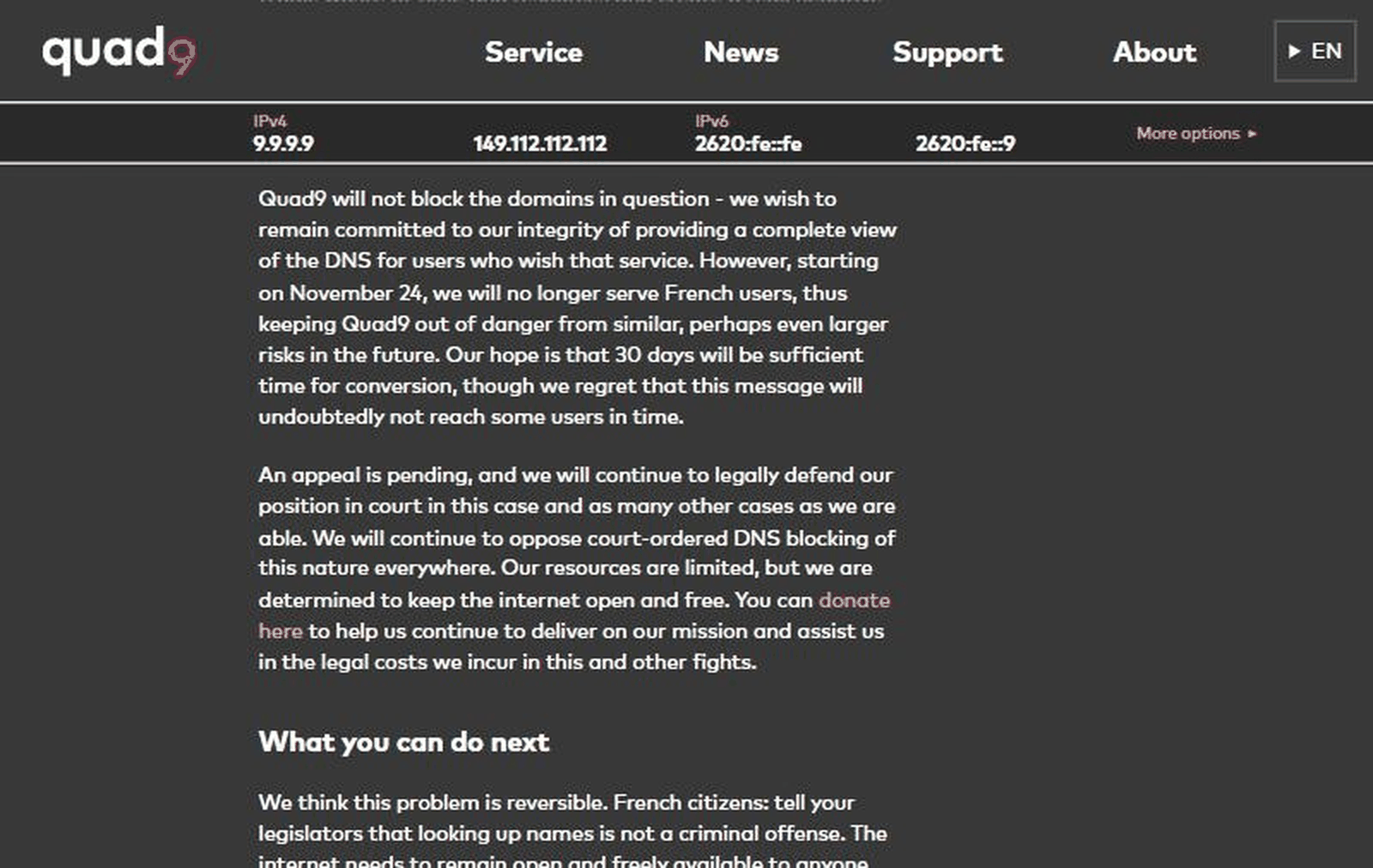
- October 22: Quad9 publishes “Farewell, France” and gives roughly a month of notice, saying it hopes “30 days will be sufficient time for conversion”.
- November 14: the date Quad9’s post gives for the end of the period in which the daily penalty would apply (“until the blocking concludes on November 14”).
- November 17: Cloudflare publishes its commentary and says a Belgian court has issued a similar order against Cloudflare, Google and Cisco, with penalties if they do not begin blocking by early January 2027.
- November 24: the date on which Quad9 says it stops serving users in France.
What Quad9 says happened
According to Quad9’s post, beIN sought to force the resolver to block a set of domains that beIN says infringe its audiovisual rights on sports broadcasts. Quad9 says it has no association with those domains or their operators. The court, it says, significantly reduced the financial penalty, “from €580,000 to €1,000 per day”, but Quad9 calls the case “a matter of principle” and says it “cannot comply with this ruling over the long term”.
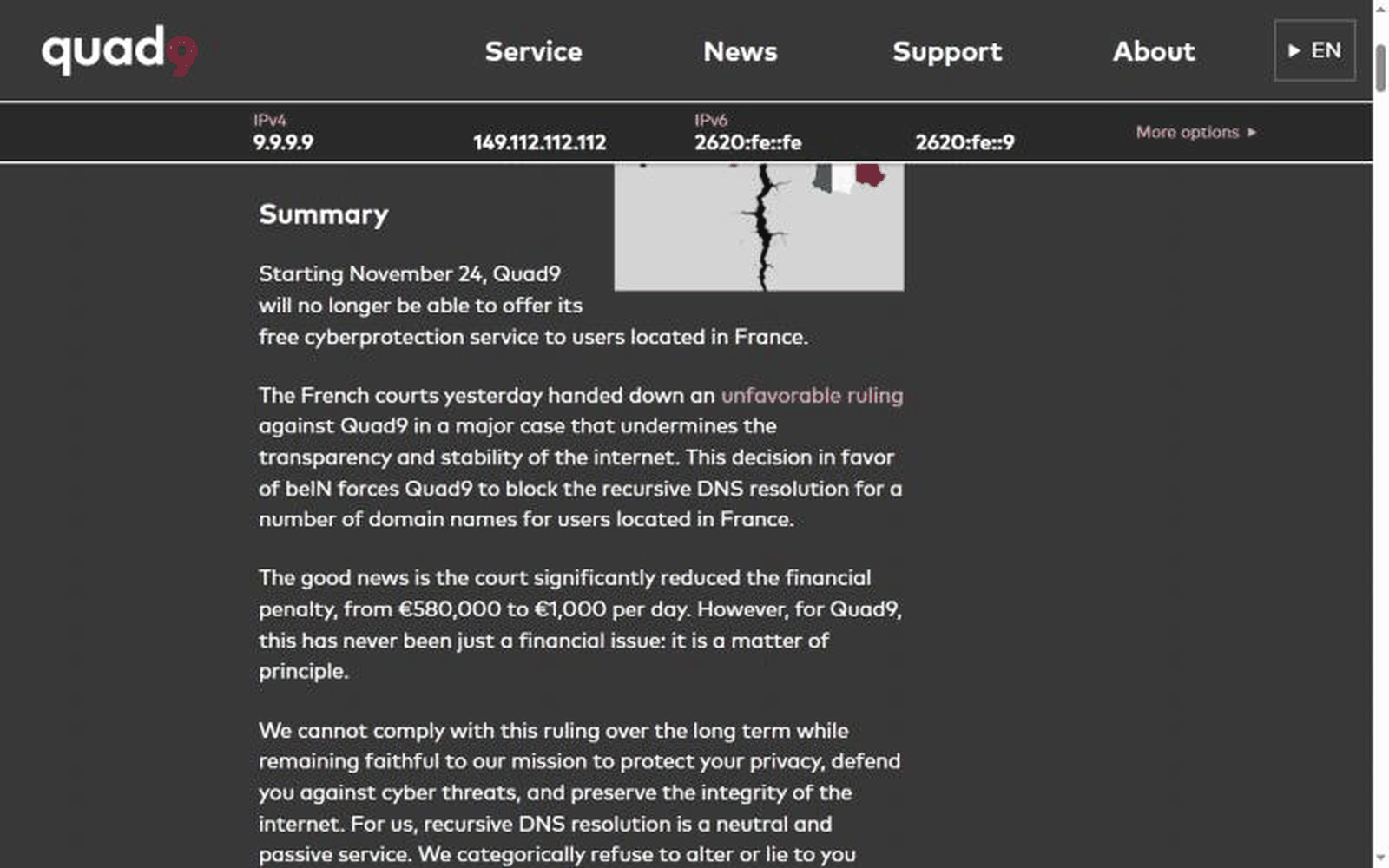
Quad9 gives four reasons it will not simply comply:
- No way to identify French users. It says it has no database linking users to jurisdictions, requires no sign-up and “we have no list of French users”.
- Global blocking is unacceptable to it. It could add the domains to its malicious-domain list, which would satisfy the court, but that would apply a French decision to every user of its filtered service worldwide.
- Geographic blocking failed before. In a German case brought by Sony Music, Quad9 says it used IP-based geoblocking as a stop-gap, the plaintiff used a VPN to reach the blocked content, and the court found Quad9 in contempt. Quad9 says it eventually won that case after several years and six-figure costs.
- Other lawsuits are waiting. It says about 20 other cases are pending in France that demand blocking of hundreds of names, and that it “cannot survive” the accumulation of penalties.
What Cloudflare adds, and why to read it as advocacy
Cloudflare’s post explains why it believes resolver-level blocking does not work: a resolver can only decline to return an address, the content stays online, and “any Internet user who wants to reach a blocked site can circumvent the block in less than a minute” by switching resolver. It adds that DNS works at the domain level, so a block takes down everything on a domain, legal or not, and that the user gets no explanation when a site simply fails to load.
It also reports four context points that Quad9’s post does not:
- Cisco previously withdrew its OpenDNS resolver from France, Portugal and, temporarily, Belgium under similar circumstances.
- A French court rejected penalties against Cloudflare for not blocking through 1.1.1.1, finding that other actions Cloudflare took through its CDN and reverse-proxy service were sufficient.
- A Belgian court order would impose substantial penalties if Cloudflare, Google and Cisco do not start blocking through their public resolvers by early January 2027. Cloudflare says it has “never done” that and has appealed with Google and Cisco, hoping for a resolution before the end of the year.
- Courts in Germany several years ago ruled in favor of Cloudflare and Quad9, rejecting requests to require DNS blocking.
Cloudflare is not a neutral observer: it operates a rival public resolver and faces a related order in Belgium. Its claims about its own privacy practices, such as that 1.1.1.1 “doesn’t collect any user data”, and its description of ISP resolvers as possibly monetizing browsing data are statements from the company itself, and we did not verify them. Equally, Quad9’s description of the French ruling comes from the losing party, and we have not seen the judgment.
The numbers we checked
- The penalty cut. €580,000 divided by €1,000 is 580, so the daily penalty Quad9 describes fell by a factor of 580, or about 99.8 percent.
- The exposure Quad9 quotes. Quad9 says the €1,000 daily penalty would run until November 14 and total €24,000. From October 21 to November 14 is 24 days, so 24 times €1,000 is €24,000. The figure is consistent with a start on the day after the ruling date we inferred. If the original €580,000 a day had applied to the same 24 days, it would have come to about €13.9 million (our arithmetic, assuming the same period).
- The notice period. From October 22 to November 24 is 33 days, slightly more than the “30 days” Quad9 mentions. November 24, 2026 is a Tuesday, which matches the “Tuesday, November 24” in Quad9’s post.
- The remaining time. From today, November 18, to November 24 is 6 days.
One point stands out and we could not resolve it: by Quad9’s own description, the period in which the beIN penalty accrues ends on November 14, which is already past, yet the withdrawal date is still November 24. Quad9 explains that the larger risk is the roughly 20 other pending cases, but it does not say what happens to the beIN order after November 14, and its news page, last updated October 22 when we looked, carries no later notice.
Who is affected, and how
Quad9 says it will stop serving “users located in France”, and that its traffic statistics show many users there, including infrastructure, finance, education and public-sector networks. Its post lists, as examples, networks associated with the prime minister’s digital directorate (DINUM), France Travail, a national research centre and others, and notes that autonomous systems are not strictly tied to a country. Cloudflare warns that hospitals, universities, utilities and government offices could be “caught unaware”, because a resolver that stops answering produces no error message, “their Internet will simply stop working”, and devices that are hardwired to use Quad9, such as security systems or thermostats, may be slow or impossible to fix.
What we do not know is how Quad9 will decide who is “in France” on the day. It argues that no reliable method exists, so the mechanism, whether by network range or by other signals, is not described in the pages we read, and users on foreign networks or VPN exits could behave differently from users on French ones. Treat anyone in or routing through France as potentially affected.
What to check before November 24
- Find out whether you use Quad9. Quad9’s addresses, shown in its page header, are 9.9.9.9, 149.112.112.112, 2620:fe::fe and 2620:fe::9. Its post also mentions 9.9.9.10 and “secondaries” for the unfiltered service. On Windows, run
ipconfig /alland read the DNS Servers lines; on a Linux system with systemd-resolved,resolvectl status; on macOS,scutil --dns. Also open your router’s DHCP and DNS settings. - Check every place a resolver can be set. Router, individual devices, browsers with their own “secure DNS” setting, DNS-over-TLS settings on phones, servers’ resolv.conf or network manager files, container and VM images, firewalls and VPN client configurations.
- Find hardwired devices. Cameras, alarms, thermostats and similar equipment sometimes carry a fixed resolver. Check each one’s settings page or vendor documentation now, not after it stops working.
- Pick a replacement deliberately. Options are your ISP’s default resolver, another public resolver, or one you run yourself. Cloudflare notes that ISP defaults may monetize browsing data and that some resolvers are “essentially anonymous services whose practices are unknown or undocumented”, so read a resolver’s privacy policy and note which ones are fighting blocking orders in their own markets. Also remember the Belgian order described above if you operate there.
- Keep a second resolver configured. A secondary that belongs to a different provider avoids a total outage if one is withdrawn or blocked.
- Test, then document. After changing, resolve a few domains from each network segment and write down which resolver each system uses. For organizations, record the change date so a future audit can see why it was made.
- Note what you lose. Quad9’s protective resolver blocks malicious domains for phishing and malware. If you move to a resolver without that filtering, consider another layer such as endpoint protection or a filtering resolver you trust.
What we could not confirm
- The text of the French court decision, and whether any step has changed since Quad9’s October 22 post.
- How Quad9 will separate French users from others on November 24.
- What the November 14 date refers to in the court order, and why the withdrawal proceeds after it.
- Whether other public resolvers in France face similar orders beyond those Cloudflare and Quad9 describe.
- Cloudflare’s statements about the Belgian order, its appeal and the French ruling in its favor, which come from Cloudflare alone in the pages we read.
Frequently asked questions
Does this affect people outside France?
Quad9 says its service for everyone else continues and that it refuses to apply the French blocking worldwide. Its message is limited to users located in France.
Will my internet stop working on November 24?
Only if your devices depend on Quad9’s resolver and you are treated as being in France. In that case, Cloudflare warns that name lookups will fail without a clear message, which is why checking your DNS settings beforehand matters.
Where are the original sources?
Quad9’s “Farewell, France” post at quad9.net/news/blog/au-revoir-france/, its news page at quad9.net/news/ and Cloudflare’s post at blog.cloudflare.com/quad9-withdrawal-from-france/.
More Security and Infrastructure News
- NGINX HTTP/2 Remote Code Execution Flaws: Affected Versions, Fixes and What to Check Today
- PHP 8.6 Is Out and PHP 8.2 Loses Security Support on December 31: What WordPress Site Owners Should Check
- OpenSSL CVE-2026-121481: A 9.8 in NVD, a Fix Still in Review and No Advisory on OpenSSL’s Own Page
- Synology DSM Critical Flaw CVE-2026-120382: Deactivate OAuth Service Now, Fixed Builds Due by November 20