OpenSSL CVE-2026-121481: A 9.8 in NVD, a Fix Still in Review and No Advisory on OpenSSL’s Own Page
Published November 20, 2026. A news analysis built from OpenSSL’s own vulnerabilities page, the public GitHub pull request numbered 33652 in the openssl/openssl repository, the CVE record for CVE-2026-121481 and its NVD entry, and our own screenshots. This article contains no affiliate links and we have no commercial relationship with OpenSSL or any vendor named in it. We did not test or reproduce anything, we do not publish any way to trigger the bug, and every calculation marked “ours” is our own arithmetic.
The short version
- Official page, as we read it: OpenSSL’s vulnerabilities page lists 60 advisories for 2026. 48 are Low, 10 are Moderate, 2 are High and none is Critical. The most recent batch, on November 17, contains three Low-severity CVEs.
- The entry that is not there: CVE-2026-121481, a “Buffer overflow in EVP_EncodeBlock()”, has a published CVE record and an NVD entry that shows a CVSS base score of 9.8 (Critical), but we did not find it on OpenSSL’s vulnerabilities page.
- The fix is still being reviewed in public: the pull request was opened on November 10 and was still open when we checked on November 20, after a reviewer’s approval on November 19 and a note that backports will require separate pull requests.
- The score and the maintainers do not obviously agree: the 9.8 is a secondary entry in NVD, OpenSSL’s own record carries no score, and one OpenSSL maintainer questioned whether the report should be a CVE at all.
- What to do: apply the November 17 updates through your normal channel, watch for the advisory, and do not treat this as an emergency unless you maintain software that encodes very large buffers with this function.
What OpenSSL’s official page says
OpenSSL publishes security advisories on its “Vulnerabilities” page, newest first. The page also states that all OpenSSL versions before 1.1.1 are out of support and that extended support for 1.0.2 is available from OpenSSL Software Services for premium support customers. We read the 2026 section on November 20 and counted its entries.
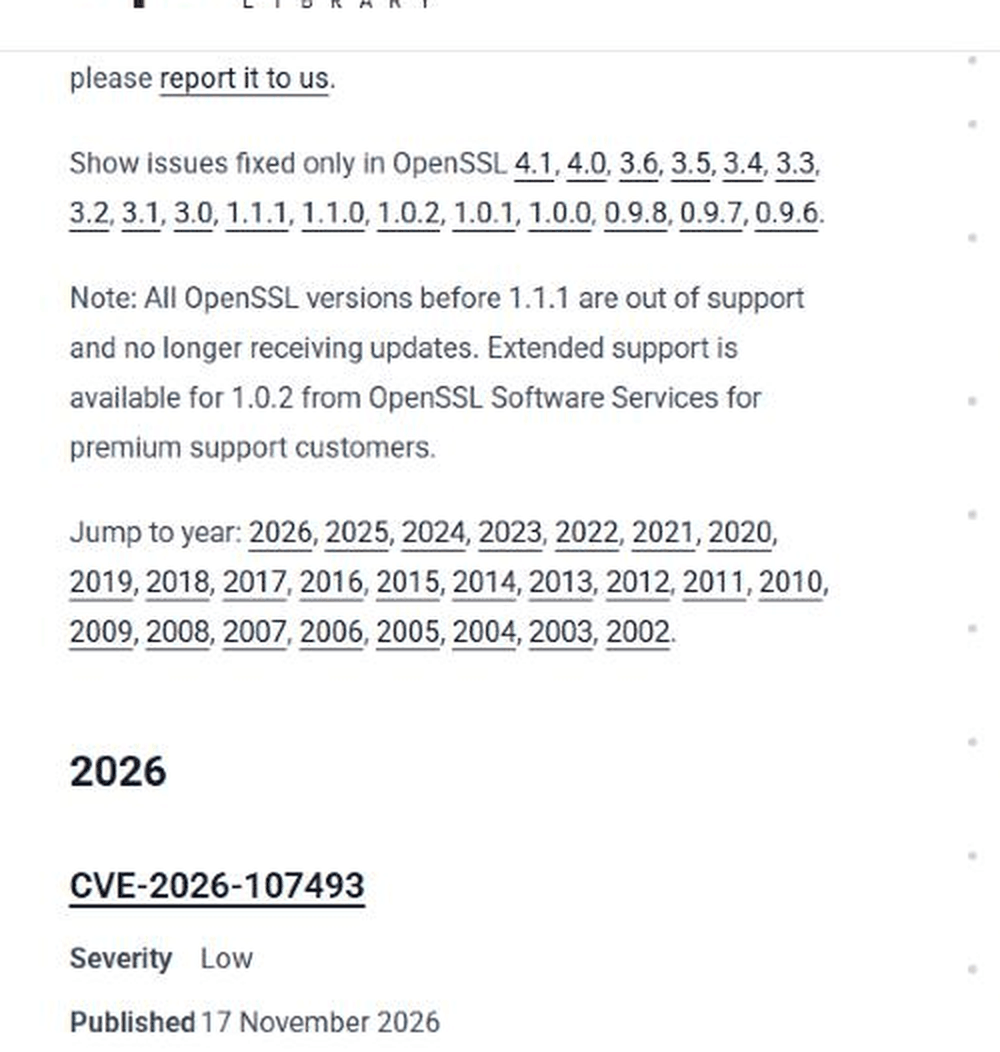
| Severity (as rated on the page) | Advisories in 2026 | Share (ours) |
|---|---|---|
| Critical | 0 | 0% |
| High | 2 | 3.3% |
| Moderate | 10 | 16.7% |
| Low | 48 | 80% |
| Total | 60 | 100% |
The 60 advisories were published on 10 separate dates between January 27 and November 17. The two High entries are CVE-2026-45447, a heap use-after-free in PKCS7_verify() (June 9), and CVE-2026-84782, DTLS handshake messages retransmitted from a stale buffer offset (September 29). By our count of the titles, 13 advisories concern QUIC and another 13 concern CMS or CMP code, which are the parts of the library most people never touch directly.
The most recent batch is three Low-severity CVEs published on November 17: a use-after-free in PEM_X509_INFO_read_bio_ex() when appending to a caller-supplied stack fails, unbounded memory retention in the QUIC server for rejected streams, and an out-of-bounds read in TLS 1.3 key-share processing when the Suite B certificate flag is set. The first lists these affected ranges: 4.1.0 before 4.1.1, 4.0.0 before 4.0.4, 3.5.0 before 3.5.10, 3.0.0 before 3.0.24, 1.1.1 before 1.1.1zk and 1.0.2 before 1.0.2zt.
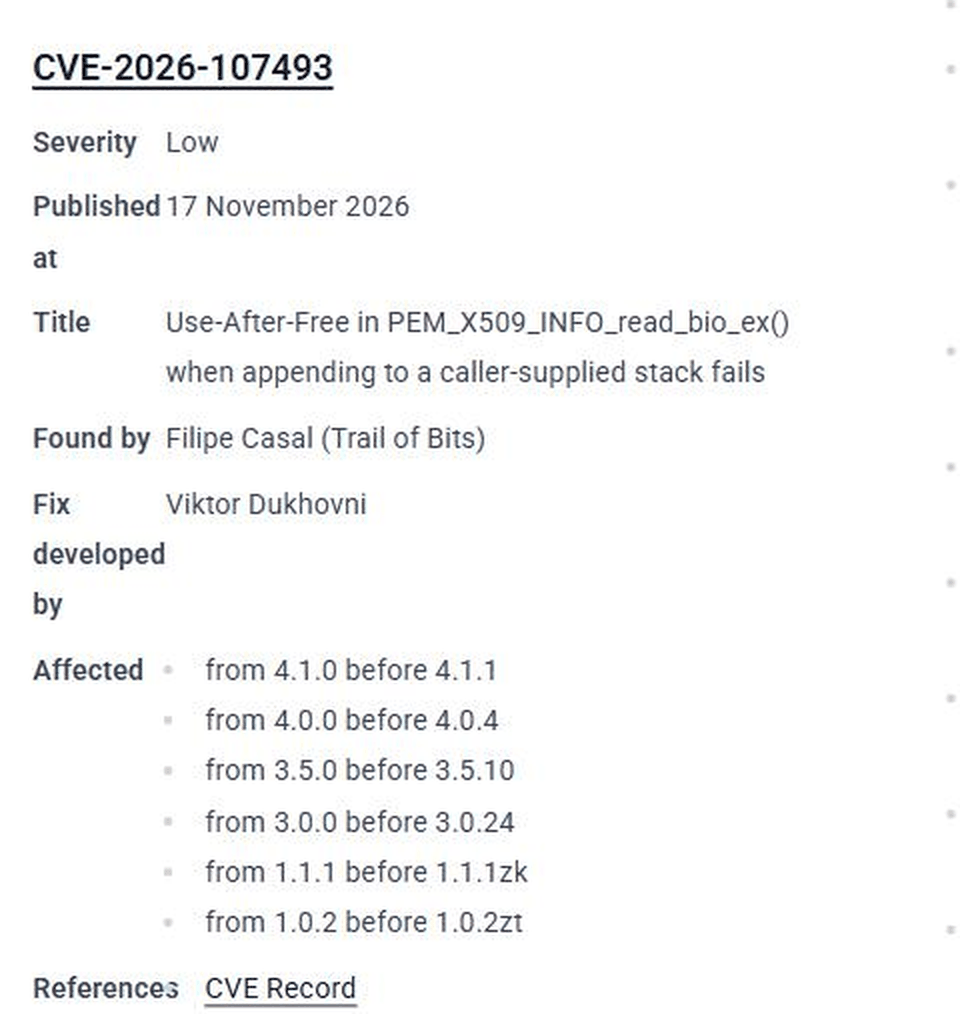
The CVE that is not on that page
A Hacker News post pointed to a GitHub pull request titled “[NSF] [CVE-2026-121481] Buffer overflow in EVP_EncodeBlock()” and gave the issue a CVSS score of 9.8. We checked the three places where the facts would be recorded.
- The CVE record. It shows OpenSSL as the assigning organization, the identifier reserved on November 3 and published on November 18. The description says that calling EVP_EncodeBlock() with an input length close to INT_MAX may overflow the calculation of the encoded output size and write past the end of the caller’s output buffer. The affected ranges are 4.1.0 before 4.1.1 and 4.0.0 before 4.0.4. The only reference is the pull request. The record contains no severity score.
- NVD. The entry was published on November 18, last modified on November 19, and has the status “Awaiting Analysis”. It carries a CVSS 3.1 base score of 9.8, with a network, low-complexity, no-privileges vector, from a secondary source rather than from OpenSSL. A CISA coordinator’s SSVC block lists exploitation as “none”, automatable as “yes” and technical impact as “total”.
- OpenSSL’s vulnerabilities page. We did not find the CVE there. The pull request says the advisory is “still pending” and that the OpenSSL security team asked for the fix to be made publicly.
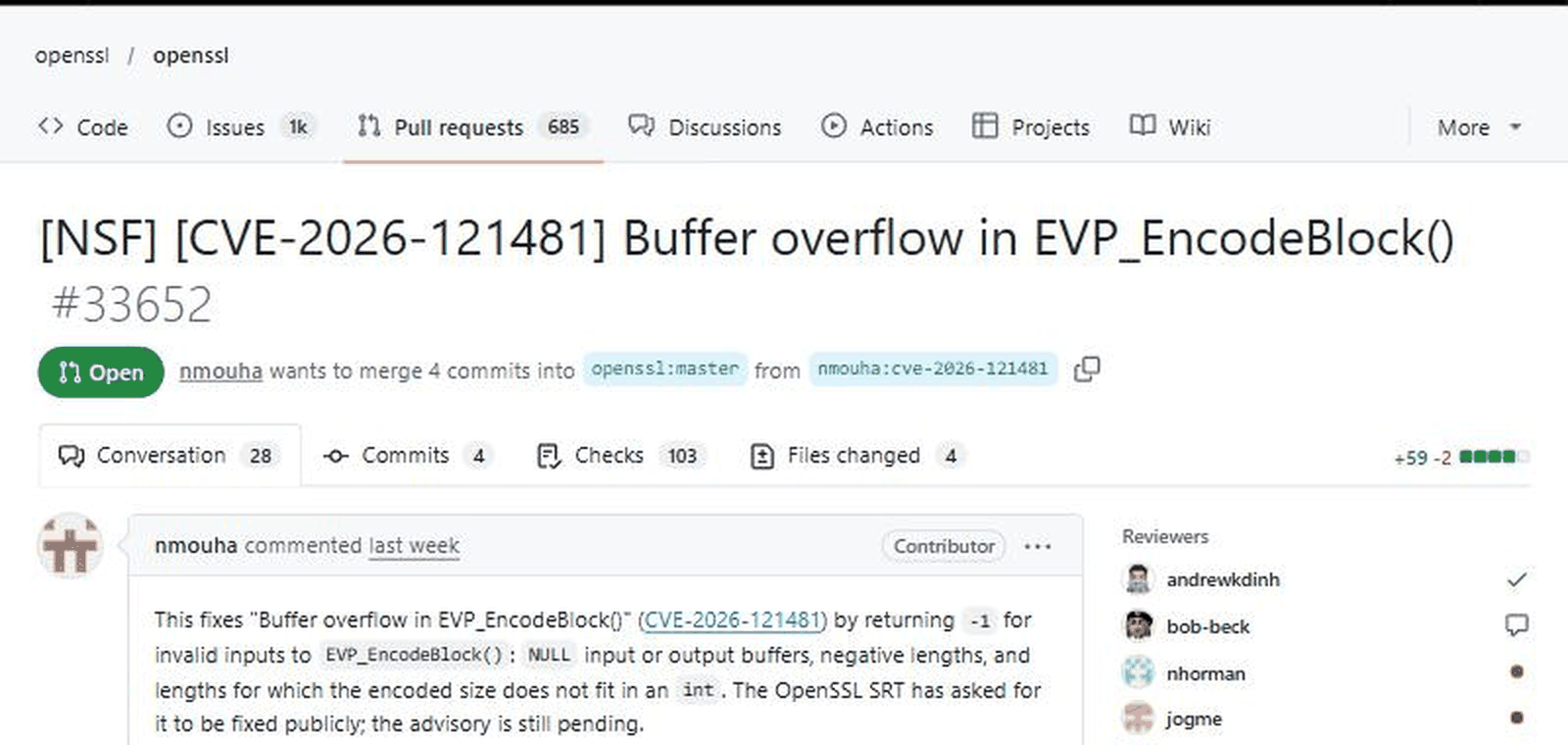
What happened in the pull request
The pull request was opened on November 10 by a contributor. It proposes to make EVP_EncodeBlock() reject invalid inputs: null buffers, negative lengths and lengths whose encoded size does not fit in an int. It also adds a similar guard to EVP_DecodeBlock(), a length-check fix in the HTTP client code, tests and documentation. The change is small: four files, 59 lines added and 2 removed.
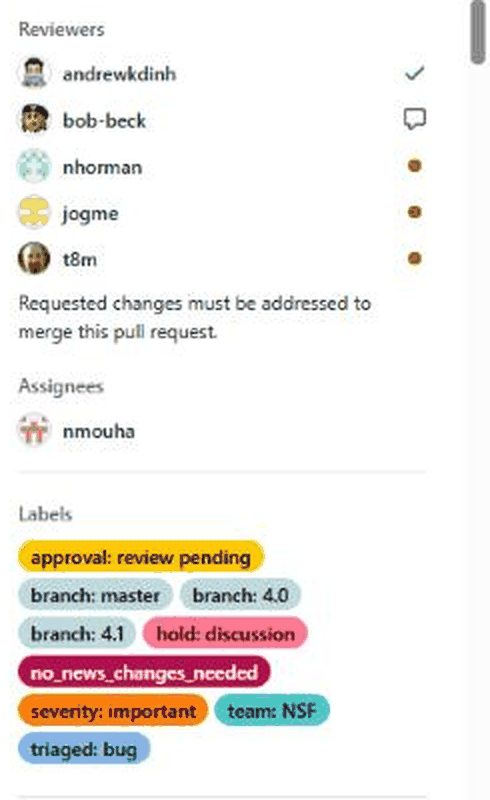
The public review is the useful part. On November 12 and 13 reviewers argued about the right design. Two asked whether returning -1 is safe because existing third-party code might cast the return value to an unsigned type without checking; another said that 0 is a legitimate success value for this function, so using it as an error would be wrong. An OpenSSL maintainer wrote that the report’s reproducer was “completely synthetic” and that it probably should not be a CVE without evidence that it really happens. The author revised the approach several times. On November 17 a maintainer wrote that the patch looked fine apart from two nits, and on November 19 another reviewer approved it and noted that backports to release branches need separate pull requests. The labels show the status: “approval: review pending”, “hold: discussion” and “severity: important”, with the 4.0 and 4.1 branches marked.
How big a buffer does it take? Our arithmetic
Base64 output is about four bytes for every three bytes of input. The largest value of a signed 32-bit integer is 2,147,483,647. The record says the output-size calculation can overflow when the input length is close to INT_MAX. Working backwards (ours): the encoded size stops fitting in an int when the input passes about 1.61 billion bytes, which is INT_MAX times three divided by four, and the function takes a length that cannot exceed INT_MAX itself. So an application would have to hand this function a single buffer of roughly 1.6 to 2.1 gigabytes.
That does not make the bug unreal. A library API that writes past a buffer when given a large length is a defect, and fixing it is reasonable. But it explains why a generic 9.8 score, which assumes an attacker can reach the function over a network with no privileges, and a maintainer’s doubt about real-world impact can both be present at once. Whether any widely used program passes attacker-controlled data of that size to this function is a question for each project, and we did not audit any.
What to check
- Know what you run. On a server you manage, run the openssl version command and note the branch. Many Linux distributions backport fixes without changing the version number, so check your vendor’s security tracker for CVE-2026-121481 and for the three November 17 CVEs.
- Apply the November 17 updates through your operating system or package manager when they reach you. The advisories list fixes in 4.1.1, 4.0.4, 3.5.10, 3.0.24, 1.1.1zk and 1.0.2zt.
- If you use shared hosting or a managed platform, OpenSSL is updated by the provider, not by you. Check the provider’s status or security notices rather than your control panel.
- If you write C or C++ code that calls EVP_EncodeBlock(), cap the input length yourself before the call. That is good practice whether or not the CVE turns out to matter.
- Follow the primary records. Watch OpenSSL’s vulnerabilities page and security announcements, the NVD entry (which is still awaiting analysis) and the pull request. Scores and affected-version ranges can change.
- Do not rely on version labels from news posts. The affected ranges in the CVE record mirror the November 17 release numbers. The sources we read do not say whether those releases already contain a fix, so check the release notes of the version you plan to install.
What we could not confirm
- Whether OpenSSL’s 4.1.1 and 4.0.4 releases contain a fix for this CVE: the record lists them as the first unaffected versions, but we did not read the release notes or the code.
- Why 3.x branches are not listed as affected. We did not investigate.
- Who set the 9.8 score in NVD beyond the “secondary” label, and whether it will change after analysis.
- Whether any real application is exposed. We tested nothing.
- When OpenSSL will publish the advisory, and what severity it will give.
Frequently asked questions
Is CVE-2026-121481 a critical OpenSSL vulnerability?
NVD shows a CVSS 9.8 (Critical) score from a secondary source. OpenSSL’s own CVE record has no score, OpenSSL’s vulnerabilities page did not list the CVE when we read it, and a maintainer questioned the real-world impact in the pull request. We cannot confirm the severity.
Which OpenSSL versions are affected?
The CVE record lists 4.1.0 before 4.1.1 and 4.0.0 before 4.0.4. The November 17 advisories for other CVEs list a wider range of branches.
Do I need to patch my website today?
Apply updates from your provider as they arrive. We found no sign in the sources we read that ordinary website visitors can trigger this, but we did not test any software.
Why is a fix being discussed in public before the advisory?
The pull request says the OpenSSL security team asked for the fix to be made publicly and that the advisory is still pending. The CVE record was published on November 18, ahead of the advisory.
Where are the sources?
OpenSSL’s “Vulnerabilities” page; the GitHub pull request 33652 in openssl/openssl and its review comments; the CVE record and the NVD entry for CVE-2026-121481. All screenshots are ours, taken on November 20, 2026.
More Security and Infrastructure News
- Windows Server 2028 Preview Ships Hardened by Default: What Microsoft Says Changes and What Admins Should Test
- Signal Blocks OS-Level AI Agents From Reading Its Screen: What It Covers, What It Misses and What You Can Do
- Quad9 Leaves France on November 24: What Changes for DNS Users and What to Check Now
- NGINX HTTP/2 Remote Code Execution Flaws: Affected Versions, Fixes and What to Check Today
- Synology DSM Critical Flaw CVE-2026-120382: Deactivate OAuth Service Now, Fixed Builds Due by November 20