Axiom Review 2026: Features, Pricing, Pros & Cons
Axiom is a web-based Solana trading platform and wallet with limit orders, wallet tracking, a tweet monitor and…
Hands-on: The ToolReviewHub team has used Hash Hedge ourselves. Fees, rules and limits below come from Hash Hedge’s own website on the date shown. Rules can change, so confirm them before you pay.
Disclosure: the Hash Hedge links on this page are affiliate (referral) links. If you buy a challenge through them we may earn a commission at no extra cost to you. It does not change our review; see our affiliate disclosure.
Risk warning: A prop firm challenge is a paid exam, not an investment. The fee is paid whether or not you pass, and trading leveraged futures can lose money quickly. Hash Hedge’s own site says its information is for learning about trading and is not investment advice. Do not pay a fee you cannot afford to lose. This review is general information, not financial advice, and we make no promise that you will pass or earn anything.
Hash Hedge calls itself “the 24/7 RWA and crypto prop desk”. The model is common among proprietary trading firms: you pay a one-time challenge fee, trade a simulated account under strict rules, and if you reach the profit target without breaking the loss limits you qualify for a funded account, where you keep a share of the profit. Hash Hedge says funded capital goes up to $200,000 and the profit share is up to 90 percent, with markets open 24/7 including oil, metals, equities, indices and more than 160 crypto markets. It trades perpetual futures only, and payments for challenges are accepted in USDT.

The pricing section of the homepage lists one-time fees for the 1-Stage route:
Our own arithmetic on those fees: per $1,000 of account size, the cost is $19.80 for the $5,000 account, $15.90 for $10,000, $13.96 for $25,000, $11.98 for $50,000 and $9.99 for $100,000, so larger accounts are cheaper per dollar of capital. The page also mentions accounts up to $150,000 and $200,000 in other places, which we did not see priced on the homepage.
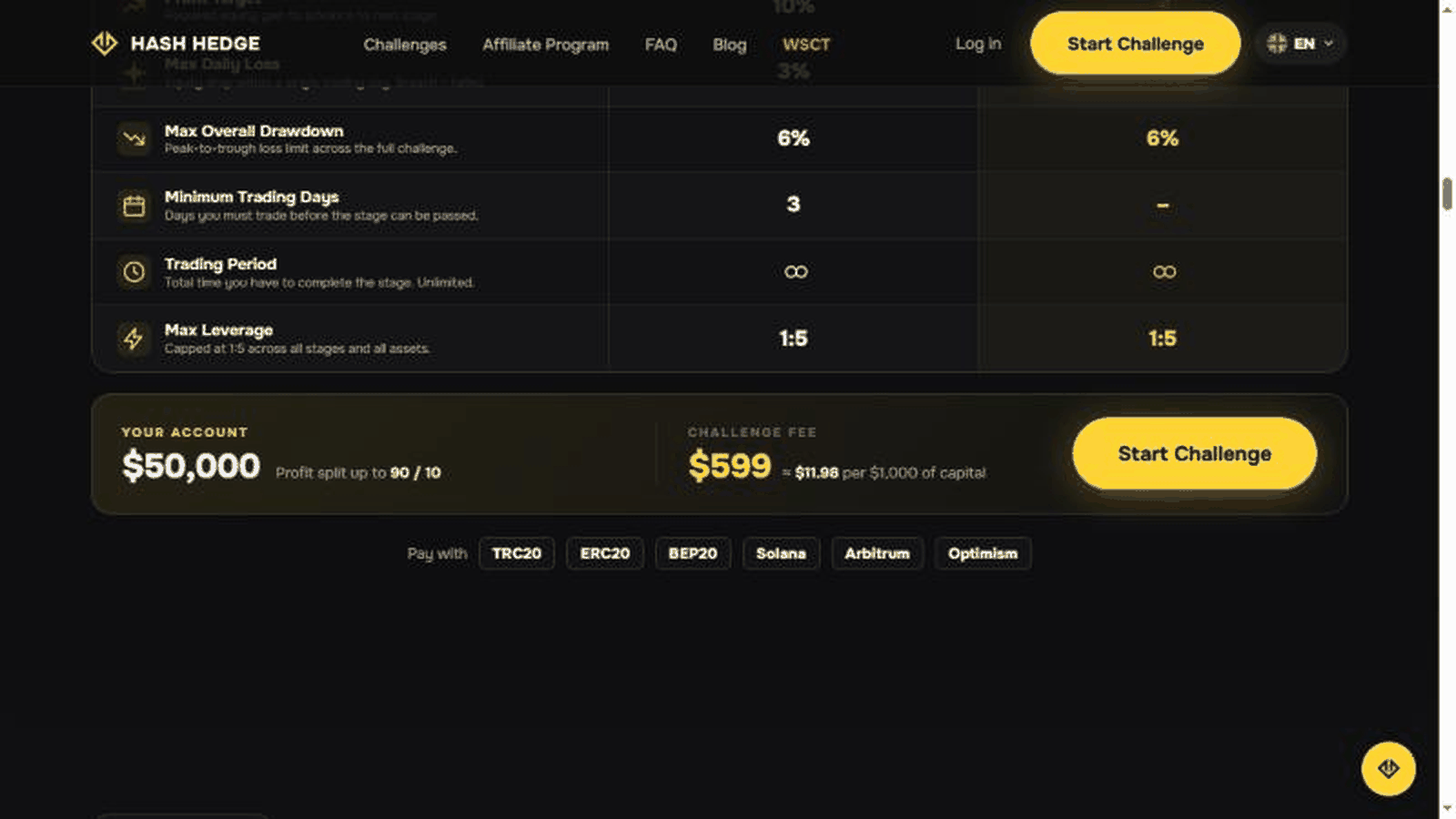
For the 1-Stage route the rules table shows a profit target of 10 percent, a maximum daily loss of 3 percent, a maximum overall drawdown of 6 percent, at least 3 trading days, no time limit and leverage capped at 1:5 on all assets. The funded stage has no profit target but keeps the 3 percent daily and 6 percent overall limits. Hash Hedge’s FAQ adds important detail: if you exceed either loss limit the challenge is “permanently locked”, unrealized losses count, the daily loss is calculated from equity against the balance at the start of the day, and the daily limit resets at 00:13 UTC+4. Hedging opposite positions inside one challenge is allowed.
Our arithmetic on a $50,000 account: a 10 percent target is $5,000; the 3 percent daily limit is $1,500; the 6 percent overall limit is $3,000. The $599 fee is about 12 percent of the profit target and 20 percent of the total loss you are allowed. In other words, you can lose the fee quickly if a trade moves against you.
Different sections of the homepage show different figures. A later feature list shows Stage 1 target +8 percent, Stage 2 target +6 percent, a 5 percent daily loss and an 8 to 10 percent drawdown, while the pricing card for the 1-Stage route shows 10, 3 and 6 percent. These probably belong to different routes (the page also offers a 2-Stage route with lower targets), but the page does not say so clearly. The title tag also advertises “Your Capital, Zero Risk”, which refers to not risking your own trading capital; it does not remove the risk of losing the challenge fee. Read the full rules and terms before paying.
We can describe what the site says and what we could not confirm. It displays a 4.5 Trustpilot rating, 5,914 funded traders, a list of recent payout certificates and media logos under “as featured in”. These are Hash Hedge’s own claims and testimonials, and the payout list on the homepage is selected by the company. We did not find licensing, company registration or regulator details on the homepage; look in the Terms and Commercial Terms pages. A prop firm is not a broker or a bank, so your challenge fee is not protected by deposit insurance. Paying in USDT also means payments are hard to reverse. If any detail matters to you, ask support in writing first and keep copies.
From $99 for a $5,000 account to $999 for a $100,000 account on the 1-Stage cards, plus other sizes listed on the site.
The FAQ says the challenge is permanently locked. You do not get the fee back.
Leverage is capped at 1:5 across stages and assets, according to the rules table.
In USDT to your wallet; Hash Hedge says it covers the network fee and pays within 72 hours or triples the payout. We did not test it.
Hash Hedge presents a straightforward prop-firm offer with published fees, tight but clearly stated loss limits and no time limit. The offer only makes sense for traders who already have an edge and accept that the fee can be lost. The inconsistent numbers on the homepage, the company-selected proof and the absence of visible regulatory details on the page are reasons to read the terms and ask questions before paying. If that suits you, see the current Hash Hedge challenges. This is general information, not financial advice.
Read more in our Cryptocurrency and Forex categories. General information, not financial advice.
Axiom is a web-based Solana trading platform and wallet with limit orders, wallet tracking, a tweet monitor and…
SafePal S1 is a credit-card-sized hardware wallet that signs transactions offline through QR codes and supports more than…
Trezor makes open-source hardware wallets that store your crypto private keys offline, with the Trezor Suite app for…
Customer Reviews
No reader reviews yet — be the first to share your experience.