Hash Hedge Review 2026: Features, Pricing, Pros & Cons
Hash Hedge is a crypto and RWA prop trading firm that sells paid challenges, with funded accounts of…
Last updated: November 2, 2026. This page is updated as the Binance incident develops.
Hands-on: The ToolReviewHub team has used Binance ourselves. Fees, limits and availability below come from Binance’s official pages on the date shown, so confirm them before you deposit.
Disclosure: the Binance links on this page are affiliate (referral) links. If you sign up through them we may earn a commission at no extra cost to you. It does not change our review; see our affiliate disclosure.
Important, security incident update (October 29, 2026): CoinDesk reports that Binance suffered a hack in which about $6.3 billion of crypto was stolen, about $3 billion of it frozen onchain. Binance says it will absorb the losses and has replaced about 95% of the affected assets (up from 90% a day earlier), with the main tokens fully backed. Binance began reopening withdrawals in phases on November 1, starting with bitcoin, and CNBC and The Block report about $3.64 billion in net outflows as customers moved funds off the platform. The FBI says North Korea was responsible, the investigation is still open, and the full cryptographic proof of reserves is expected around November 2 or 3. Facts are still changing, so check Binance’s official announcements and your own account status before depositing, and never keep more on any exchange than you can afford to lose.
Risk warning: cryptocurrency and leveraged trading are high risk and you can lose all of your money. This review is general information, not financial advice. Binance is not available in every country, and crypto rules where you live may restrict or ban its use.
Quick verdict: Binance is the largest crypto exchange by its own figures, with low fees (0.10% spot, 0.075% with BNB), a huge range of coins and products and a large user base. It also has a heavy compliance history (a $4.3 billion US settlement in 2023) and, in the last days, a reported $6.3 billion hack. For most readers the sensible approach right now is to wait for Binance’s investigation, withdrawal and proof-of-reserves updates before moving significant funds.
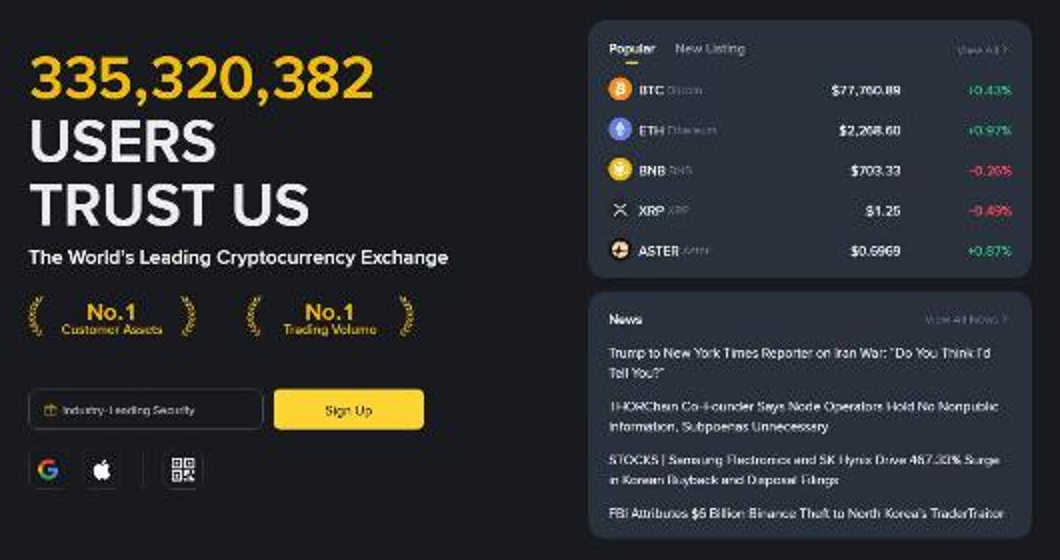
Binance is a centralised cryptocurrency exchange launched in 2017. Its homepage claims 335,320,382 users and calls itself the world’s leading exchange, with “No.1” customer assets and trading volume. These are Binance’s own claims, not independently verified here. It offers spot trading, margin, USDⓈ-M and COIN-M futures, options, a Earn section, P2P trading, fiat on-ramps, stocks and TradFi futures, a social feed (Square), institutional services and AI features.
Binance’s official spot fee page shows these base rates by 30-day volume and BNB balance:
| Level | 30-day volume | BNB balance | Maker / taker | With BNB (25% off) |
|---|---|---|---|---|
| Regular user | under $1M | any | 0.100% / 0.100% | 0.075% / 0.075% |
| VIP 1 | $1M or more | 5 BNB | 0.090% / 0.100% | 0.0675% / 0.075% |
| VIP 2 | $5M or more | 25 BNB | 0.080% / 0.100% | 0.060% / 0.075% |
| VIP 3 | $20M or more | 100 BNB | 0.040% / 0.060% | 0.030% / 0.045% |
For comparison, see our Bybit review, as well as Coinbase and KuCoin.
Update, November 3: Binance has published a zero-knowledge proof of reserves for ten assets and says about 95% of the affected amount is covered; phased withdrawals began November 1 and later phases and a further reserve snapshot were still pending in reports. See our news summary for the latest.
None of this means Binance will fail, and its own figures say customers are covered, but it is a reminder that a centralised exchange holds your crypto. Keep long-term holdings in your own wallet if you can, use two-factor authentication and withdrawal whitelists, and do not rely on a single platform.
Binance.com restricts or blocks users in a number of jurisdictions, and US residents use a separate platform, Binance.US, with different products. The list of restricted countries changes, so check Binance’s current terms of use and local rules before you sign up. Do not use a VPN to get around a restriction, as that can lead to a frozen account.
Binance’s official fee page (November 1, 2026) says Binance does not charge deposit fees. Withdrawals cost a flat network fee that Binance sets per coin and network and can change with congestion, so always read the figure on the withdrawal screen.
| Coin / network | Deposit fee | Withdrawal fee | Minimum withdrawal |
|---|---|---|---|
| USDT on BNB Smart Chain (BEP20) | 0 | 0.01 USDT | 1 USDT |
| USDT on opBNB | 0 | 0.015 USDT | 5 USDT |
| USDT on Polygon | 0 | 0.03 USDT | 3 USDT |
| USDT on Solana | 0 | 0.3 USDT | 5 USDT |
| USDT on Ethereum (ERC20) | 0 | 0.6 USDT | 1 USDT |
| USDT on Tron (TRC20) | 0 | 1.5 USDT | 5 USDT |
| BNB on BNB Smart Chain (BEP20) | 0 | 0.00001 BNB | 0.0005 BNB |
| BNB on opBNB | 0 | 0.00001 BNB | 0.005 BNB |
| BNB on Ethereum (ERC20) | 0 | 0.0014 BNB | 0.012 BNB |
Is withdrawing on the BNB chain free? Not literally, but it is the cheapest route: depositing is free, and sending USDT on BNB Smart Chain costs about 0.01 USDT, versus 1.5 USDT on Tron. BNB itself costs 0.00001 BNB on BEP20 or opBNB. Always choose a network your receiving wallet or exchange supports, because sending to the wrong network can lose your funds. Also check Binance’s withdrawal status during the October 2026 incident.
Because of the October 2026 incident, also check Binance’s official announcements for withdrawal status and limits before you move funds.
CoinDesk and Binance report a hack on October 29, 2026 involving about $6.3 billion of crypto. Binance says it will cover the losses, and that withdrawals began reopening in phases on November 1, 2026. The investigation is ongoing.
Binance says customer balances remain fully backed for the main tokens and that it will absorb the losses. Nothing is risk free on an exchange. Check the proof-of-reserves update and consider holding long-term funds in your own wallet.
Regular spot users pay 0.10% maker and taker, or 0.075% when paying fees with BNB. Futures, margin and other products have separate schedules.
That depends on your country. Binance is restricted in several places, and US residents use Binance.US. Check local law and Binance’s terms.
Base spot fees are the same at 0.10%. Both have been hit by major hacks (Bybit in February 2025, Binance in October 2026). See our Bybit review and pick the exchange that is allowed in your country and that you trust most.
Binance remains a low-fee, high-liquidity exchange, but a reported $6.3 billion hack and an open investigation make caution essential this week. If you decide to use it, first read Binance’s official updates, wait for the proof-of-reserves release and confirmation that withdrawals work, start small, and use strong security settings. You can check Binance and its current status here. Always follow your local law.
Method: this review is based on Binance’s official homepage and spot fee page as read on October 31 and November 1, 2026, CoinDesk reports on the October 2026 incident, and CNBC and US Justice Department-related coverage for the 2023 settlement and sentencing, plus our own use of the platform. This is a developing story, and Binance’s figures and policies may change. Confirm everything on Binance’s official channels.
Hash Hedge is a crypto and RWA prop trading firm that sells paid challenges, with funded accounts of…
Axiom is a web-based Solana trading platform and wallet with limit orders, wallet tracking, a tweet monitor and…
SafePal S1 is a credit-card-sized hardware wallet that signs transactions offline through QR codes and supports more than…
Customer Reviews
No reader reviews yet — be the first to share your experience.